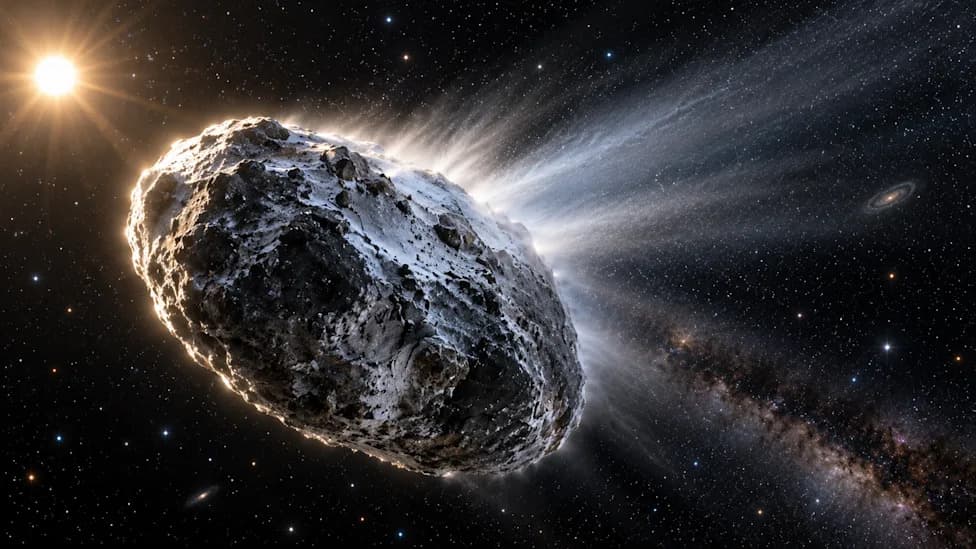
1998 SH2, tracked since 1998 and long classified as an asteroid, was reclassified as a "dark comet" after a 2025 close approach revealed a faint coma and narrow tail. Orbital simulations show the object's unexpected accelerations are best explained by outgassing from sublimating subsurface ice. The discovery implies a population of comet‑like bodies may be masquerading as asteroids, with consequences for theories of water delivery to Earth and for planetary defence.
An Asteroid Tracked for 27 Years Is Actually a 'Dark Comet' — Hidden Outgassing Reveals Its True Nature
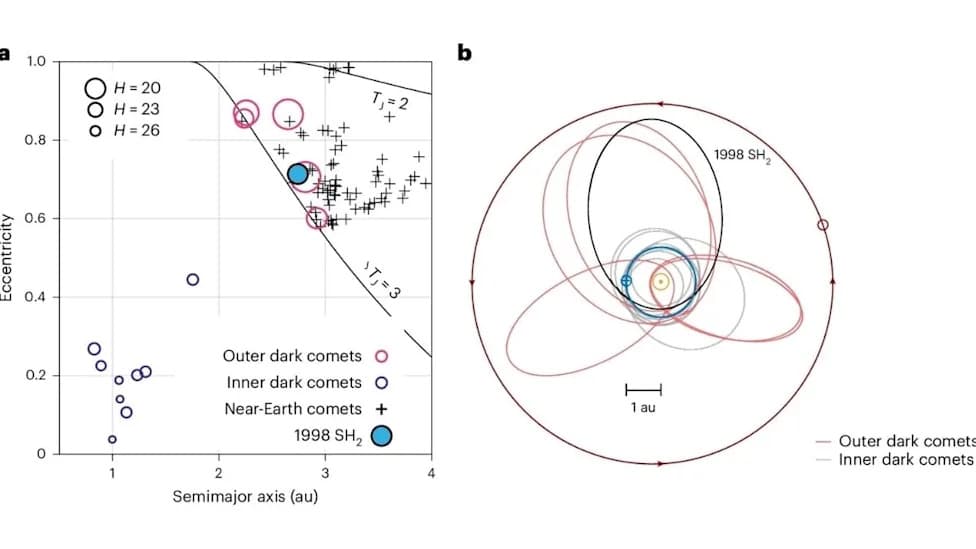
A distribution of discovered 'dark comets' and their distance from the Sun. (Farnocchia et al., Nat. Astron., 2026)
The Solar System still carries the ghostly leftovers of its violent formation: small rocky bodies that never coalesced into planets and the shattered cores of larger objects broken apart by ancient collisions. Astronomers long divided these remnants into two main classes — asteroids and comets — based on appearance, composition and orbital behavior. A growing population of hybrid objects, however, challenges that tidy classification.
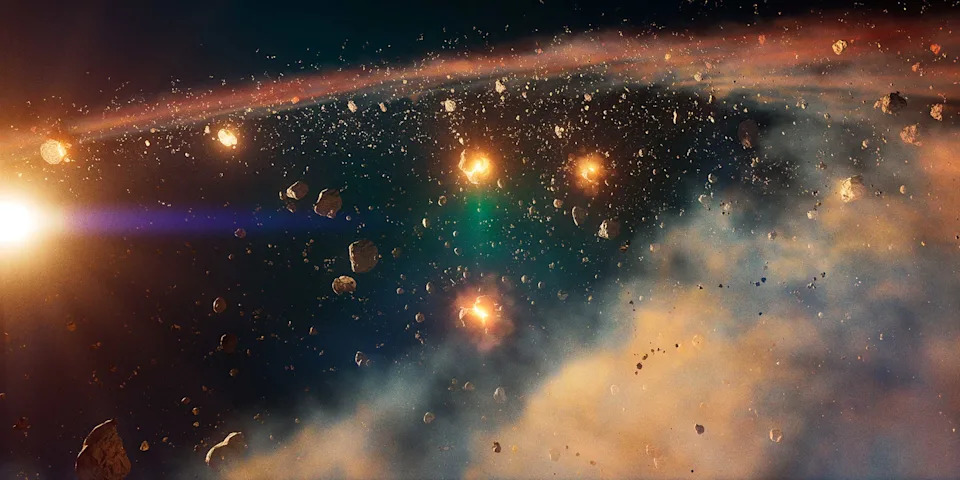
An illustration of the chaotically violent early Solar System and its untold colliding bodies.(ETH Zurich)
1998 SH2, an object discovered in 1998 and tracked intermittently for almost three decades, has now been reclassified as a "dark comet." Observations during a close 2025 approach to Earth revealed subtle cometary features and confirmed that non‑gravitational forces — produced by outgassing from sublimating subsurface ice — altered its orbit.
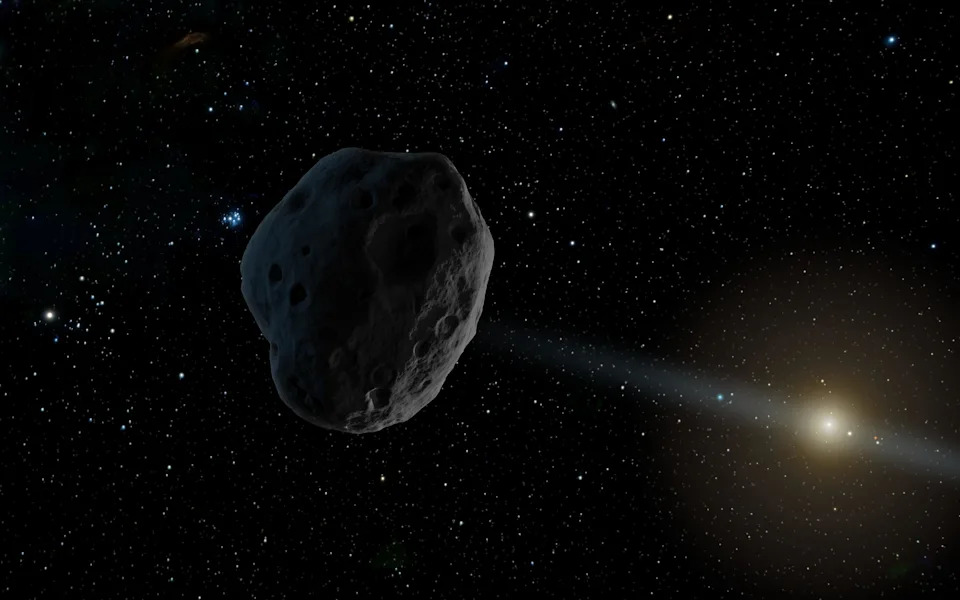
An illustration of a potential 'dark comet,' designated 2016 WF9, moving pastJupiteron the sunward portion of its orbit.(NASA/JPL-Caltech)
How It Was Discovered
Astronomers followed 1998 SH2 from its discovery through 2016, after which the object was not detected during the next two ~4.5‑year orbits. When it returned on its subsequent sunward pass in 2025 and came within roughly 3 million kilometres (2 million miles), about 0.02 astronomical units, of Earth, its trajectory diverged from predictions based on earlier observations.
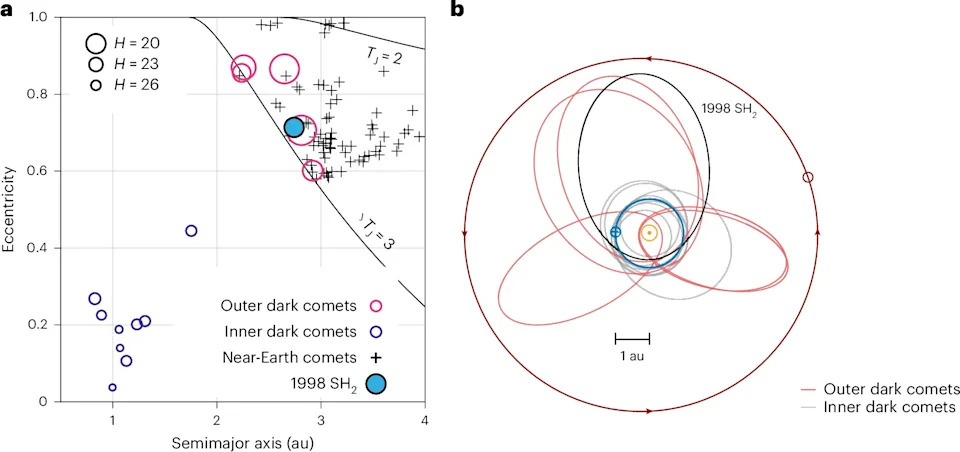
A distribution of discovered 'dark comets' and their distance from the Sun.(Farnocchia et al.,Nat. Astron., 2026)
Teams used optical facilities worldwide — including ATLAS (Asteroid Terrestrial-impact Last Alert System), the Canada‑France‑Hawai'i Telescope (CFHT), and European Southern Observatory (ESO) telescopes in Chile — to reobserve the object. The follow‑up images showed a faint coma (a tenuous gaseous halo) and a weak, narrow tail. These low‑level signatures explain why the object had appeared asteroid‑like for decades: when cometary activity is weak, outgassing can remain undetected for many orbits.

Subscribe to ScienceAlert's free fact-checked newsletter
Why It Matters
Orbital simulations favor sublimation of buried ice as the cause of the non‑gravitational accelerations, rather than impacts or material shed by rotation. The study's authors highlight that 1998 SH2 is the first object for which cometary activity was predicted from its orbital perturbations and then confirmed by targeted observations — a milestone for small‑body science.
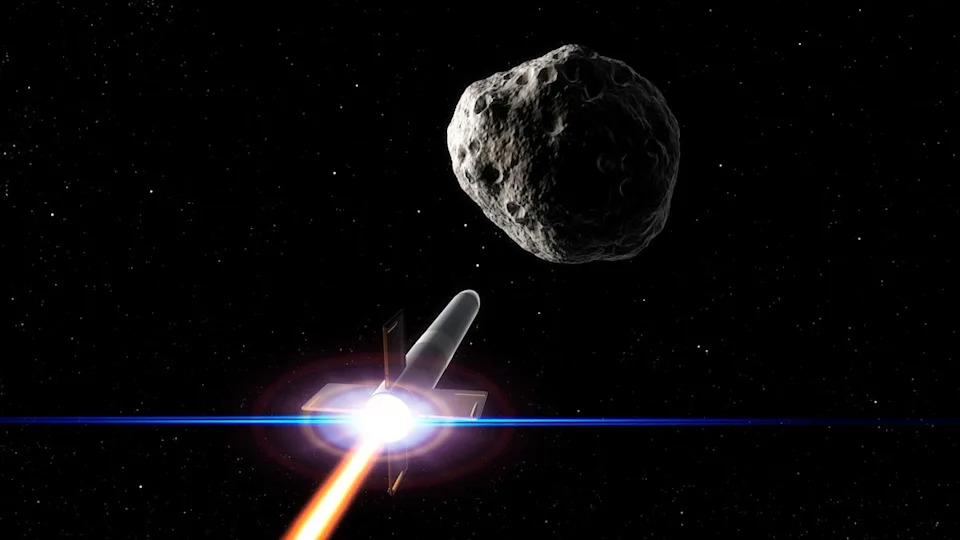
An illustration of a hopefully unnecessary planetary defense scenario: averting an Earthbound space rock using a nuclear device.(Sciepro/Science Photo Library/Getty Images)
"This work shows the importance of continuously tracking near‑Earth objects," says Davide Farnocchia, lead author and navigation engineer at NASA JPL's Center for Near‑Earth Object Studies.
If dark comets are common, they could have contributed to Earth's early water budget. Their subtle jets also offer a plausible, physics‑based account for unusual accelerations seen in objects such as the interstellar visitor 'Oumuamua, without invoking exotic explanations.
Implications for Planetary Defence
Accurate classification matters for impact risk assessment. Outgassing can change a body's trajectory in ways that standard gravitational models do not predict, complicating long‑term forecasts used by planetary defence programmes. For scale, the Chelyabinsk meteor (2013) was ~18 metres across and released energy equivalent to more than 30 atomic bombs; by contrast, 1998 SH2 is estimated to be roughly 380 metres in diameter. Current analysis finds no impact risk from 1998 SH2, but its behavior underscores the need for continuous monitoring and reanalysis of astrometric data to spot other 'hidden' comets.
The research was published in Nature Astronomy (2026). The detection also reinforces the value of global, coordinated follow‑up observations and of searching astrometric archives for small non‑gravitational anomalies that may signal cometary activity.
Key Observational Details:
- Object: 1998 SH2 (reclassified as a dark comet)
- Close approach: ~3 million km (0.02 AU) from Earth in 2025
- Signs of activity: faint coma and narrow tail detected in optical images
- Cause of perturbations: likely sublimation of subsurface ice (outgassing)
- Estimated diameter: ~380 metres
Continuous tracking and careful astrometric analysis remain essential to distinguish asteroids from faintly active comets and to improve planetary defence readiness.
Help us improve.