
The meteorite that struck a Hillsborough, New Jersey house on July 16, 2024 was quickly recovered and analyzed by researchers. A Science Advances paper reports mineral evidence of ancient salty brine and amino acids that are rare on Earth and likely extraterrestrial. The combination of video-recorded trajectory and rapid recovery allowed scientists to link the rock to the asteroid belt and demonstrate that water-driven chemistry occurred on its parent body billions of years ago.
Meteorite Pierces New Jersey Roof — Scientists Find Ancient Salty Water and Extraterrestrial Amino Acids
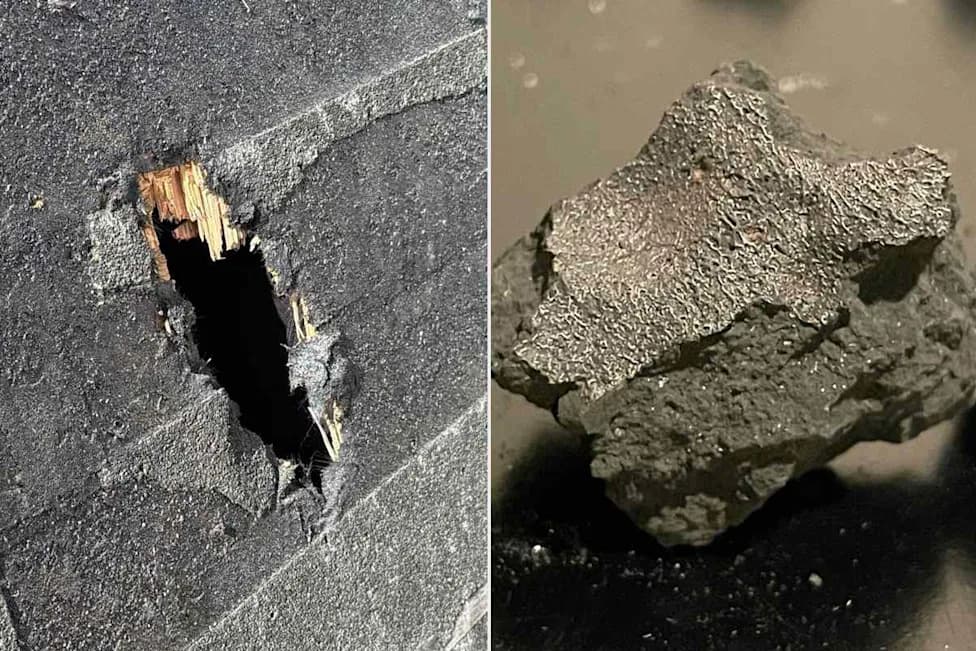
The rooftop hole where the mteorite landed; the meteoriteCredit: M. Kirschner and M. Hankey, American Meteor Society
A meteorite pierced the roof of a Hillsborough, New Jersey, home on July 16, 2024, and was promptly recovered by the homeowners — one of whom is an amateur astronomer. Because the fall was recorded on video and the fragments were preserved, researchers could combine trajectory data with laboratory analyses to determine the rock's likely origin and ancient history.
NASA-Led Study Reveals Brine Alteration and Rare Organics
In a paper published in Science Advances, an international team that includes NASA scientists reports microscopic mineral deposits consistent with ancient salty water (brine) that once flowed through the meteorite's parent asteroid. Chemical tests also detected amino acids that are rare on Earth and described by the authors as likely extraterrestrial in origin.
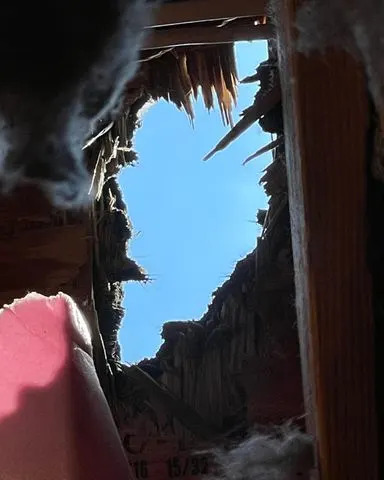
The rooftop hole where the meteorite landedCredit: M. Kirschner and M. Hankey, American Meteor Society
Because the fireball was documented on video and the specimen was quickly recovered, researchers were able to reconstruct the meteorite's trajectory and link its composition to a probable source in the asteroid belt. That combination of documented fall and rapid retrieval provides an unusually complete record for studying a space rock's provenance and post-formation history.
"When we have both a documented fireball and a quick recovery of its meteorite, we can learn not only what the rock is made of, but where it came from in the asteroid belt," said Peter Jenniskens, the study's lead author and a meteor astronomer at NASA's Ames Research Center and the SETI Institute.
The brine-altered minerals indicate that liquid water once circulated through the parent body billions of years ago. Water-driven chemistry on small asteroids can synthesize and concentrate organic molecules, making such bodies potential contributors to the early solar system's reservoir of prebiotic compounds.
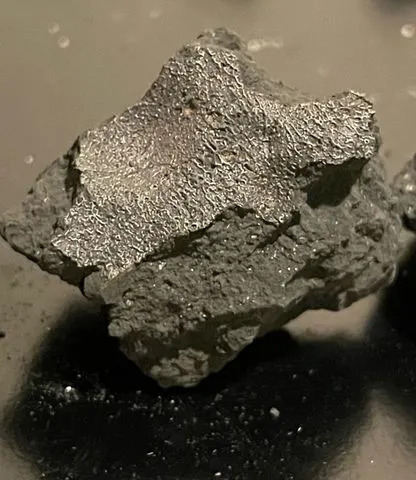
The meteoriteCredit: M. Kirschner and M. Hankey, American Meteor Society
"Following the history of water through the solar system is an essential part of understanding the origin of life," said co-author Mike Zolensky, a meteorite researcher. While the study does not claim the meteorite carried life, its findings strengthen evidence that aqueous, organic-rich environments existed on small bodies and may have helped distribute life's building blocks before and during planet formation.
The anonymous homeowners said they recognized the specimen's scientific value, collected fragments while wearing gloves, and turned them over to authorities. Their quick and careful actions — combined with eyewitness video — were crucial for preserving the sample and enabling the detailed analyses reported in the study.
These results add a tangible data point to efforts to understand how water and organic chemistry operated on asteroids during the formative epochs of the solar system, shedding light on processes that could have influenced the emergence of prebiotic chemistry on Earth.
Help us improve.





















