
A reanalysis of INTEGRAL’s full 2002–2025 gamma‑ray dataset reveals tentative 511 keV electron–positron annihilation signals beyond the Milky Way, notably near Complex C and along the Magellanic Stream. If some positrons escape the Galaxy and annihilate in surrounding gas, the Milky Way’s total positron production could be ≈2–3× larger — about 100 tredecillion positrons per second (≈1×1044/s). The strongest signal reaches ~4σ, so upcoming missions like NASA’s COSI (2027) will be essential to confirm these hints and clarify their origin.
Astronomers See Hints of Positron Annihilation Outside the Milky Way — A Bigger Antimatter Puzzle
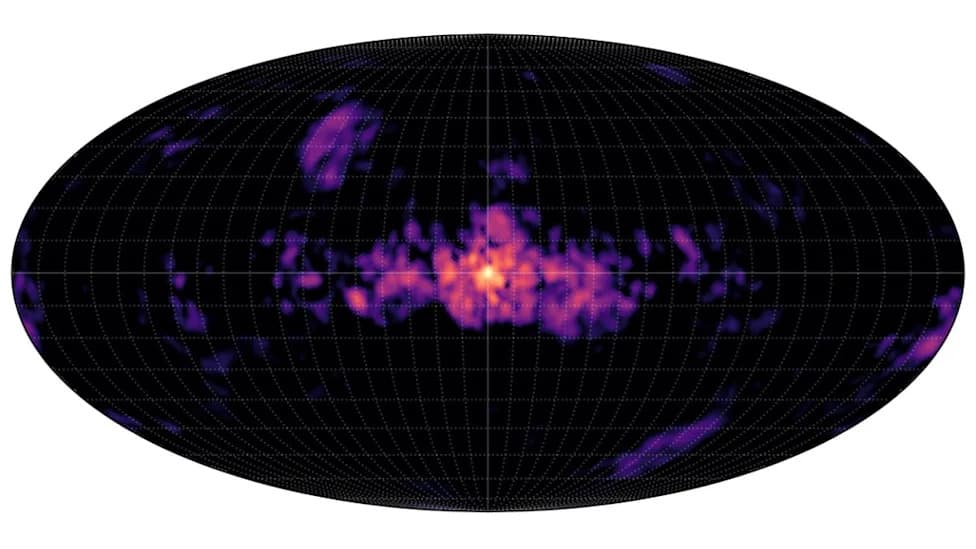
The 20-year 511 keV map from the INTEGRAL gamma-ray space telescope. (Yoneda et al., A&A, 2025)
A longstanding mystery at the heart of our galaxy may have just grown more complicated. A new reanalysis of the full INTEGRAL gamma‑ray dataset suggests the characteristic 511 keV signature of electron–positron annihilation may have been detected beyond the Milky Way for the first time.
YouTube Thumbnail
Physicists Thomas Siegert (Julius Maximilian University of Würzburg) and Hiroki Yoneda (Kyoto University) compiled INTEGRAL’s complete observing record (2002–2025) to make the most detailed maps yet of the 511 keV emission. While constructing cumulative images from successive three‑year slices of the dataset, they found persistent signals that strengthened as more data were added — a pattern the authors argue is unlikely to be an instrumental artifact.
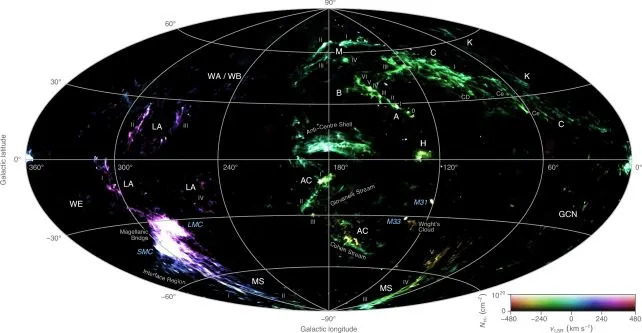
A map of high-velocity clouds in the Milky Way. Complex C is in the upper right quadrant. (Westmeier,MNRAS, 2018)
Where the Signals Appear
The most compelling tentative detection is associated with Complex C, a large high‑velocity cloud of hydrogen falling toward the Milky Way’s disk. A second, weaker hint shows up along the Magellanic Stream, the long ribbon of gas trailing the Large and Small Magellanic Clouds. Neither region is expected to produce large numbers of positrons locally, which suggests the particles may have traveled from elsewhere before slowing and annihilating.
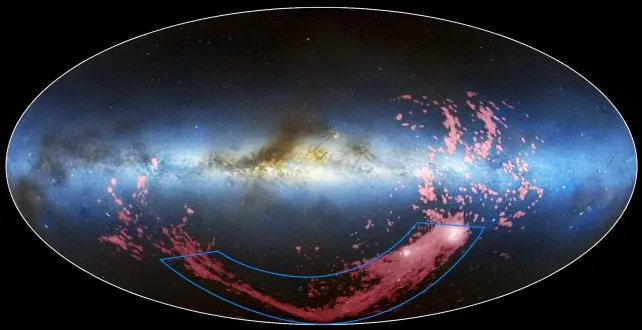
The Magellanic Stream. (David L. Nidever et al., NRAO/AUI/NSF and Mellinger, LAB Survey, Parkes Observatory, Westerbork Observatory, and Arecibo Observatory)
Why This Is Surprising
Positrons must be slow (nonrelativistic) to annihilate efficiently with electrons and produce the narrow 511 keV line. Conventional thinking holds that such slow positrons are unlikely to escape the Galaxy. To explain annihilation far outside the disk, Siegert and Yoneda propose a population of higher‑energy positrons can escape the Milky Way, propagate into surrounding gas, slow down, and then annihilate — an unexpected propagation behavior.

Subscribe to ScienceAlert's free fact-checked newsletter
Implications For Galactic Antimatter
If a fraction of positrons do escape and annihilate outside the disk, the Milky Way’s total positron production must be larger than estimates based only on annihilations observed inside the galaxy. Siegert and Yoneda estimate the production could be roughly 100 tredecillion positrons per second (≈1×1044 positrons/s), about 2–3 times higher than previous estimates.

YouTube Thumbnail
“That in itself would mean that the positron content of the Milky Way is much larger than what is currently observed ‘inside’,” Siegert told ScienceAlert. He adds that the propagation and origins of these positrons remain challenging to explain with conventional astrophysical sources.
Statistical Significance and Next Steps
The detections are tentative. The strongest signal reaches about 4σ significance (roughly a one‑in‑15,000 chance of being a fluctuation); particle physics generally requires 5σ to claim a discovery. Siegert is confident an annihilation feature exists in the maps, but he and other researchers stress that further observations are essential to confirm the strength and location of the signals.
Future instruments will be crucial. NASA’s Compton Spectrometer and Imager (COSI), scheduled for launch in 2027, should have the sensitivity to verify faint 511 keV emission and help determine whether the INTEGRAL hints are genuine and where Galactic positrons originate.
Wider Consequences
If confirmed, these extragalactic annihilation signals would deepen one of astronomy’s longest‑running antimatter mysteries. Researchers would need to reexamine conventional positron sources — such as radioactive isotopes from stellar explosions, jets and winds from black holes and neutron stars, and other energetic processes — and may eventually consider more exotic explanations, including certain light dark matter models, if conventional sources cannot supply enough positrons.
Reference: Siegert & Yoneda, Astronomy & Astrophysics (analysis of the full INTEGRAL 2002–2025 dataset). Additional confirmation is expected from future missions such as COSI (2027).
Help us improve.





















