
Quick summary: The Sun is called a "yellow dwarf" because it's a G2-type main-sequence star on the Hertzsprung-Russell diagram, not because it is truly yellow. Its emission peaks in the green part of the spectrum, and the combined visible wavelengths make it appear white in space. From Earth, Rayleigh scattering removes blue light and gives the Sun a yellow, orange, or red appearance; larger particles (Mie scattering) from smoke or pollution can intensify those warm hues.
NASA Explains Why the Sun Is Called a 'Yellow Dwarf' — But Isn't Actually Yellow
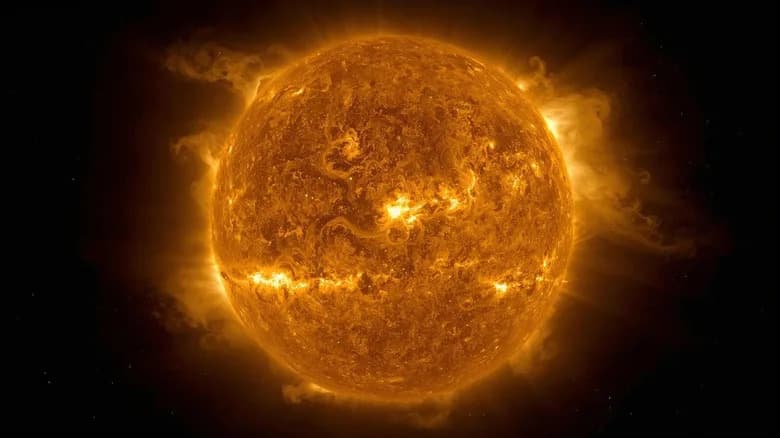
Jack Parinussa/Shutterstock
The Sun is often drawn as a yellow circle, but that simple picture hides the science. NASA and astronomers call our star a "yellow dwarf" because of its spectral classification and its place on the Hertzsprung-Russell diagram — not because its true color is bright yellow when seen from space.
Why It's Called a "Yellow Dwarf"
The Hertzsprung-Russell (H-R) diagram sorts stars by temperature and luminosity. The spectral sequence runs O, B, A, F, G, K, M (hottest to coolest), and each letter is subdivided with digits 0–9 to indicate relative temperature within the class. Our Sun is a G2 star: that places it in the G (yellow) group near the hotter side of that category. The term "dwarf" refers to its size and evolutionary stage — the Sun is a main-sequence (dwarf) star, fusing hydrogen in its core rather than being a giant or supergiant.
What Color Is the Sun Really?
Sunlight's spectrum peaks in the green portion of the visible band, and the Sun's effective surface temperature is about 5,778 K. Because the Sun emits across the whole visible spectrum, those wavelengths mix and the combined light is essentially white. In space, away from Earth's atmosphere, the Sun appears white to an observer or to cameras calibrated to human vision.

Gergitek/Shutterstock
Why the Sun Looks Yellow From Earth
The reason the Sun appears yellow, orange, or red from the ground is atmospheric scattering. Rayleigh scattering by the small gas molecules in Earth's atmosphere preferentially scatters shorter (blue) wavelengths out of the direct sunlight that reaches our eyes. When the Sun is high in the sky the effect is modest and the disk may look white or pale yellow; at sunrise and sunset the light travels through much more air, so most blue light is scattered away and the Sun looks orange or red.
Smoke, Pollution, And Mie Scattering
Large particles such as smoke, dust, or urban pollution produce Mie scattering, which affects a broader range of wavelengths and can deepen reds and oranges or give the sky an eerie tint. These particles not only change the visual colors but also represent real health and environmental hazards.
Bottom line: "Yellow dwarf" is a useful astronomical label but not a literal statement about the Sun's color. Its apparent color depends on where you view it from: white in space, and yellow-to-red when filtered through Earth's atmosphere.
Help us improve.





















