NASA released a microscopic image of a potassium chloride crystal grown aboard the ISS that twists into stair‑stepped, pyramid‑like shapes due to microgravity. In orbit, reduced gravity lets molecular forces dominate, producing "hopper growth" where edges grow faster than centers. These space‑grown crystals often have fewer defects, offering researchers a clearer view of ideal lattice structures. Understanding such growth could inform manufacturing advances for semiconductors and other high‑performance materials.
NASA Shares Surreal Microscopic Photo of a Potassium Chloride Crystal Grown on the ISS
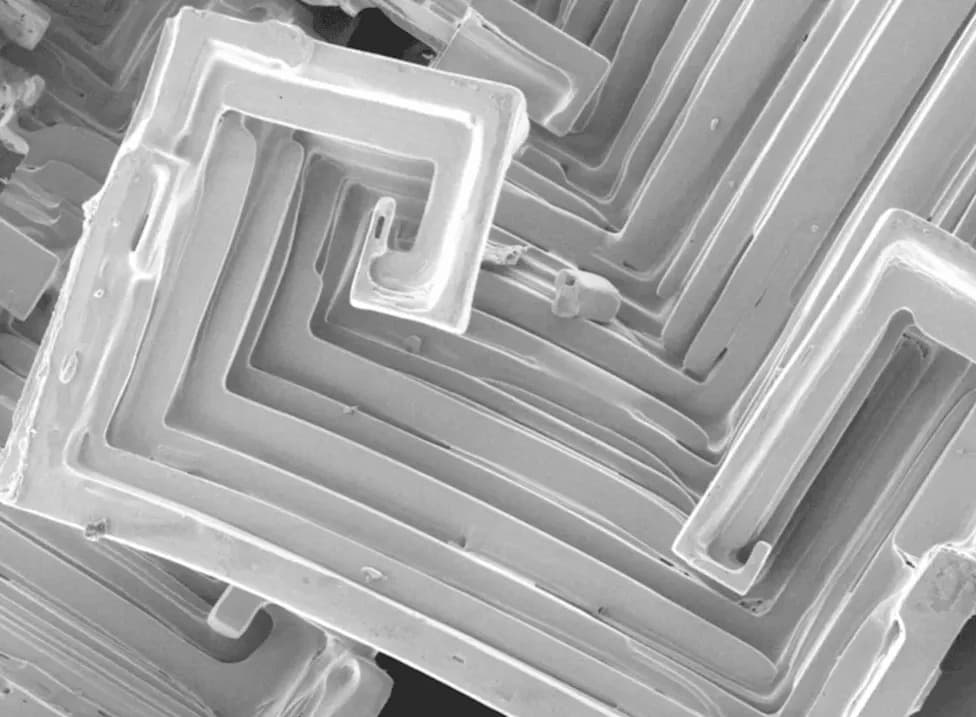
This striking potassium chloride crystal was grown aboard the International Space Station | ©Image Credit: NASA astronaut Don Petit
NASA has released a striking microscopic photograph of a potassium chloride (KCl) crystal grown aboard the International Space Station (ISS). The structure, captured by astronaut Don Pettit, resembles a twisting miniature skyscraper rather than a typical salt grain, and its unusual form is a direct result of growth in microgravity.
What Makes It Unusual
On Earth, potassium chloride typically forms neat, cubic crystals. In microgravity, however, the reduced influence of gravity allows other forces—molecular attraction and polarity—to dominate the growth process. The result is a dramatic growth mode known as hopper growth, where crystals expand mainly from edges and corners while centers remain hollow, producing stair-stepped, often curling geometries.
Expert Explanation
"When you take away the constant downward pull, subtler forces that are normally masked by gravity can shape crystal growth," explains Anne Wilson, professor of chemistry and biochemistry at Butler University. "That lets crystals extend in ways that are nearly impossible to reproduce on Earth."
Scientific Importance
Crystals grown with minimal gravitational disturbance often develop with far fewer defects. Studying these near‑ideal lattices provides researchers with a clearer view of intrinsic crystal structure and growth dynamics. Those insights can help scientists and engineers reduce imperfections in high-performance materials.
Potential applications include improvements in semiconductor fabrication and other advanced manufacturing processes where crystal quality directly affects device performance. Though visually striking and shareable, the photo represents meaningful materials‑science research that could influence future technologies.
Source: Image by NASA astronaut Don Pettit; reporting based on Live Science and GEEKSPIN.
Help us improve.