New York has launched a six-month pilot that equips 10 street vendors with removable rechargeable batteries to replace petrol generators, aiming to reduce noise, air pollution and health risks. The trial, begun in July, uses bicycle-style batteries supplied by PopWheels and recharged at fire‑resistant lockers; an inverter on each cart holds up to six batteries. City officials propose a subscription model to scale the service, but upfront inverter costs and charging infrastructure remain key hurdles. Converting all ~20,500 licensed carts could cut emissions roughly equivalent to removing about 30,000 cars annually.
New York Food Carts Go Electric: Battery Pilot Cuts Noise and Pollution
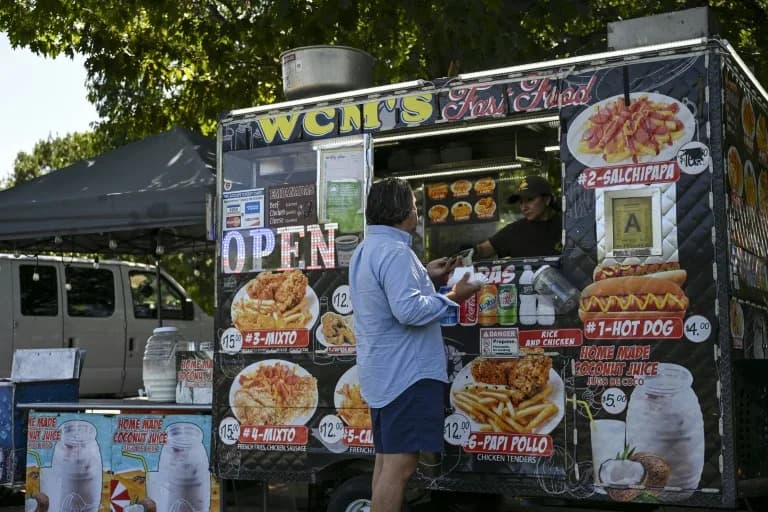
New York City has around 20,500 licensed food vendors (ANGELA WEISS)
Walk the streets of New York and you usually hear the constant rumble of petrol generators that power the city's tens of thousands of food carts. One vendor, however, is quieting that soundtrack.
William Arevalo’s cart — serving hot dogs, empanadas and fried shrimp — now runs on rechargeable batteries as part of a six-month municipal pilot aimed at reducing noise, air pollution and health risks associated with exhaust fumes.
“I can't believe it. Now we don't have noise and all our equipment is still working,” Arevalo, 59, told AFP from his cart parked in the shade of trees in a Queens park. He said the replacement of his petrol generator with batteries has eliminated smoke inside the cart and improved communication with customers. “Now it's 100 percent better,” he added.
Pilot Setup And Technology
Launched in July, the pilot equips 10 street vendors with removable, bicycle-style batteries supplied by PopWheels, a New York startup. An inverter mounted at the back of Arevalo’s cart holds up to six foot-long batteries, which he rotates roughly every five hours to keep freezers and fans operating. PopWheels charges the batteries in nearby, fire-resistant lockers.
Benefits And Vendor Experience
Vendors report several immediate advantages: dramatically reduced noise, no generator smoke inside tight quarters, and more reliable operation on hot days when petrol generators can overheat and fail. Arevalo said the battery system has proven dependable and draws interest from fellow vendors who still use petrol units.
“All the smoke from the generator used to come inside the truck. It's really bad for our health,” Arevalo said. “Sometimes when I was with a customer, I couldn't hear them because of the generator noise.”
Scaling Challenges And Policy Plans
Scaling the pilot citywide would be a major undertaking. Roughly 20,500 licensed food carts across New York depend on generators to power stoves, freezers and ventilation. The city council estimates that converting all of them to electric power could be roughly equivalent to removing about 30,000 cars from the road each year in emissions terms — but upfront costs and charging infrastructure remain hurdles.
Inverter systems can cost several thousand dollars, similar to mid-sized petrol generators, though city officials argue that long-term operating costs for battery systems may be lower. The city is exploring financial supports — including loans — to help vendors cover installation costs.
To address past scaling problems, officials hope to offer a subscription-style model in which vendors pay a fee to access batteries and charging stations rather than owning the entire charging network themselves. The plan attempts to avoid pitfalls from earlier experiments: a 2013 effort that tied some Manhattan carts to the grid reduced noise and emissions but could not be expanded, and a prior nonprofit-led battery pilot faltered because of insufficient charging infrastructure.
Outlook
For now, the trial is small but promising. Organizers will monitor vendor experiences, costs and operational reliability during the six-month period to determine whether a subscription model and public supports could make electric power viable for thousands of carts across the city.
By reducing noise and fumes, the pilot aims to improve vendors' working conditions and public health while testing a scalable path to cleaner, quieter streets.
Help us improve.