The study published in Science reconstructs global language diversity over the last 12,000 years and finds evidence for a recent "golden age" when linguistic diversity may have peaked between about 1,000 and 3,000 years ago. Researchers estimate roughly 4,500–6,200 languages at the start of the Holocene and many model trajectories imply a peak in the tens of thousands before a long decline. That decline appears to have begun with expanding states and empires long before European colonialism, producing a selective historical bottleneck among surviving languages.
Researchers Reconstruct a Lost “Golden Age” of Global Languages — Tens of Thousands May Once Have Existed
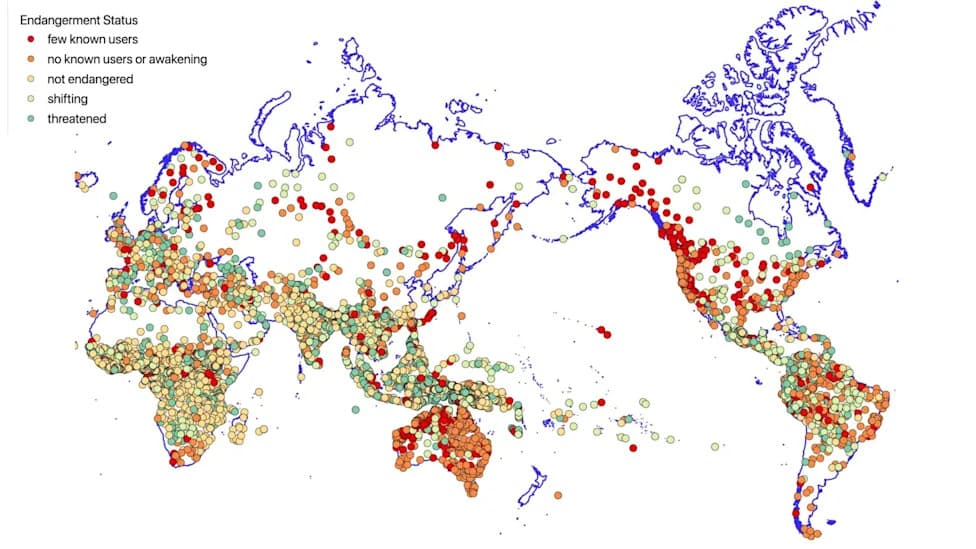
Contemporary languages and endangerment status. (Claire Bowern via SWNS)
New research published in Science suggests that humanity once experienced a global "golden age" of linguistic diversity, when tens of thousands of distinct languages may have been spoken between roughly 1,000 and 3,000 years ago. The study combines ethnographic records, prehistoric population estimates and computational modeling to reconstruct plausible trajectories of language diversity over the last 12,000 years.

Hittite language example, known only from ancient sources and no longer spoken. Tablet fragment. Invocations to Hattic deities; CTH 733. Hittite. Clay. YBC 16173. (Klaus Wagensonner via SWNS)
Key Findings
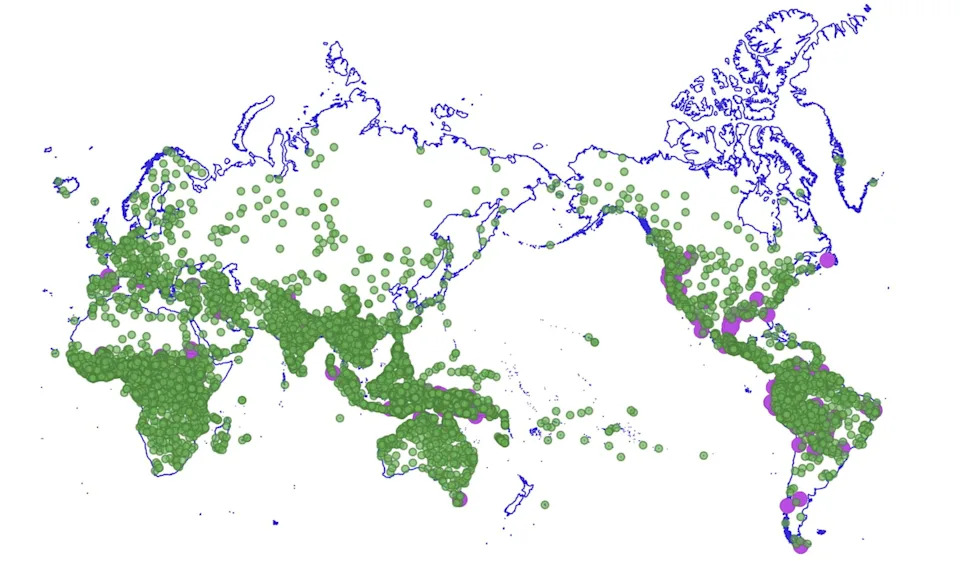
Contemporary languages; with language isolates highlighted in pink. (Claire Bowern via SWNS)
The team estimates that at the start of the Holocene (about 12,000 years ago) there were likely between 4,500 and 6,200 languages (with a broader plausible range of about 3,300–7,800). As human populations expanded, linguistic diversity grew and — according to many model trajectories — peaked between 1,000 and 3,000 years ago, possibly reaching the tens of thousands. A long and selective decline in the number of languages then followed, beginning long before European colonialism and accelerating during the last two millennia.

(Photo byChandan ChaurasiaviaUnsplash)
How the Study Was Done
The international research team, with contributors from the United States, Germany, Spain and elsewhere, combined several lines of evidence: ethnographic data from 171 hunter-gatherer and fisher groups, independent reconstructions of prehistoric global population size (estimated at roughly 4.4–7 million people around 12,000 years ago), and social-computational and statistical models. They used these inputs to estimate distributions of ethnolinguistic group sizes and to simulate thousands of possible language-diversity trajectories linking the early Holocene to the present.

(Photo byJos ZwaanviaUnsplash)
"The languages we see today are the survivors of a massive and highly selective historical bottleneck," said study lead author Damian Blasi (ICREA and Harvard University).
Interpretation and Implications
The analysis suggests that large states and expanding empires played a major role in reducing linguistic diversity well before the onset of European colonial expansion. Languages carried by expanding populations were disproportionately likely to survive, while those of absorbed, displaced or shrinking groups disappeared. The surviving set of languages therefore represents a "small and historically biased sample" of past global linguistic variety.
The model does not single out specific empires, regions, or events as the sole drivers of decline; rather, it shows that a very large and selective reduction in languages must have occurred across many places and periods. The findings challenge the view that the current crisis of language loss began only with modern colonialism, highlighting long-term historical forces that shaped which languages endured.
Why It Matters
By reconstructing long-term trends in linguistic diversity, the study offers a new perspective on human cultural history and on how demographic, technological, and political changes have reshaped the world's linguistic landscape. It also underscores that features common across many languages today might reflect the historical success of particular populations rather than inherent linguistic superiority.
Authors and Affiliations: The international team includes researchers such as Damian Blasi (ICREA & Harvard), Claire Bowern (Yale University), Russell Gray (Max Planck Institute for Evolutionary Anthropology), Marcus Hamilton (University of Texas at San Antonio), and others.
Source: Study published in Science.
Help us improve.