
Researchers propose that some of JWST's "Little Red Dots," seen ~600 million years after the Big Bang, are nascent globular clusters containing short-lived supermassive stars. Those stars (1,000–10,000 solar masses; ~1 million-year lifetimes) could produce the unusual helium and metal abundances observed in many modern globular clusters. The model matches the objects' timing, masses and distribution, but definitive proof is not yet available. The study is available as a preprint on arXiv.
JWST's 'Little Red Dots' May Be the Birthplaces of Globular Clusters, Study Suggests
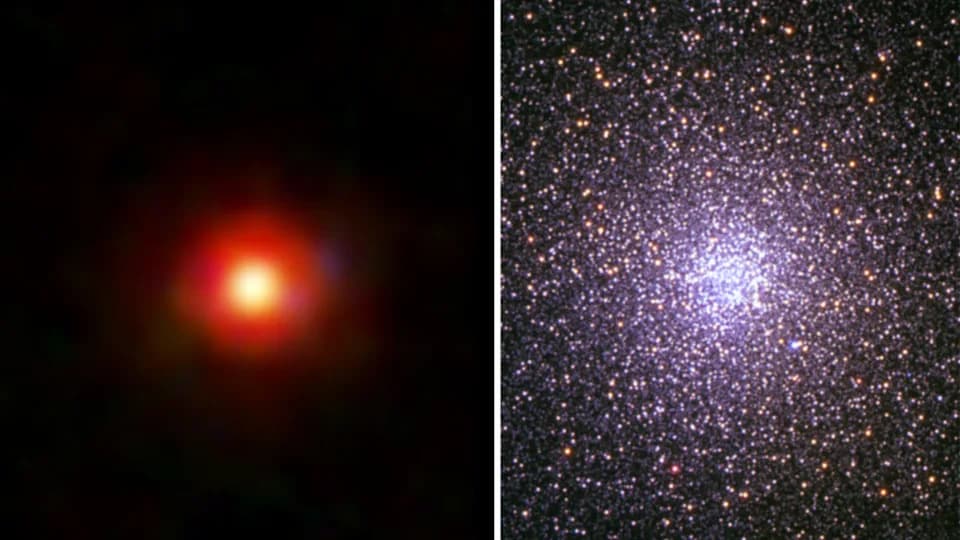
Did Little Red Dot like the one on the left evolve into globular clusters like 47 Tucanae (right)?. | Credit: NASA, ESA, CSA, STScI, Dale Kocevski/Colby College, ESO
New research suggests that the compact, red sources detected by the James Webb Space Telescope (JWST) in the early universe — nicknamed "Little Red Dots" — may be the precursors of the dense, ancient star systems astronomers call globular clusters.
JWST began finding large numbers of Little Red Dots about 600 million years after the Big Bang. These objects are puzzling because many of them appear to vanish from observations by the time the universe is roughly 2 billion years old. Explanations proposed so far include faint, dust-shrouded galaxies and exotic objects such as black-hole–host systems. The new model from researchers at the University of Texas at Austin adds a compelling alternative: some Little Red Dots could be proto-globular clusters whose cores host a short-lived supermassive star.
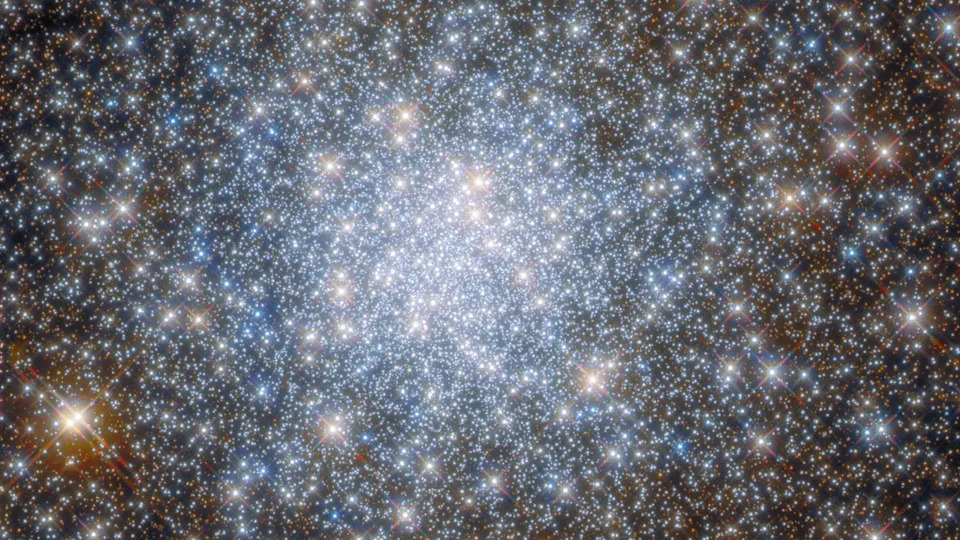
Globular cluster NGC 6638, as seen by the Hubble Space Telescope. | Credit: ESA/Hubble & NASA, R. Cohen
How a Supermassive Star Could Explain the Puzzle
Supermassive stars — hypothetical stars with masses of roughly 1,000 to 10,000 times that of the Sun — would be extremely hot and short-lived (on the order of ~1 million years). In a crowded, rapidly forming stellar cluster, repeated collisions and mergers could produce such an object. The intense nuclear fusion inside a supermassive star could create the unusual abundance patterns (high helium, nitrogen, sodium, aluminum and low carbon, oxygen, magnesium) seen in many globular-cluster stars today.
"These may not be just a strange new JWST population with no connection to the universe around us today," said study leader John Chisholm (UT Austin). "Instead, Little Red Dots may persist past the early universe, evolving into something relatively familiar."
Linking Early Objects to Modern Clusters
The authors point out several lines of supporting evidence: the epoch when Little Red Dots appear (~600 million years after the Big Bang) matches theoretical times for globular-cluster formation; the estimated masses and spatial distribution of many Little Red Dots are consistent with progenitors of today's clusters; and the chemistry produced by a supermassive-star phase naturally explains the strange element patterns observed in many globular-cluster stars.
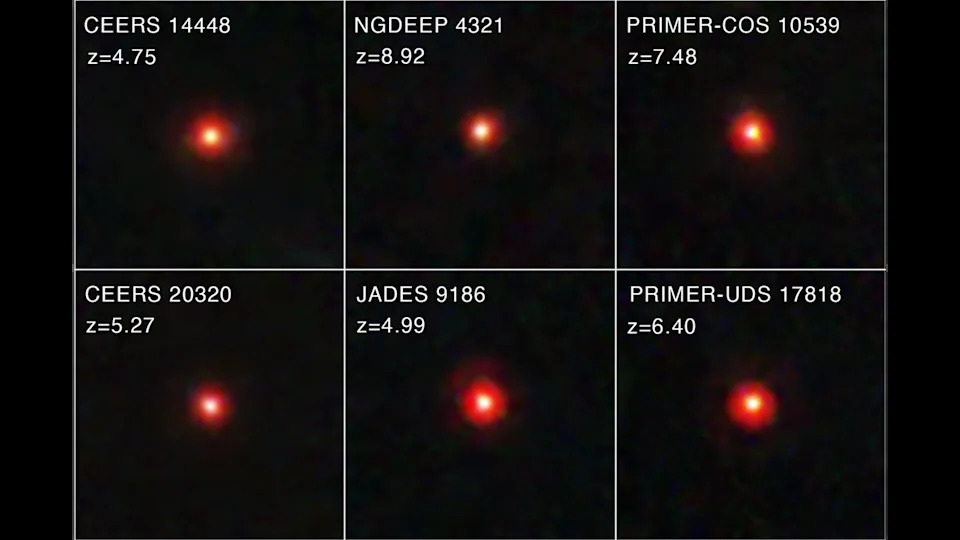
Just some of the "little red dot" galaxies discovered by the JWST. | Credit: NASA, ESA, CSA, STScI, Dale Kocevski (Colby College)
When a supermassive star explodes as a supernova, the heavy elements it forged would be dispersed into the cluster gas and incorporated into subsequent generations of stars, imprinting the chemical signatures astronomers later observe. According to the model, once the supermassive star dies the visible object may no longer appear as a Little Red Dot, even if the cluster survives for billions of years.
Not Yet a Smoking Gun
The researchers emphasize there is not yet definitive proof that Little Red Dots are nascent globular clusters. Alternative scenarios — including compact galaxies, black-hole–dominated sources, or other exotic early-universe objects — remain plausible. Still, the globular-cluster hypothesis unifies multiple puzzling observations and is a strong candidate for further investigation.
The study is currently available as a preprint on arXiv.
Help us improve.





















