NASA's Psyche spacecraft completed a month‑long Mars flyby from May 2–15 and released a new video of high‑resolution surface images, including impact craters and the north polar cap. The encounter served as a gravity assist and an in‑flight rehearsal, letting engineers test nearly every major instrument. Psyche's twin cameras also captured Mars' moons Phobos and Deimos, while the neutron spectrometer detected expected neutron signals from about 2,864 miles up and the magnetometer recorded increased magnetic activity crossing Mars' bow shock. The mission remains on track to reach asteroid 16 Psyche in 2029 to study a rare metal‑rich world.
NASA’s Psyche Spacecraft Returns Stunning Close‑Ups of Mars During Gravity‑Assist Flyby
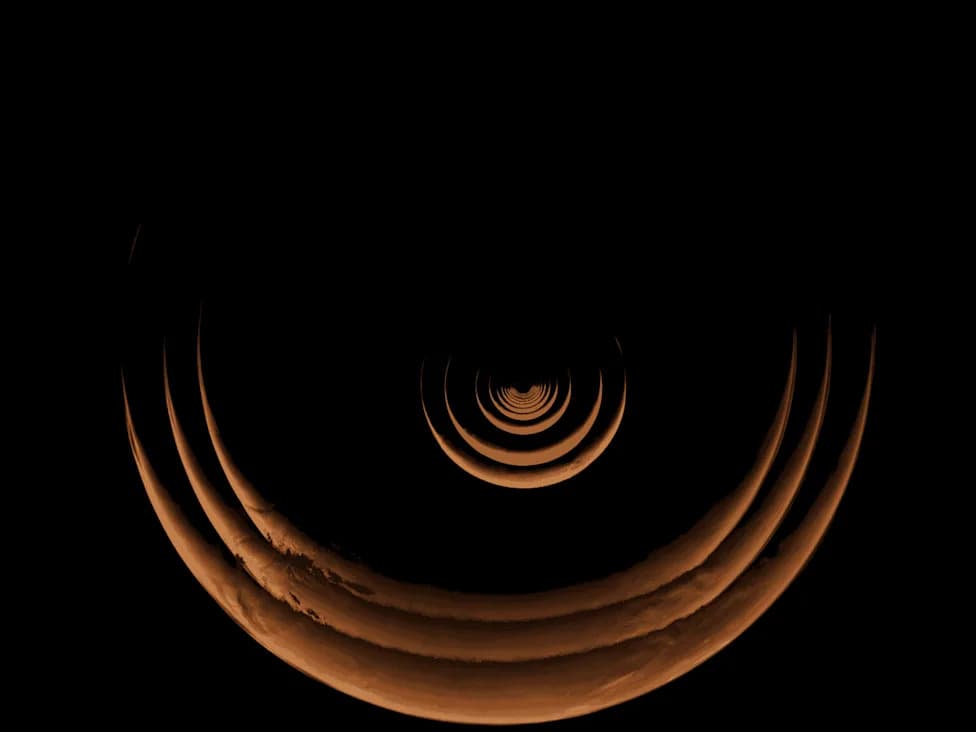
NASA’s Psyche spacecraft took images of Mars while testing its cameras and scientific instruments for the journey ahead | ©Image Credit: NASA/JPL-Caltech/ASU
NASA's Psyche spacecraft, en route to the metal‑rich asteroid 16 Psyche, performed a month‑long flyby of Mars from May 2 to May 15 and returned a striking new video compilation of the planet's surface. Far from distant postcards, the footage includes high‑resolution close‑ups of vast impact craters, windswept plains and the icy north polar cap, offering imagery that rivals space wallpapers.
Real‑World Test During a Gravity Assist
Launched in 2023, Psyche is headed to an asteroid more than 2.2 billion miles away. Before reaching that destination in 2029, the spacecraft used Mars for a gravity assist. NASA turned the opportunity into an operational rehearsal, running nearly every major scientific instrument in a real flight environment to validate systems ahead of arrival at the asteroid.
Imaging and Camera Calibration
Psyche's twin cameras captured detailed surface images while helping engineers calibrate the imaging system and evaluate how it handles scattered sunlight. The cameras also recorded Mars' small moons, Phobos and Deimos, providing valuable practice for later searches for any tiny moons orbiting asteroid 16 Psyche.
Composition and Magnetic Measurements
The spacecraft's neutron and gamma‑ray spectrometer searched for clues about Mars' chemical composition. While Psyche never flew closer than about 2,864 miles (4,606 km) above the surface—too far to detect gamma rays—it did register neutron signals that matched scientists' predictions, confirming instrument performance at range.
Equally important, Psyche's magnetometer, which has monitored the solar wind since launch, detected a sharp uptick in magnetic activity as the spacecraft crossed Mars' bow shock—the invisible boundary where the solar wind collides with the planet's magnetic environment. These measurements improve understanding of how Mars interacts with charged particles from the Sun, even if they won't become desktop art.
What Comes Next
Although the new Mars images are visually impressive, they were primarily a systems check. Psyche remains on course for its ultimate objective: the metal‑rich asteroid 16 Psyche, where scientists hope to study what may be the exposed core of an early planetesimal and learn more about planetary formation and the interiors of early rocky bodies.
Sources: NASA, Popular Science
Help us improve.