The Naval Postgraduate School in Monterey has installed an NVIDIA DGX GB300 under a CRADA with NVIDIA that began in December 2024. The system, equipped with 36 Grace CPUs and 72 Blackwell Ultra GPUs, is designed for large-scale AI workloads and high-resolution modeling while operating within existing campus utilities. It will support research in logistics, cybersecurity, and meteorology/oceanography, and will be available to students and faculty with managed access.
Pentagon’s Most Powerful Supercomputer Goes Live at Naval Postgraduate School in Monterey
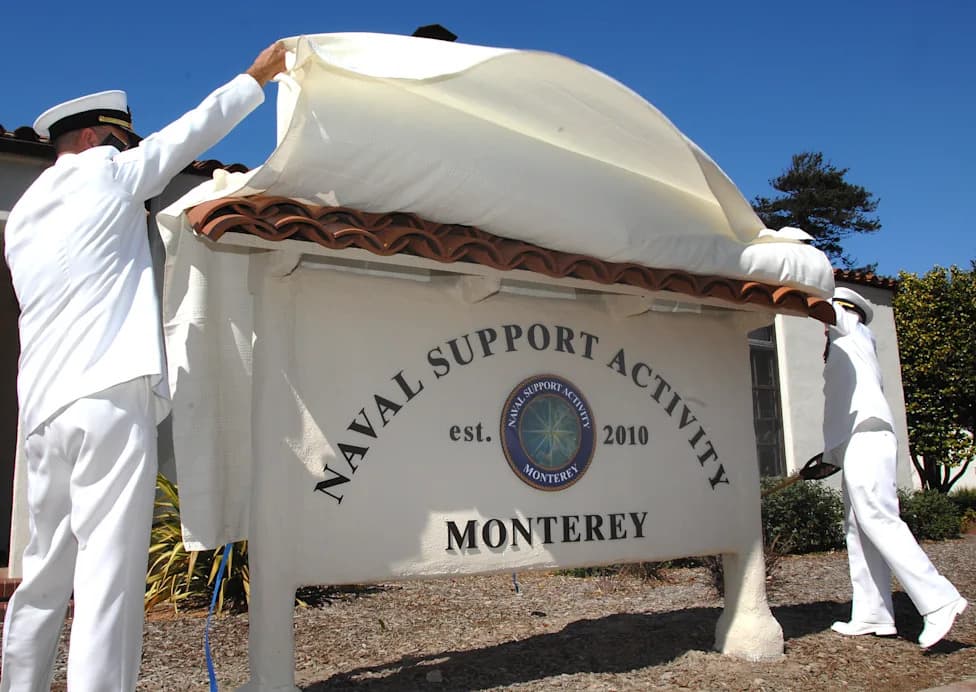
Naval Support Activity Monterey, California. (Javier Chagoya/Navy)
The Naval Postgraduate School (NPS) in Monterey, California, is now home to the Pentagon's most powerful supercomputer: an NVIDIA DGX GB300 installed under a cooperative research and development agreement (CRADA) that began in December 2024.
The DGX GB300—configured with 36 NVIDIA Grace CPUs and 72 NVIDIA Blackwell Ultra GPUs—is integrated into the NPS.edu network and designed to run large-scale AI workloads while operating within the school’s existing power and water infrastructure, Navy officials said. A ribbon-cutting ceremony to launch the system included NVIDIA founder and CEO Jensen Huang and Commander of U.S. Pacific Command Adm. Samuel Paparo.
Capabilities and Intended Uses
The system’s hybrid CPU/GPU architecture lets it process massive volumes of work in parallel, making it particularly well suited for training large AI models, analyzing extensive datasets, and running high-resolution simulations. NPS officials highlighted defense-focused applications such as logistics and supply-chain optimization, cybersecurity threat modeling, and higher-resolution meteorology and oceanography to support tactical operations.
"You can think of massive logistics-scale challenges of, how would you distribute beans, bullets and all of the standard defense logistics things — supply chain management challenges," said Capt. Michael Owen, NPS's vice provost for warfare studies and leader of the school's AI Task Force. "It could be … cybersecurity models to be able to be better positioned to understand where there are potential threats in network traffic."
Owen added that the new capability enables modeling at much finer spatial scales—moving beyond coarse 50-kilometer grids to provide localized forecasts and environmental predictions that better support military operations.
Research Focus, Access, And Strategic Value
Unlike the Defense Department’s operational Defense Supercomputing Resource Center in Vicksburg, Mississippi, NPS will emphasize research and innovation: using the DGX GB300 to develop, refine and improve models rather than only running established operational simulations. Officials said the system will be available to NPS students and faculty, with staff "carefully managing demand" as utilization ramps up.
NPS also launched a new master’s program in artificial intelligence in December; its first cohort of 11 students is already underway. Navy officials noted that the system’s value will be measured not only in compute hours but in how quickly students and researchers convert data into actionable knowledge and operational solutions.
Help us improve.