Nvidia has donated a GB300 "Grace Blackwell" supercomputer to the Naval Postgraduate School Foundation and installed it on the NPS campus in Monterey, California. The company and school confirmed the system is in place but did not disclose detailed specifications. Officials say the donation — the first direct deployment of Nvidia's most advanced servers to a U.S. military-linked institution — will support research and education on fast-moving, complex defense problems. Leaders emphasized AI's growing role in national security and the need to prepare leaders to use it responsibly.
Nvidia Donates GB300 "Grace Blackwell" Supercomputer to Naval Postgraduate School Foundation — First Direct Military Deployment
FILE PHOTO: Illustration shows NVIDIA logo and computer motherboard
Nvidia has donated a cutting-edge supercomputer built on its latest GB300 "Grace Blackwell" servers to the Naval Postgraduate School (NPS) Foundation, a nonprofit affiliated with the U.S. Navy, company and school officials said.
The Naval Postgraduate School, operated by the U.S. Navy and located in Monterey, California, awards master's and doctoral degrees in fields such as computer science and aerospace engineering, with a strong emphasis on military applications. Nvidia's donation is the most direct deployment of the company's most advanced AI servers to a U.S. military-linked institution to date.
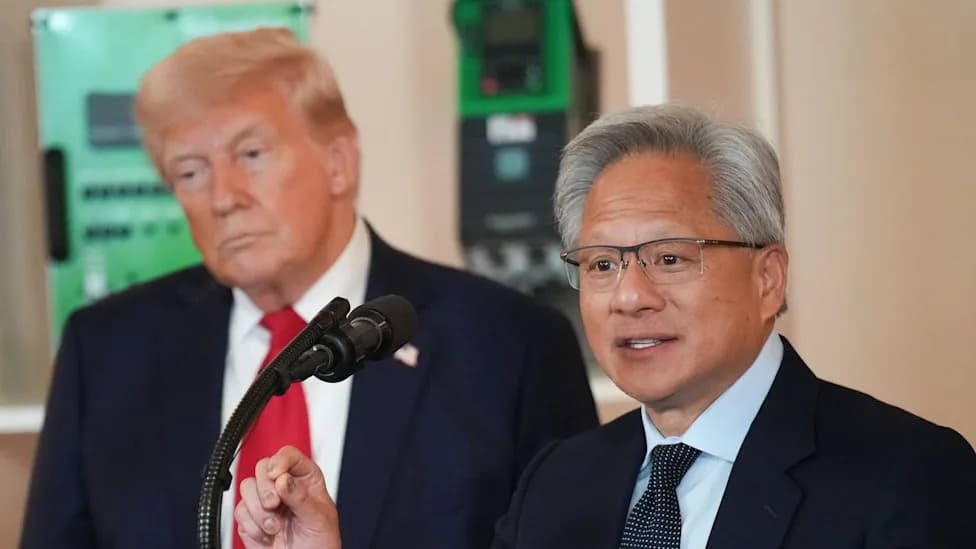
Neither Nvidia nor NPS disclosed the system's full specifications or overall size, but both confirmed the GB300 Grace Blackwell system has been installed on the NPS campus. An on-campus event to announce the installation was planned with Adm. Samuel J. Paparo, Commander of U.S. Pacific Command, and Nvidia CEO Jensen Huang.
Why It Matters
While Nvidia's Blackwell processors are already scheduled for use in U.S. government supercomputers being developed by the Department of Energy, this gift brings high-end AI compute directly to students and faculty at a military-focused graduate school. Officials say the system will accelerate research into fast-changing, complex problems relevant to operational fleets and national defense.
"AI will be a backbone of America's defense," Nvidia CEO Jensen Huang said in a statement.
"As we modernize our technology, we must also modernize how we educate our leaders," Adm. Paparo said, adding that access to advanced computing helps NPS students and faculty understand both the opportunities and responsibilities that come with these technologies.
"Initially, we will need to carefully manage demand as we bring this capability online," Trenton Hancock, NPS chief information officer, said. "But what this system really gives us is the ability to explore more complex, real-world problems, especially those that mirror the challenges our operational fleet faces every day."
Observers note that both the United States and China are accelerating efforts to apply AI in military contexts, from targeting and decision support to autonomous systems such as drones. Placing advanced AI hardware at an educational and research institution bridges operational needs with academic study and helps train the next generation of military technologists.
Reporting: Stephen Nellis in San Francisco. Editing: Chizu Nomiyama.
Help us improve.