The FAO’s 2026 report finds global undernourishment fell to 7.8% in 2025, marking a third consecutive annual decline. Despite progress since 1970 when nearly 35% of people in developing countries were undernourished, 645 million people still faced hunger in 2025. Conflict drives acute food insecurity in most hotspots, and projections suggest about 510 million people will remain undernourished by 2030 — meaning the UN’s zero-hunger goal is unlikely without accelerated action.
Global Hunger Falls to 7.8% in 2025 — Progress Since 1970, But 2030 Target Still Out of Reach
Komelau/Dreamstime
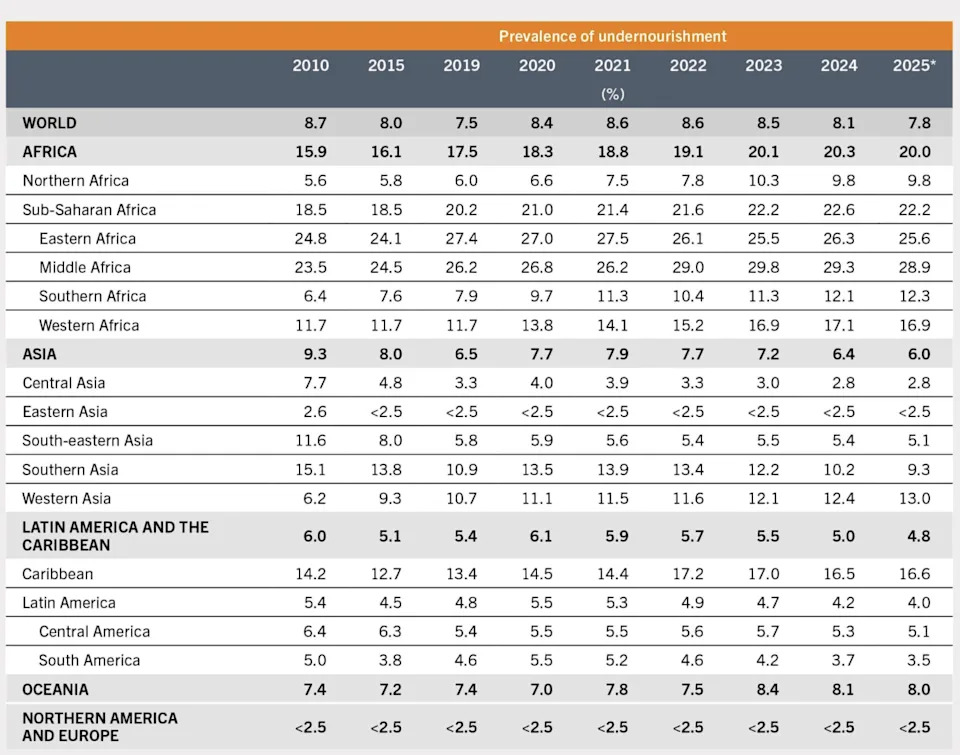
The Food and Agriculture Organization's (FAO) 2026 report, The State of Food Security and Nutrition in the World, finds that global undernourishment declined for a third consecutive year, falling to 7.8% of the world’s population in 2025.
Key Findings
The FAO estimates that 645 million people were undernourished in 2025, down from higher rates in 2023 and 2024 (8.5% and 8.1%, respectively). The 2025 level remains above the pre-pandemic low of 7.2% recorded in 2017.
The report highlights stark regional differences: fewer than 2.5% of people in the United States, Canada, Eastern Asia and Europe are undernourished, so most of the global burden is concentrated in developing countries across Africa, Latin America and much of Asia.
FAO
Main Drivers
Armed conflict and violence are identified as the primary drivers of acute food insecurity in 12 of the 13 hunger hotspots jointly identified by the FAO and the World Food Programme, underscoring the strong link between instability and hunger.
Long-Term Progress and Remaining Challenges
The decline to 7.8% represents a marked improvement since 1970, when nearly 35% of people in developing countries were undernourished. Despite this progress, the FAO projects that hunger will fall by roughly 20% over the remainder of this decade, leaving an estimated 510 million people undernourished by 2030.
Those projections indicate the world is not on course to meet the United Nations' Sustainable Development Goal of achieving zero hunger by 2030 without accelerated action.
Implications
While the downward trend is encouraging, the concentration of hunger in conflict-affected and low-income regions, combined with the large absolute number of people still facing hunger, means policymakers, humanitarian actors and donors must sustain and increase efforts to address the root causes: conflict resolution, social protection, resilient food systems and targeted nutrition programs.
Source: FAO, The State of Food Security and Nutrition in the World 2026.
Help us improve.