The Nancy Grace Roman Space Telescope, launching Aug. 30, 2026, could detect tidal disruption events — stars being torn apart by supermassive black holes — back to 'cosmic noon' (about 11–12 billion years ago). Roman's High-Latitude Time-Domain Survey will repeatedly image a wide field (roughly 90 full moons), enabling discovery of faint, distant transients and improved counts of TDEs versus redshift. Those counts can help distinguish between 'light seed' and 'heavy seed' formation models for early supermassive black holes.
Roman Space Telescope Could Spot Black Holes Tearing Stars Apart Back to Cosmic Noon
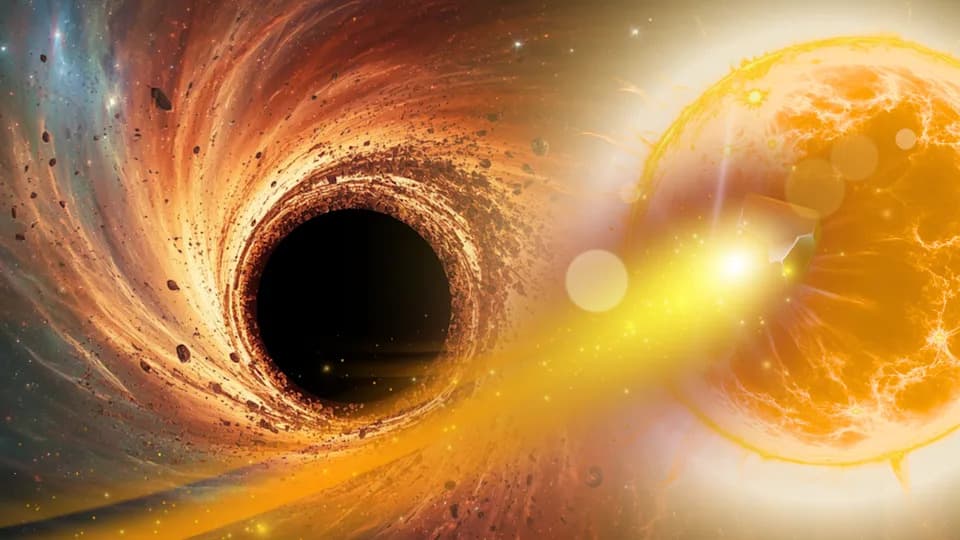
An illustration shows a black hole ripping apart and devouring a star in a tidal disruption event (TDE). | Credit: Robert Lea (created with Canva)
The Nancy Grace Roman Space Telescope (Roman), scheduled to launch on Aug. 30, 2026, may dramatically expand astronomers' ability to find and study tidal disruption events (TDEs) — the violent episodes when a star is torn apart by a supermassive black hole. New analysis suggests Roman could detect such events back to the universe's 'cosmic noon' about 11–12 billion years ago, shedding light on how early supermassive black holes grew so rapidly.
How TDEs Reveal Otherwise Hidden Black Holes
Tidal disruption events occur when a star wanders too close to a supermassive black hole. Extreme gravity stretches and compresses the star in a process often described as 'spaghettification,' creating hot streams of plasma that form an accretion disk and produce a bright flare. Because the event horizon conceals black holes unless they are actively accreting, TDEs provide one of the clearest opportunities to observe otherwise quiet or low-mass supermassive black holes.
Which Black Holes Produce Bright TDEs?
TDEs are most luminous and observable around black holes with masses roughly between 100,000 and 100 million times the mass of the Sun. Extremely massive black holes (above ~1 billion solar masses) tend to swallow stars whole without a bright disruption, while smaller black holes can produce dramatic flares that outshine their host galaxies for months. This makes TDE counts a useful probe of the population of lower-mass supermassive black holes across cosmic time.
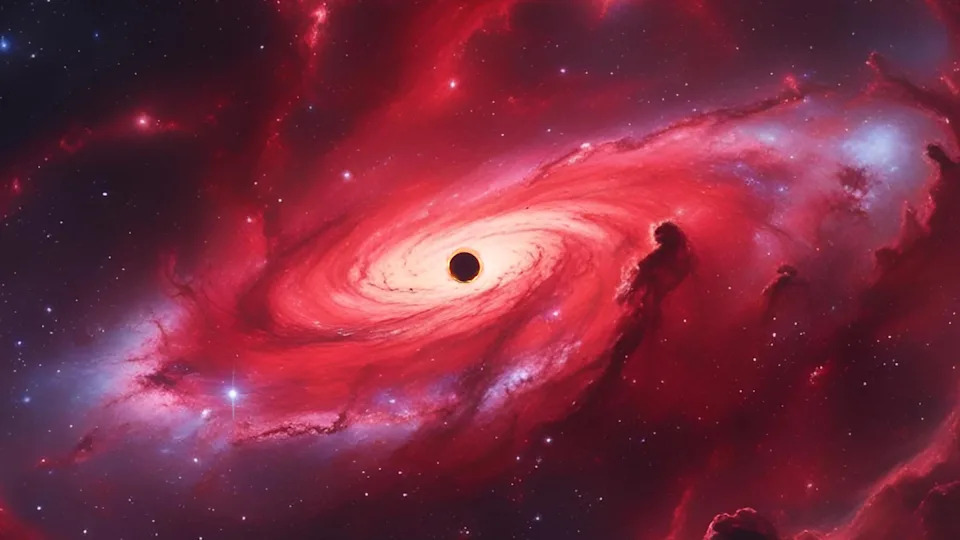
An illustration shows a direct collapse black hole forming at the heart of an ancient galaxy. | Credit: Robert Lea (created with Canva)
Roman, Rubin, and the Hunt for High-Redshift TDEs
Roman's High-Latitude Time-Domain Survey will repeatedly image a sky area equivalent to about 90 full moons. Its combination of wide area, cadence, and sensitivity should let astronomers discover faint, distant transients — including TDEs — at much earlier cosmic epochs than current wide-field surveys typically reach. Complementary facilities such as the Vera C. Rubin Observatory are expected to detect thousands to tens of thousands of TDEs per year, with hundreds potentially tracing back to cosmic noon.
Why This Matters For Black Hole Formation Theories
Observations from the James Webb Space Telescope (JWST) have revealed evidence for supermassive black holes when the universe was less than a billion years old, intensifying the debate over how such massive objects formed so fast. Two leading hypotheses exist:
- Light Seed Model: Black holes begin as remnants of massive stars (hundreds of solar masses) and grow rapidly through accretion and mergers. If this is common, many young galaxies should host million-solar-mass black holes early on.
- Heavy Seed Model: Massive black holes form directly from the collapse of large primordial gas clouds, producing rarer but much heavier initial seeds that enable fast early growth.
Because TDEs preferentially occur around lower-mass supermassive black holes, counting their frequency as a function of redshift provides a practical way to discriminate between these scenarios. If Roman finds many TDEs at cosmic noon, that would favor a plentiful population of lighter seeds; if TDEs are rare, heavy seeds would be more likely.
The team's study was published on July 14 in The Astrophysical Journal.
Help us improve.