Sperm whales off Dominica alter their vocal patterns when ships are nearby: they shorten the gaps between clicks and increase certain vowel-like sounds, making those sounds harder to distinguish. Project CETI analyzed over 1,000 codas from acoustic tags on 15 whales across four years and found that rhythm and click timing are the strongest indicators of vessel presence. The findings suggest shipping noise is reshaping whale communication and could have conservation implications.
Sperm Whales Alter Vocal Patterns Near Ships — Shorter Clicks and Shifted 'Vowel' Sounds
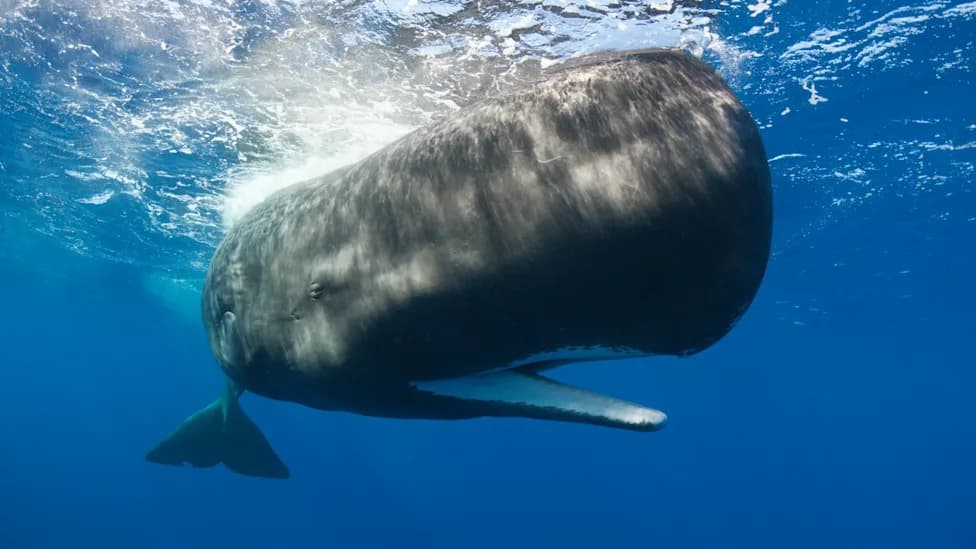
An adult sperm whale swimming in the Caribbean Sea near Dominica.
Sperm whales (Physeter macrocephalus) change the way they communicate when ships pass nearby. Researchers reporting in Ecological Informatics found that whales compress the timing between clicks and shift how they produce vowel-like sounds — a response likely driven by increased noise from vessels.
Over six years, Project CETI (Cetacean Translation Initiative) has recorded sperm whale vocalizations off Dominica in the Eastern Caribbean. Using acoustic tags, robotics, and machine-learning tools, the team has worked to identify the basic units of sperm whale communication and to build models that link vocal patterns to behavior.
The new study analyzed more than 1,000 codas — the structured sequences of clicks whales use to communicate — recorded from 15 individual whales across a four-year span. The researchers also tracked two categories of vowel-like signals, labeled A-vowels and I-vowels.
When vessels were present, codas became notably compressed: the interclick interval (the spacing between successive clicks) shortened significantly. At the same time, whales increased the use of certain vowel-like elements (particularly A-vowels), and those sounds grew harder to distinguish in recordings.
"One key thing is they're going to be really close together. We call it the interclick interval. So the spacing between each click becomes really compressed," said David Gruber, Project CETI founder and CEO and a National Geographic Explorer. "And then they will increase their use of a certain vowel. So they'll be using more of the encoded vowels. They become harder for us to distinguish, and they kind of look like spaghetti."
The team compares this behavior to how people change speech in noisy bars or nightclubs: conversations become simpler, more repetitive and focused on immediate needs rather than long, nuanced exchanges. The researchers also showed that coda rhythm and click timing are strong predictors that a vessel is nearby — meaning the whales' vocal changes can be used to detect shipping activity.
Project CETI's linguistics lead, Gašper Beguš (University of California, Berkeley), added: "This study is the first to show that whales shift how they use these vowels in response to their environment when shipping noise is present. This may be a glimpse that the complex features of sperm whale codas potentially convey information about what's happening in the world around them."
Noise from shipping already affects other species: long-finned pilot whales in the Strait of Gibraltar are forced to use the upper limits of their vocal range — essentially "shouting" over traffic — while humpback mothers and calves may dive deeper to avoid boat noise, increasing risk. Although Dominica is not currently a major shipping corridor, global shipping has grown roughly 300% over the past 30 years, increasing acoustic disturbance worldwide.
With more acoustic monitoring and improved translation of whale vocalizations, the Project CETI team aims to advance scientific understanding and inform conservation policy. As Gruber put it, the researchers liken themselves to "baby whales" learning an alphabet of sounds; each advance brings them closer to understanding more complex aspects of sperm whale communication.
Implications: Changes in coda timing and vowel usage likely reflect how human-made noise alters marine communication and could indicate stress or behavioral disruption. Understanding these shifts can help guide measures to reduce acoustic impacts on whales.
Help us improve.