
Researchers find that curl originates inside the follicle: follicle shape — not post-growth treatments — largely determines whether hair emerges straight or curly. Cellular asymmetry in bent follicles produces uneven keratin distribution, creating curls. A 2019 review supports follicle shape as the main factor, and 2023 manikin tests suggest tight curls may better shield the scalp from solar heat. Many details and evolutionary explanations remain under investigation.
Scientists Explain Why Some Hair Is Curly — The Answer Lies Beneath the Skin
(Angela Weiss/AFP/Getty Images)
If you’re frustrated with poker-straight strands or uncontrollable ringlets, the explanation is rarely your shampoo or the weather. The roots of curl begin beneath the skin, in the tiny follicles that cover the scalp.
YouTube Thumbnail
How Follicle Shape Creates Curl
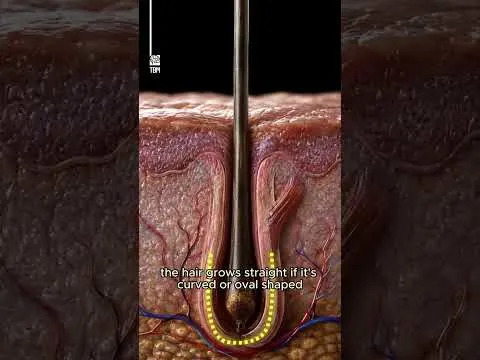
Every hair shaft is formed inside a follicle under the skin and then grows out through a pore. When a follicle sits upright, the hair that emerges tends to be straight. But when a follicle is curved — often likened to a bent golf club — the hair already has a built-in curve as it forms.
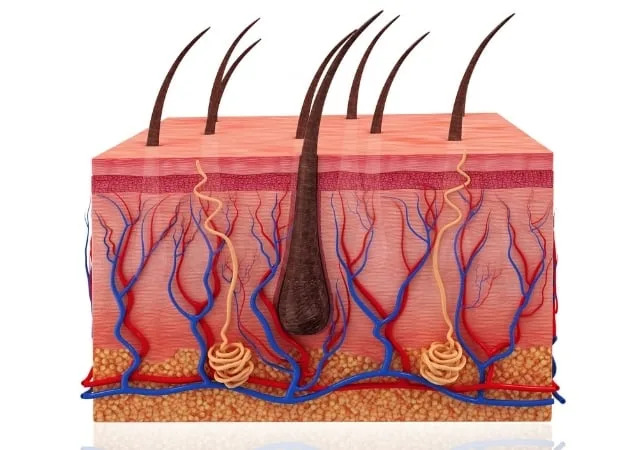
Illustration of hair follicles emerging from human skin. (Science Photo Library/Canva)
Recent evidence indicates that cells on one side of that curved "mould" divide and mature differently from cells on the other side. This uneven cellular behaviour leads to an asymmetric distribution of keratin and other proteins around the hair shaft, producing a strand that kinks or curls in a preferred direction. By contrast, follicles that produce straight hair are generally more symmetrical.

Subscribe to ScienceAlert's free fact-checked newsletter
What the Research Shows
Dissections of human scalp follicles in 2005 showed that curl patterns are established before the hair exits the scalp, suggesting the follicle bulb programs curl versus straightness. A 2019 review of the literature reinforced this view: while the internal make-up of a hair fibre can affect its coarseness and texture, the follicle’s shape is the primary determinant of whether a hair emerges coiled, kinked, or straight.
Once a hair leaves the scalp it is essentially a dead keratin structure — a biological rope whose form is fixed by its development inside the follicle.
Evolutionary Function: Thermoregulation?
Why different follicle shapes evolved is still an open question. New experiments published in 2023 used a thermal manikin fitted with different human-hair wigs in a climate-controlled chamber. The researchers found that any wig reduced heat absorption compared with a bald head, and tightly curled hair performed best at protecting the scalp from simulated solar radiation coming from above. These findings support, but do not conclusively prove, the idea that scalp hair shape may have adaptive value for temperature regulation.
Other Important Points
Follicle architecture is inherited, which is why hair type often runs in families. Although people sometimes classify hair types by racial categories, the scientific evidence shows that all populations exhibit a range of hair shapes; some curl patterns are simply more common in certain genetic lineages. Many details of curly-hair biology remain unresolved, and researchers continue to explore the developmental and evolutionary origins of hair diversity.
Fact-checked and edited: this summary synthesizes findings from key studies (2005 follicle dissections, a 2019 literature review, and 2023 thermal experiments) and emphasizes cautious interpretation of evolutionary explanations.
Help us improve.





















