
Hkeeli ya Jnoub at Beit Beirut gathers photographs, videos and reconstructed rooms to preserve memories of southern Lebanon after successive Israel–Hezbollah clashes. The exhibition’s centerpiece, "Keys Without Homes," shows southerners who have held on to keys from houses that no longer stand. Through intimate installations and personal testimony, artists such as Adeeb Farhat, Sama Beydoun and Rawan Mazeh explore loss, memory and the barriers to returning home.
Beit Beirut’s “Keys Without Homes” Evokes Loss and Memory of Southern Lebanon
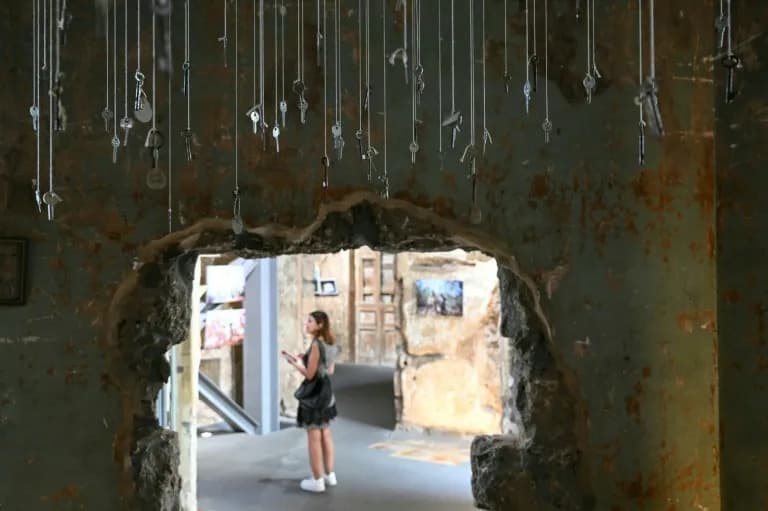
An installation featuring keys from destroyed houses in south Lebanon forms part of an ongoing exhibition at a Beirut museum (JOSEPH EID)
Tears streamed down Fatima Hajj Ali’s face as she stared at dozens of keys suspended like wind chimes from the ceiling of Beit Beirut — each one meant to represent a home, including her own, destroyed in repeated strikes. The installation is part of Hkeeli ya Jnoub ("Tell Me, O South"), a new exhibition that seeks to preserve the memory of southern Lebanon amid ongoing violence and displacement.
Context: Conflict and Displacement
Thousands of people from southern Lebanon have lost their homes in a series of clashes between Israel and Hezbollah that began in 2023, with a further flare-up in March. Although a memorandum of understanding between the United States and Iran on June 17 eased tensions for a time, intermittent Israeli strikes and widespread demolitions continue to prevent many families from returning.
"We were supposed to go home and open the door with the key, but there is no door anymore," said the 23-year-old Hajj Ali, recalling her house in Nabatieh al-Fawqa. "Half the house collapsed and half remained."
Featured Works
One central project, "Keys Without Homes," presents videos of three southerners who have kept the keys to houses that no longer stand. Artist Adeeb Farhat, 36 and originally from the south, said the idea first took shape during the 2024 conflict when he feared losing his own home. Farhat cited the Palestinian tradition of preserving keys from the Nakba — the 1948 displacement known in Arabic as the "catastrophe" — as a powerful parallel.
The exhibition also reconstructs domestic spaces — a bedroom, living room and kitchen, complete with a glass jug, coffee pot and spice containers — to evoke ordinary daily life in southern Lebanese homes. Photographs of Tyre, archival footage of Nabatieh and notebooks where visitors leave memories further deepen the show’s intimate, documentary feel.
In "What Remains," Paris-based artist Sama Beydoun (29) presented photographs of her grandfather's destroyed house in Bint Jbeil, near the Israeli border, which she last visited in 2025. A technical fault left many of her images blurred; Beydoun said the effect made the pictures feel like a dream, underscoring memory’s fragility.
Rawan Mazeh’s photo essay "Manufacturing Estrangements" revisits detention at Khiam Prison under the South Lebanon Army, an Israeli-aligned militia, during Israel's 22-year occupation that ended in 2000. Mazeh said the exhibition offers "a comfortable place where people could come and feel close to their land."
Conclusion
Hkeeli ya Jnoub combines personal objects, testimony and reconstruction to document what has been lost and to keep alive the everyday textures of life that displacement has interrupted. The show is both an act of remembrance and a quiet protest against the continuing obstacles preventing many families from returning home.
Help us improve.





















