A new PNAS study uses route modelling and elevation data to test which Alpine passes would have been least costly for Hannibal’s force of about 40,000 men, 7,000 horses and 37 war elephants. The results favor the Col de la Traversette (2,948 m / 9,669 ft) as the shortest and most energy-efficient route. Models estimate men would have lost roughly 19% of body-fat reserves on the Traversette, while elephants would have lost about 4%. The analysis strengthens—but does not definitively settle—the debate over Hannibal’s exact route.
Major Clue in Hannibal’s Alps Crossing: Study Favors Traversette Pass
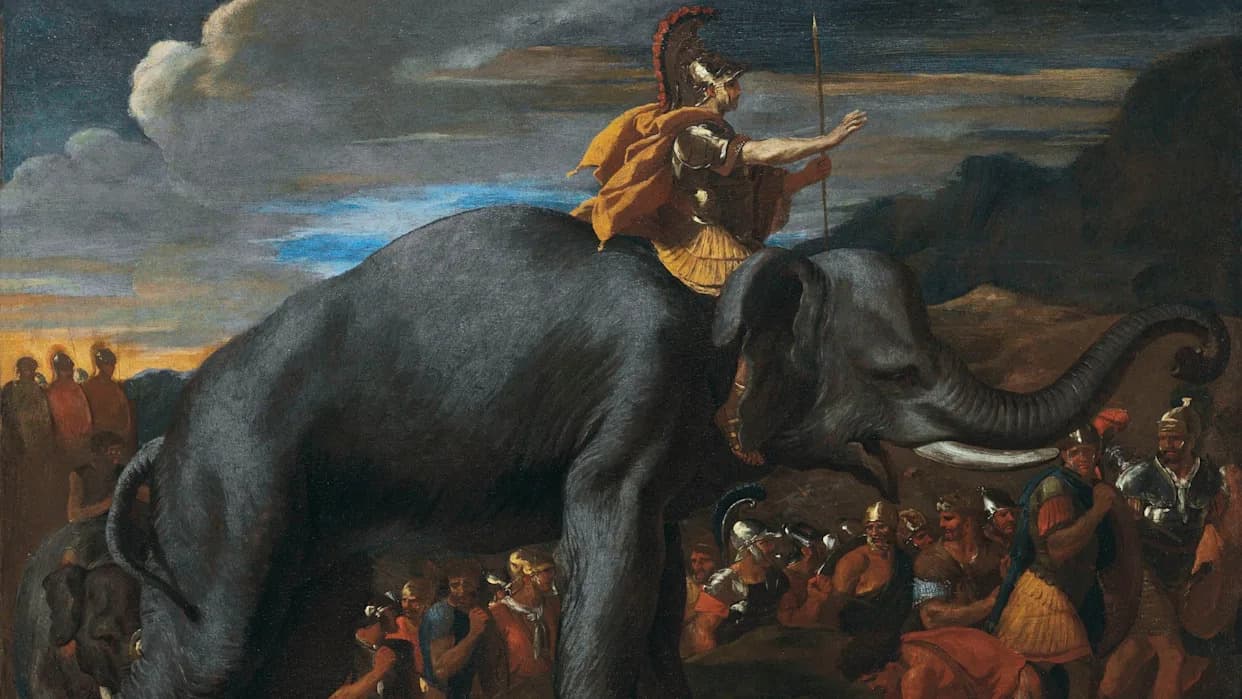
‘Hannibal crossing the Alps on elephants’ circa 1625-1626.
New route-modelling research published in Proceedings of the National Academy of Sciences (PNAS) strengthens the case that Hannibal likely led his army over the Col de la Traversette when he crossed the Alps in 218 BCE. The analysis finds Traversette would have been the shortest and most energy-efficient path for a force of roughly 40,000 men, 7,000 horses and 37 war elephants.
Background
Hannibal, the Carthaginian general, famously marched from what is now southern France into Italy during the Second Punic War to avoid Rome’s naval dominance and fortified coastal approaches. Contemporary accounts of the crossing are limited to two surviving narratives written some decades after the event—most notably Polybius and Livy—and there is no definitive archaeological record. That uncertainty has left historians debating several candidate passes for generations.
What the Study Did
An international team from the University of Oxford, the German Centre for Integrative Biodiversity Research (iDiv) and Friedrich Schiller University Jena used digital elevation data and route-modelling to estimate the energetic cost of alternative Alpine crossings. Their models incorporate empirical measurements of energy expenditure from modern African elephants, scaled for body mass and slope, and apply comparable estimations for humans and horses.
Key Findings
The simulations indicate the Col de la Traversette (2,948 m / 9,669 ft) would have required the least energy overall. Compared with Traversette, the Col de Montgenèvre would have needed about 11% more energy, Col du Clapier about 16% more, and Col du Mont Cenis about 19% more. The authors conclude Traversette is the most energetically favorable of the major candidate routes.
The models also highlight the severe physical toll of the crossing. If Hannibal used Traversette, the marching men would have expended enough energy to deplete roughly 19% of their body-fat reserves—one factor that could help explain the high human casualties later in the campaign. By the end of the Italian campaign Hannibal had lost on the order of 20,000 troops. By contrast, the elephants were estimated to lose only about 4% of their fat reserves, a resilience that likely contributed to the survival of many animals.
Dr. Emilio Berti, a co-author and biologist at iDiv and Friedrich Schiller University Jena, said: "The new analysis does not remove all uncertainty, but it strengthens the case for the Traversette route by demonstrating that it would better accommodate the energetic demands of a large army that included elephants moving through extremely difficult alpine terrain."
Implications and Limits
While the modelling gives a quantifiable reason to prefer Traversette among the major candidates, it cannot definitively prove which pass Hannibal took. The study depends on assumptions about army size, timing, and how modern elephant physiology scales to historical animals, and it must be read alongside the classical sources and archaeological evidence (or the lack of it).
Nonetheless, by combining terrain analysis with biologically informed energy estimates, the study represents a significant step in a long-standing historical puzzle and gives historians a clearer, testable hypothesis about one of antiquity’s most dramatic military feats.
Help us improve.