
NASA's James Webb Space Telescope obtained spectra of the interstellar comet 3I/ATLAS in December 2025 that reveal unusual chemistry. The observations show atypical ratios of carbon-bearing molecules and elevated deuterium compared with solar system comets, supporting an extrasolar origin. Results were published June 22 in Nature, and ongoing observations are helping scientists narrow possible formation scenarios. Public speculation rose after the discovery, but researchers say the data point to natural origins.
JWST Uncovers Chemical Clues to the Origin of Interstellar Comet 3I/ATLAS
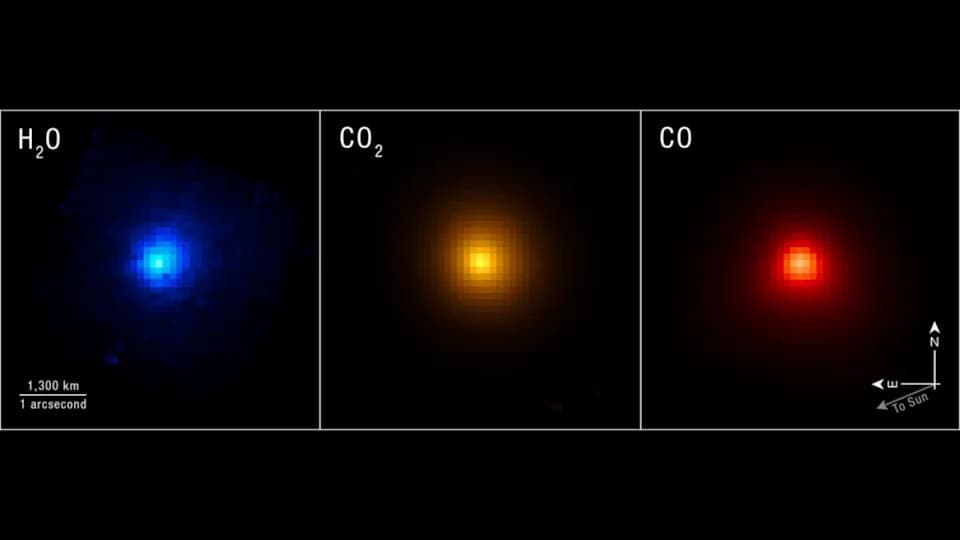
Researchers using JWST are finding clues about comet 3I/ATLAS' origins. | Credit: NASA, ESA, CSA, STScI, Martin Cordiner (CUA, NASA-GSFC); Image Processing: Alyssa Pagan (STScI)
NASA's James Webb Space Telescope is delivering new spectral data that bring astronomers closer to understanding where the interstellar comet 3I/ATLAS came from.
Designated 3I/ATLAS, the comet was discovered on July 1, 2025, by the Asteroid Terrestrial-impact Last Alert System (ATLAS). It captured global attention as only the third confirmed object known to originate beyond our solar system. After a distant and safe flyby of Earth during its passage through the inner solar system, 3I/ATLAS continues on an outbound trajectory that will carry it away from the Sun forever.
Observations with the James Webb Space Telescope taken in December 2025—just as the comet was receding from the Sun—benefited from solar heating that brightened the nucleus and coma, enabling high-quality spectral measurements. From those spectra, researchers calculated relative abundances of several chemical species.
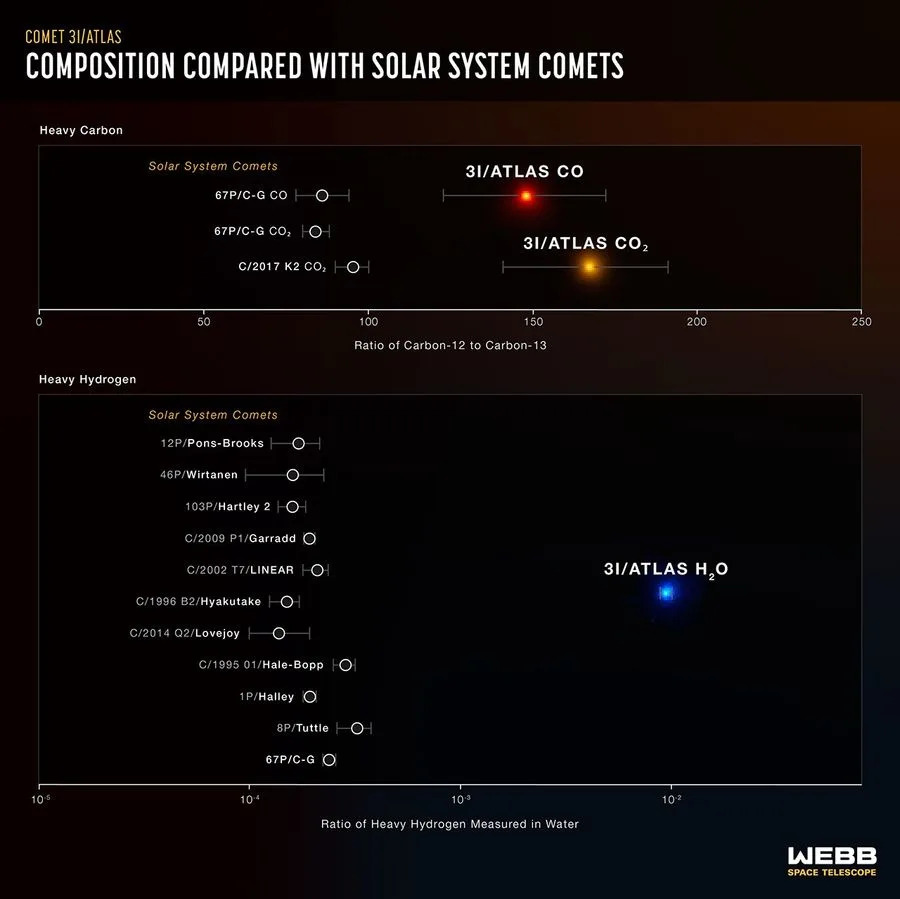
This graph shows some of the differences between 3I/ATLAS and comets found in our own solar system. | Credit: NASA, ESA, CSA, Martin Cordiner (CUA, NASA-GSFC), Leah Hustak (STScI)
The team reports unusual proportions of carbon-bearing molecules alongside elevated levels of heavy hydrogen (deuterium) compared with values typically seen in comets formed in our own solar system. These compositional differences strengthen the evidence that 3I/ATLAS is extrasolar in origin.
The findings were published on June 22 in the journal Nature, where the authors present detailed spectral analysis and discuss formation scenarios consistent with the measured chemistry.
Public Reaction And Scientific Context
Because interstellar visitors are so rare, 3I/ATLAS sparked intense public interest and a wave of speculation—some suggesting exotic explanations such as alien technology, echoing earlier reactions to the interstellar object 'Oumuamua. Scientists caution that the spectral and orbital data are best explained by natural formation processes in another planetary system.
As astronomers combine Webb data with ground-based observations and follow-up studies, the accumulating chemical and dynamical evidence is narrowing the range of plausible origins and formation histories for this unusual comet. Future observations and modeling will continue to refine our picture of where and how such interstellar bodies form.
Bottom line: Webb's spectra provide strong compositional evidence that 3I/ATLAS formed outside our solar system and offer important clues about the chemistry of other planetary systems.
Help us improve.





















