
The Gaza health system has been severely damaged by months of conflict, leaving more than 18,500 patients in need of evacuation for care unavailable in the Strip. Israel’s repeated restrictions on the Rafah crossing and the suspension of WHO-coordinated evacuations have left thousands trapped; Gaza’s health ministry says 6–10 patients die daily while waiting. Families describe treatable conditions — from sight-threatening glaucoma to degenerative neurological disease and developmental regression — that have worsened due to lack of medication, rehabilitation and functioning evacuation routes.
Patients in Gaza Dying While Israel Blocks Medical Evacuations — Families Plead for Rafah to Reopen
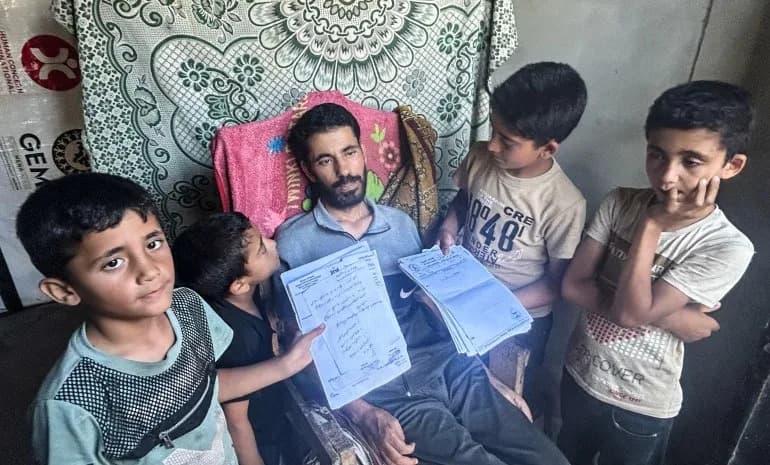
Ismail al-Aqqad with his four children in al-Mawasi, Gaza, displaying his medical papers [Mohamed Solaimane/Al Jazeera]
Khan Younis, Gaza Strip — Fifteen-year-old Rafa al-Qudra had one urgent hope: to be evacuated from Gaza in time to save her eyesight. Before Israeli authorities granted permission, her vision failed completely.
Sitting under an open-sided nylon shelter in the al-Mawasi coastal area of southern Khan Younis, Rafa pressed her hands over her eyes — sometimes to shield the light that now sears them, sometimes to hide her tears. Her father, Rafat, 57, said her sight had been manageable before the war with glasses and routine check-ups. Since October 2023, months of displacement, malnutrition, dust and the collapse of specialist care have worsened her condition.
Critical Need Outstrips Available Care
In recent months Rafa’s intraocular pressure rose to dangerous levels — about 50 mmHg in her right eye and 35 mmHg in her left (normal: 12–20 mmHg) — causing severe pain. She has undergone multiple laser procedures, surgery and lens removal. The medication normally used to reduce her eye pressure had expired because no replacement was available in Gaza. Then everything went black.
Rafa is one of more than 18,500 patients the World Health Organization says require medical evacuation from Gaza for treatments not available inside the Strip. Decades of fragility in Gaza’s health system were compounded by sustained bombardment and infrastructure damage after October 2023, pushing services to the brink.
Crossing Closures and Suspended Evacuations
The October ceasefire called for the resumption of medical evacuations from Gaza, but that provision was undermined when Israel kept the Rafah crossing largely closed. After a period of limited movement, Israel closed Rafah again on February 28, 2024, and medical evacuations have been suspended since. In April, the WHO temporarily halted its coordination of some evacuations after a contractor working for the organization in Gaza was killed.
Gaza’s Ministry of Health estimates that six to ten patients die each day while waiting for permission to leave for treatment; roughly 1,200 people have died since Israel took control of the Rafah crossing in May 2024, the ministry says. Before October 2023, the WHO reported that 50–100 patients left Gaza daily for care. Charities such as Save the Children warn that, at the current pace, evacuating everyone in need could take more than a year.
Human Stories: Treatable Conditions Worsen
Five-year-old Fatima Saeed, once making progress with physiotherapy, has regressed since services collapsed. She now suffers convulsions, has lost speech, cannot chew solid food and requires anti-convulsant medication that is unavailable locally. Her mother, Wafaa, says with proper rehabilitation, clean water and nutrition recovery is still possible — but those essentials are missing.
Elsewhere, 40-year-old Ismail al-Aqqad, who had a degenerative neurological disease, deteriorated after he lost access to medication and specialist follow-up when crossings closed. Tests at a Jordanian field hospital showed improvement remained possible with specialist care, but that care has not been accessible.
“This is a death sentence for my brother,” said Khaled, Ismail’s sibling. “His life depends on medication and treatment that only exist outside Gaza.”
Damage to Health Infrastructure
The WHO estimates that approximately 94% of Gaza’s hospitals have been damaged or destroyed in the fighting, leaving thousands without essential care. International organizations have also reported obstacles and delays to humanitarian aid and medical supplies entering the Strip despite ceasefire agreements.
Families and medical workers say thousands of patients with treatable or stabilisable conditions are trapped: needing surgery, specialised medication, rehabilitation or diagnostic services that Gaza cannot provide. With crossings closed and coordination limited, many patients continue to deteriorate while waiting for life-saving permissions to leave.
What Families Are Asking For
Relatives interviewed in al-Mawasi pleaded for the reopening of crossings and for guarantees that medical evacuations will resume without further delay. “If the crossings were open, I would take her anywhere,” Wafaa said of her daughter. “What is happening to my daughter is a sentence of helplessness imposed on a child who did nothing wrong.”
This report draws on interviews with affected families, statements from Gaza’s Ministry of Health, World Health Organization data and humanitarian organisations’ assessments.
Help us improve.





















