NASA's Chandra X‑ray Observatory has delivered the sharpest X‑ray images yet of the jet from M87*, the first black hole imaged in 2019. Located about 55 million light‑years away and weighing roughly 6.5 billion Suns, M87* launches jets that extend thousands of light‑years and travel at near‑light speeds. The new X‑ray data reveal complex, evolving structures — including features with apparent superluminal motion explained by projection effects — improving our understanding of particle acceleration and black‑hole feedback on galaxies.
Chandra Captures Sharpest X‑Ray View of Jet From M87*: Dynamic Structures and Apparent Superluminal Motion
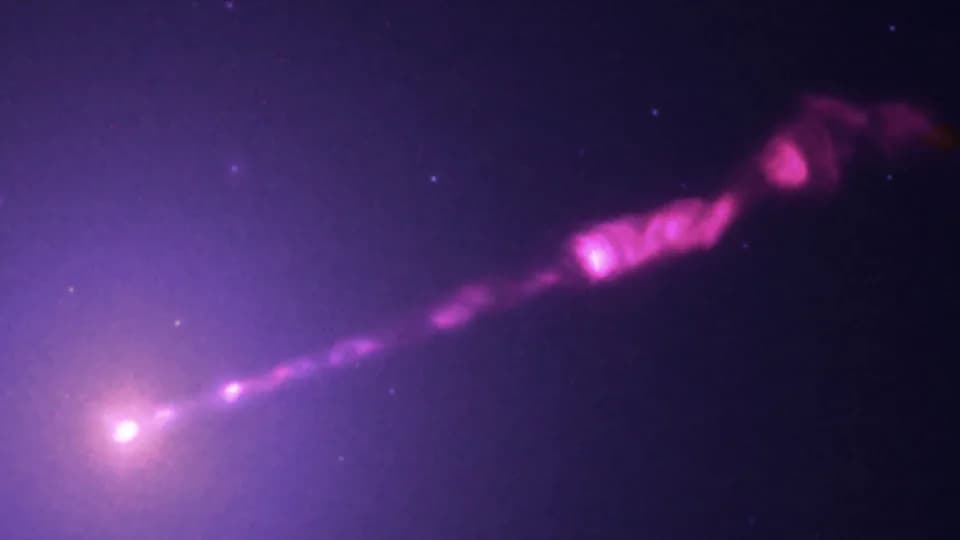
A jet erupts from M87*, the first black hole imaged by humanity. | Credit: X-ray: NASA/CXC/Univ. Laval/C. Poitras et al.; IR: NASA/CSA/STScI; Radio:NSF/NRAO/VLA; Optical: NASA/ESA/STScI; Image Processing: NASA/CXC/SAO/L. Frattare
Astronomers using NASA's Chandra X‑ray Observatory have produced the most detailed X‑ray images yet of the jet erupting from the supermassive black hole at the center of the galaxy Messier 87 (M87). These new observations reveal intricate, rapidly evolving structures and features that appear to move faster than light — an effect explained by projection.
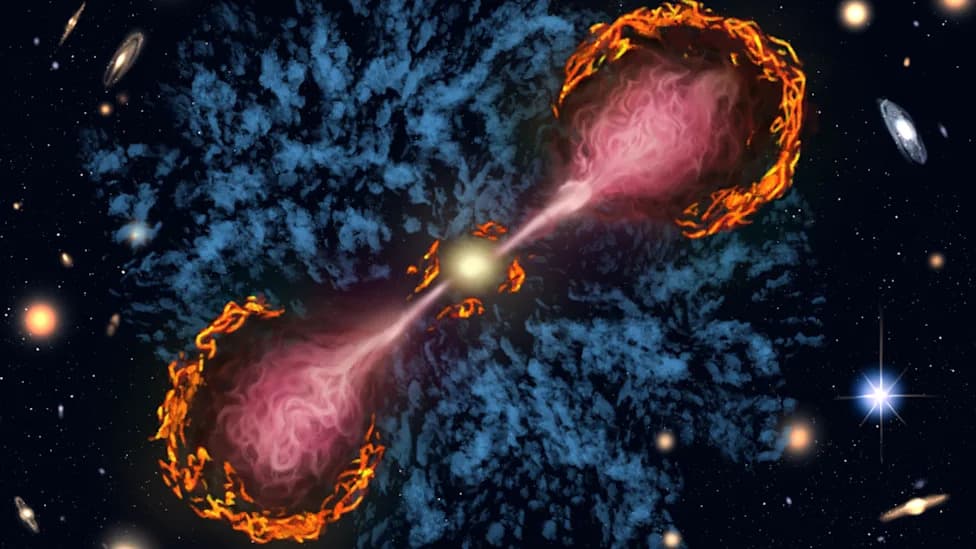
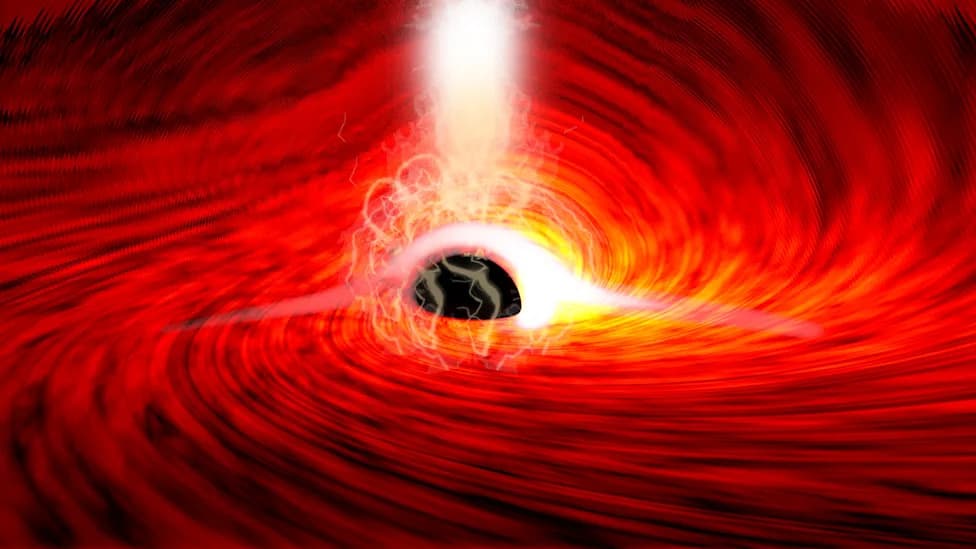
M87* lies roughly 55 million light‑years from Earth and has a mass of about 6.5 billion times that of the Sun. As gas and dust fall toward the black hole, some material is funneled along magnetic field lines toward the poles and launched as powerful, collimated jets that extend for thousands of light‑years and travel at speeds close to the speed of light.
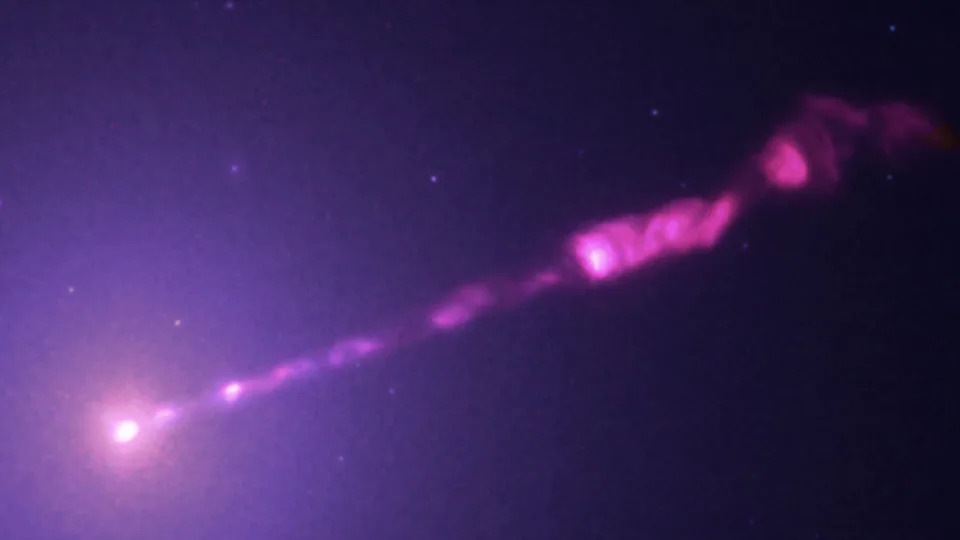
A jet erupts from M87* the first black hole imaged by humanity. | Credit: X-ray: NASA/CXC/Univ. Laval/C. Poitras et al.; IR: NASA/CSA/STScI; Radio:NSF/NRAO/VLA; Optical: NASA/ESA/STScI; Image Processing: NASA/CXC/SAO/L. Frattare
Previous images of M87*'s jets were taken at optical and infrared wavelengths; the new Chandra data provide our clearest X‑ray view to date. The X‑ray observations reveal a far more complex and dynamic flow of high‑energy particles than earlier X‑ray studies showed, allowing researchers to separate structures that formerly appeared blended together.
Camille Poitras, a Ph.D. student at Laval University and lead author of the study, said in a statement: We could already see changes in the jet, but never with this level of detail in X‑rays. Structures that previously appeared blended together can now be distinguished, allowing us to better follow the jet's evolution over more than a decade of observations.
Some features in the jet show apparent speeds up to about five times the speed of light. This superluminal motion does not violate physics: it is a projection effect that occurs when material traveling very near the speed of light moves almost directly toward Earth, creating the illusion of faster‑than‑light motion.
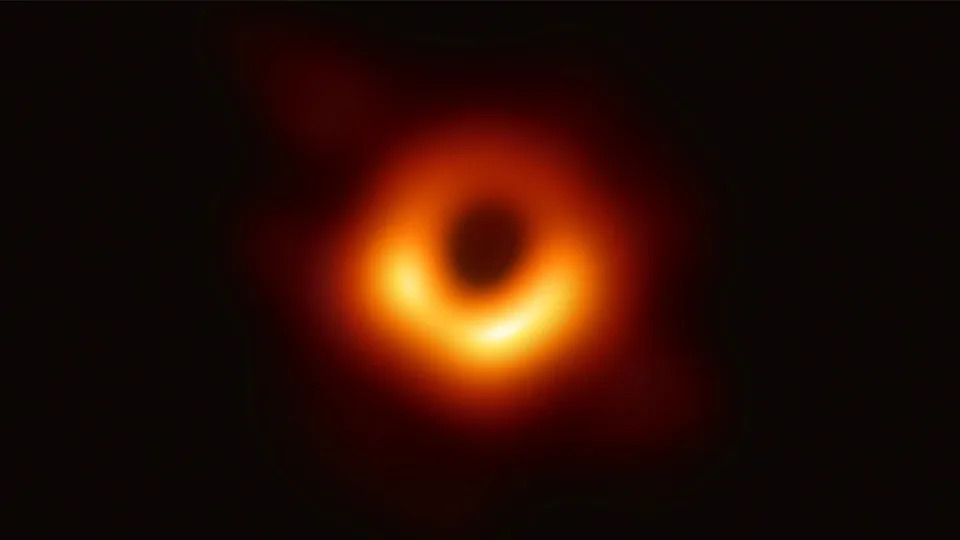
The Event Horizon Telescope captured this image of the supermassive black hole in the center of the galaxy M87 and its shadow. | Credit: EHT Collaboration
Why This Matters
The Chandra results represent a major advance in understanding jet physics. By resolving fine structures and tracking changes over more than a decade, astronomers can better study how particles are accelerated to extreme energies and how jets transport and deposit energy into their host galaxy. Such feedback from supermassive black holes plays a key role in galaxy evolution.
Gerrit Schellenberger, an astrophysicist at the Center for Astrophysics | Harvard & Smithsonian, noted that these results demonstrate how uniquely powerful Chandra remains for tracking the evolution of extreme phenomena over long timescales. They help us better understand how energy released near a supermassive black hole is carried through its jet and deposited into the surrounding galaxy.
The team's research was presented at the 248th meeting of the American Astronomical Society, and the study is also available as a preprint on arXiv.
Help us improve.