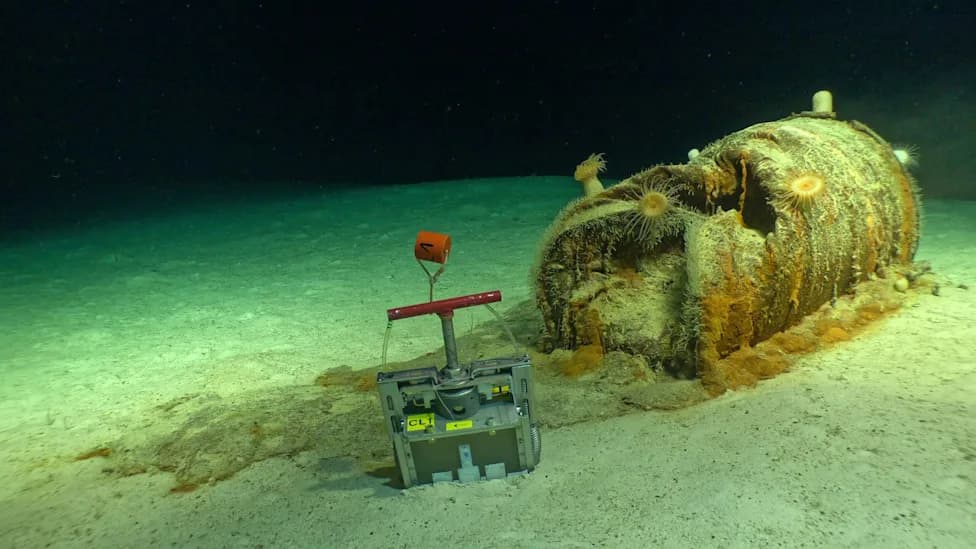
Scientists examined a deep Pacific ferromanganese crust and found plutonium-244 but no accompanying curium-247, indicating the heavy element likely originated in a rare r-process explosion more than 100 million years ago. Because curium decays faster than plutonium, its absence implies an ancient source; iron-60 traces in other layers represent separate, more recent supernovae. The team favors a distant kilonova (neutron-star merger) as a leading candidate, and Earth is still passing through the debris field from that ancient event.
Ancient Radioactive Stardust: Plutonium-244 From a Distant Cosmic Blast Still Reaches Earth
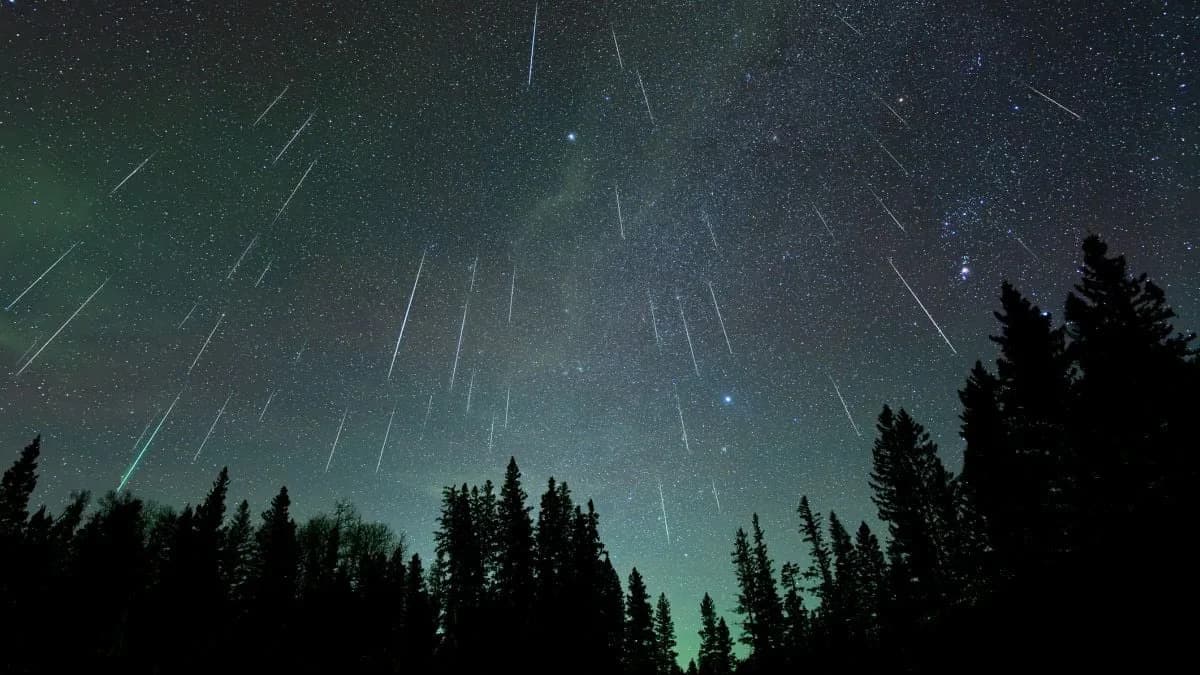
(Craig Taylor/iStock/Getty Images Plus)
A faint sprinkling of radioactive plutonium preserved in deep-ocean ferromanganese crust appears to originate from a rare cosmic explosion more than 100 million years ago — and fragments of that event are still arriving at Earth today as interstellar stardust.
YouTube Thumbnail
Led by physicist Dominik Koll of Helmholtz-Zentrum Dresden-Rossendorf in Germany, an international team searched layers of a ferromanganese crust dredged from 4,830 meters beneath the Pacific in 1976 for several telltale radioisotopes. Their work, published in Nature Astronomy, finds a plutonium-244 signal but no convincing traces of curium-247 in the same layers, a contrast that constrains the age of the source.
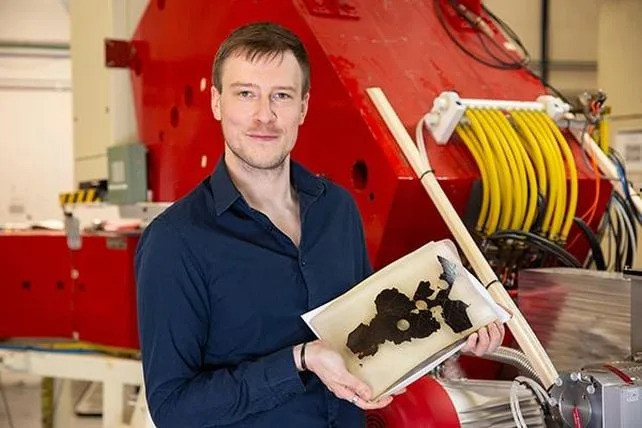
Dominik Koll with part of the crust sample. (ANSTO)
How Radioisotopes Date Cosmic Debris
The isotopes at the center of the study each have different half-lives that act like clocks. Plutonium-244 has a half-life of roughly 81 million years, while curium-247 decays much faster (about 16 million years). Iron-60, another isotope the team measured, has a half-life of only 2.6 million years and is a known marker of conventional nearby supernovae.
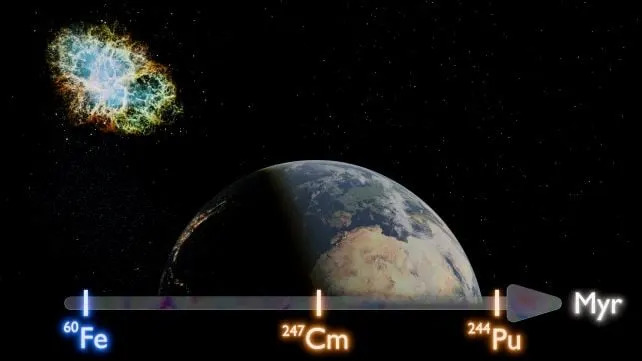
A diagram illustrating the half-life timelines of the isotopes in the study. (B. Schröder/HZDR/NASA, ESA, J. Hester, A. Loll/ASU)
Because primordial plutonium incorporated into the Solar System would have decayed away long ago, any detectable Pu-244 on Earth must be extrasolar. Previous work had interpreted a Pu-244 signal in the same crust as evidence for an event about 3.5 million years ago. Koll and colleagues instead compared multiple isotopic fingerprints: if the Pu-244 deposition were recent, accompanying Cm-247 should still be present. The absence of Cm-247 indicates an older r-process event whose short-lived isotopes have mostly decayed.

Subscribe to ScienceAlert's free fact-checked newsletter
“Our results suggest that the plutonium originated from very rare cosmic explosions, such as those that would occur during the merger of two neutron stars or in extremely energetic supernovae,”
said Anton Wallner of Helmholtz-Zentrum Dresden-Rossendorf. “Since then, it has dispersed throughout the interstellar medium.”
What Likely Produced the Plutonium?
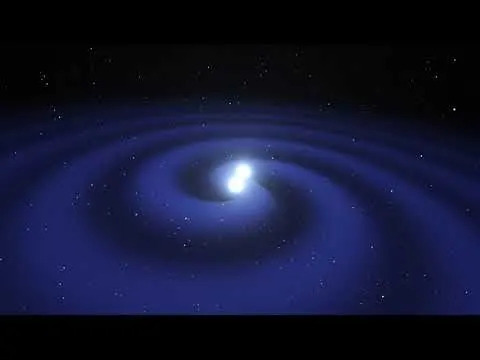
The leading explanation is a rare r-process nucleosynthesis event — the rapid neutron-capture process that builds many of the heaviest elements. One prominent r-process site is a kilonova, the bright explosion that follows the merger of two neutron stars. Such events eject neutron-rich matter into interstellar space and can seed the Galaxy with heavy radioisotopes.
Because Pu-244 decays relatively slowly, some of it can remain detectable long after faster-decaying isotopes from the same event have vanished. As Michael Hotchkis of the Australian Nuclear Science and Technology Organisation notes:
“The absence of the curium radioisotope curium-247, which was also produced in the explosion, tells us it happened a very long time ago. But not more than about 1 billion years ago — otherwise the plutonium-244 would also be undetectable.”
Implications And Open Questions
The new analysis separates the Pu-244 signal from younger iron-60 deposits in the crust that are tied to supernovae roughly 2.5 and 7 million years ago, indicating multiple, distinct influxes of cosmic material over Earth's recent geological history. While the exact source — kilonova versus an especially energetic supernova — cannot be pinned down from these data alone, the isotopic pattern favors an ancient, rare r-process source more than 100 million years old.
Traces such as these give astronomers a way to reconstruct the explosion history of the Milky Way and to map the Solar System’s passage through varying interstellar environments. They may also help clarify how the Galaxy seeded Earth with heavy elements and whether past cosmic events influenced our planet’s environment or life — questions that will require further multidisciplinary study.
Study: Koll et al., published in Nature Astronomy. Sample: ferromanganese crust dredged from 4,830 m in the Pacific Ocean (1976).
Help us improve.