
The authors reanalyzed two independent Type Ia supernova datasets and conclude the universe's expansion remains accelerated, rebutting a 2025 study that claimed acceleration had stopped after applying an "age effect" recalibration. Published in Monthly Notices of the Royal Astronomical Society, the new paper — co-authored by two Nobel laureates — found no evidence that progenitor star ages change calibrated supernova distances enough to remove the need for dark energy. Upcoming data from the Vera Rubin Observatory and the Nancy Grace Roman Space Telescope should provide stronger tests of dark energy models.
New Analysis Confirms Universe's Expansion Is Still Accelerating
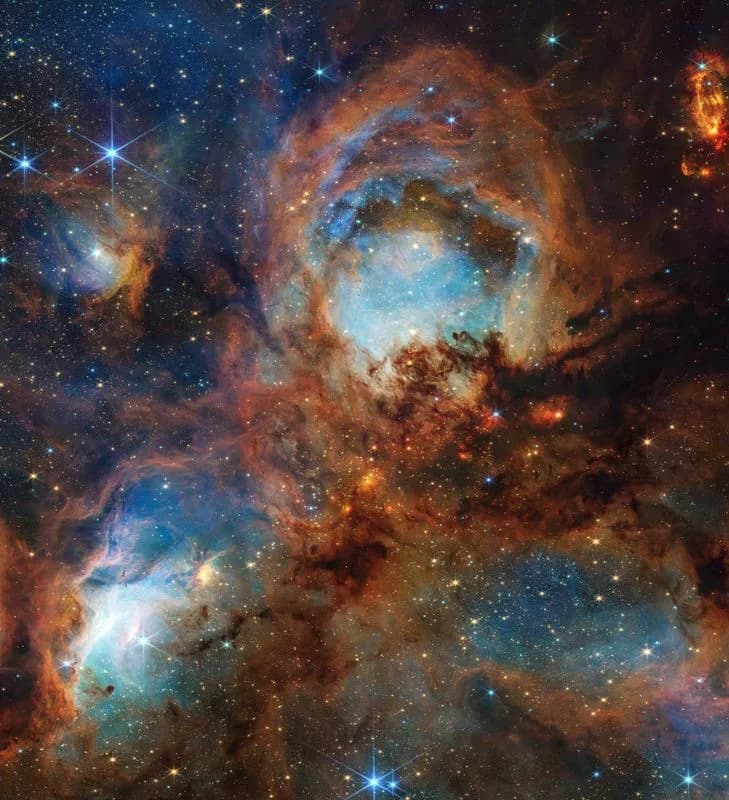
A section of the Cat’s Paw Nebula, a star-forming region composed of gas, dust, and young stars, in this image obtained by the James Webb Space Telescope, and released on July 10, 2025. The Cat’s Paw Nebula is located approximately 4,000 light-years away in the constellation Scorpius. NASA, ESA, CSA, STScI/Handout via REUTERS
A fresh reanalysis of Type Ia supernova data reaffirms the long-standing conclusion that the universe's expansion is accelerating — the discovery that in the late 1990s led scientists to propose an unknown force called dark energy.
Study Finds Continued Acceleration
The study, published this month in Monthly Notices of the Royal Astronomical Society and co-authored by researchers including two Nobel laureates, re-examined two independent datasets of Type Ia supernovae. The authors conclude there is no convincing evidence that cosmic acceleration has ended, directly challenging a 2025 paper that argued the opposite by proposing a recalibration based on the ages of supernova progenitor stars.
What the Team Did
Type Ia supernovae are used as "standardizable candles" because they exhibit similar intrinsic brightness. By comparing their observed luminosity at different distances, astronomers infer how the universe's expansion rate has changed over time. The new paper tested whether an "age effect" — a suggested dependence of supernova brightness on the age of the progenitor stars — significantly alters distance estimates. The team found no robust evidence that this effect changes the overall picture of accelerating expansion when applied to the largest calibrated supernova samples used by the cosmology community.
"The universe is still accelerating," said Brodie Popovic of the University of Southampton, a lead author on the study. "There's still a lot we don't know and are excited to learn, but we think we're on the right track."
Adam Riess of Johns Hopkins University, a co-author and 2011 Nobel laureate, emphasized that Type Ia supernovae provided the first evidence for acceleration in 1998 and that the new analysis found no support for the previously proposed recalibration that would remove the need for dark energy.
Response From The 2025 Team
Young-Wook Lee of Yonsei University, who led the 2025 study, defended his team's conclusions and said the new paper contained "serious methodological flaws or lead to conclusions that are internally inconsistent by their own logic." The scientific debate highlights the importance of methodology and sample selection in precision cosmology.
Implications And Next Steps
While the new analysis reinforces the standard cosmological model in which dark energy drives accelerated expansion, the physical nature of dark energy remains unknown. Observations from new and upcoming facilities — notably the Vera Rubin Observatory in Chile and the Nancy Grace Roman Space Telescope, scheduled for launch in August — should provide much larger, higher-quality supernova samples and other cosmological probes to help constrain dark energy models.
Background: The Big Bang occurred roughly 13.8 billion years ago. Current estimates place ordinary matter at about 5% of the universe's energy budget, dark matter at ~27%, and dark energy at ~68%.
(Reporting by Will Dunham; Editing by Daniel Wallis)
Help us improve.





















