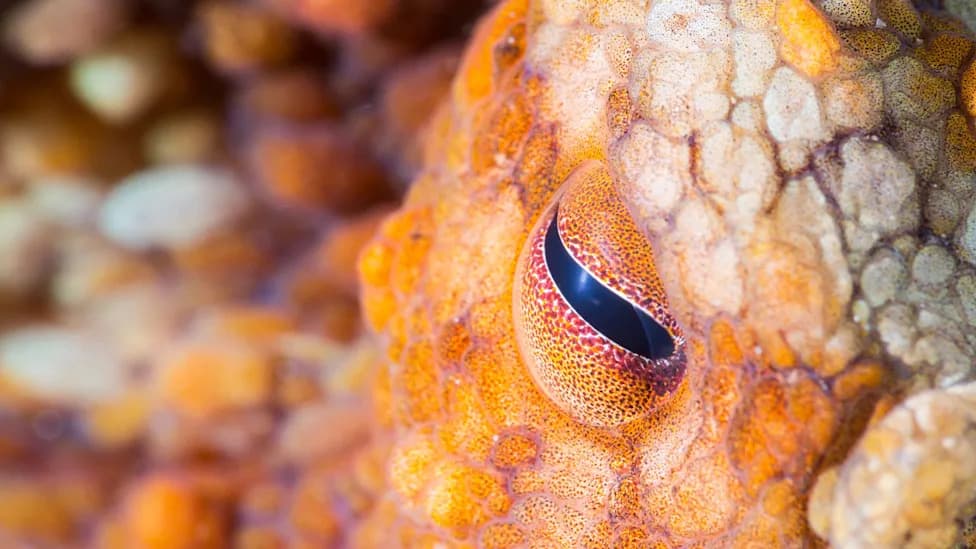
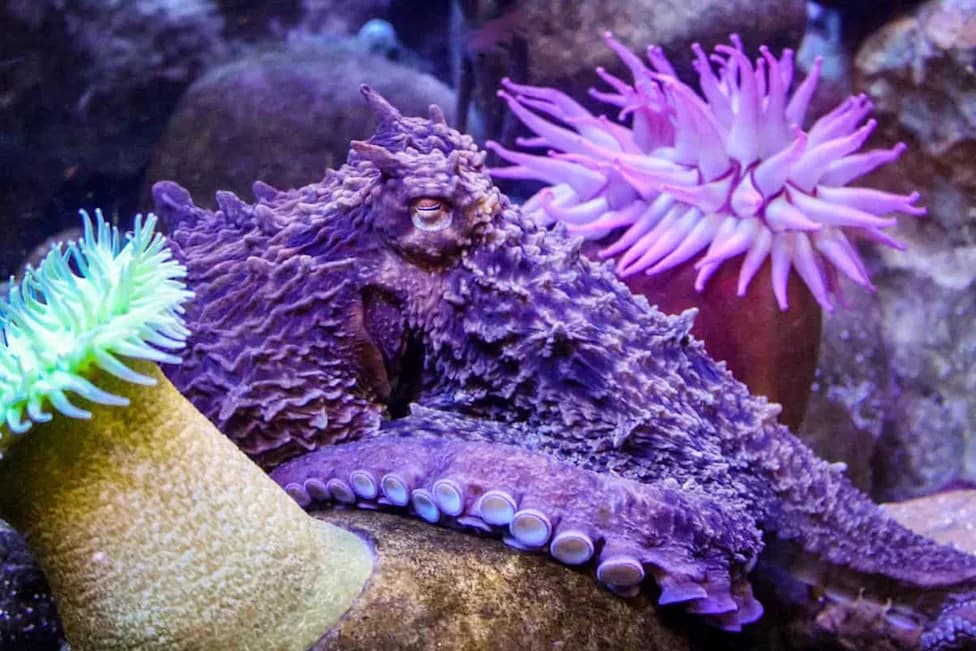
Researchers at Dartmouth College trained three California two-spot octopuses to use mirrors to locate hidden prey, a study published in Current Biology. After about 10–12 training trials each, the octopuses learned to ignore reflected crabs and approach the real prey. When virtual crab images were made visible only via a mirror, the animals chose correctly 73% of the time, and all three succeeded on their first test. The work suggests mirror-mediated perception and raises the possibility that octopuses form internal, map-like spatial representations.
Octopuses Use Mirrors to Locate Hidden Prey — First Such Ability Seen in an Invertebrate
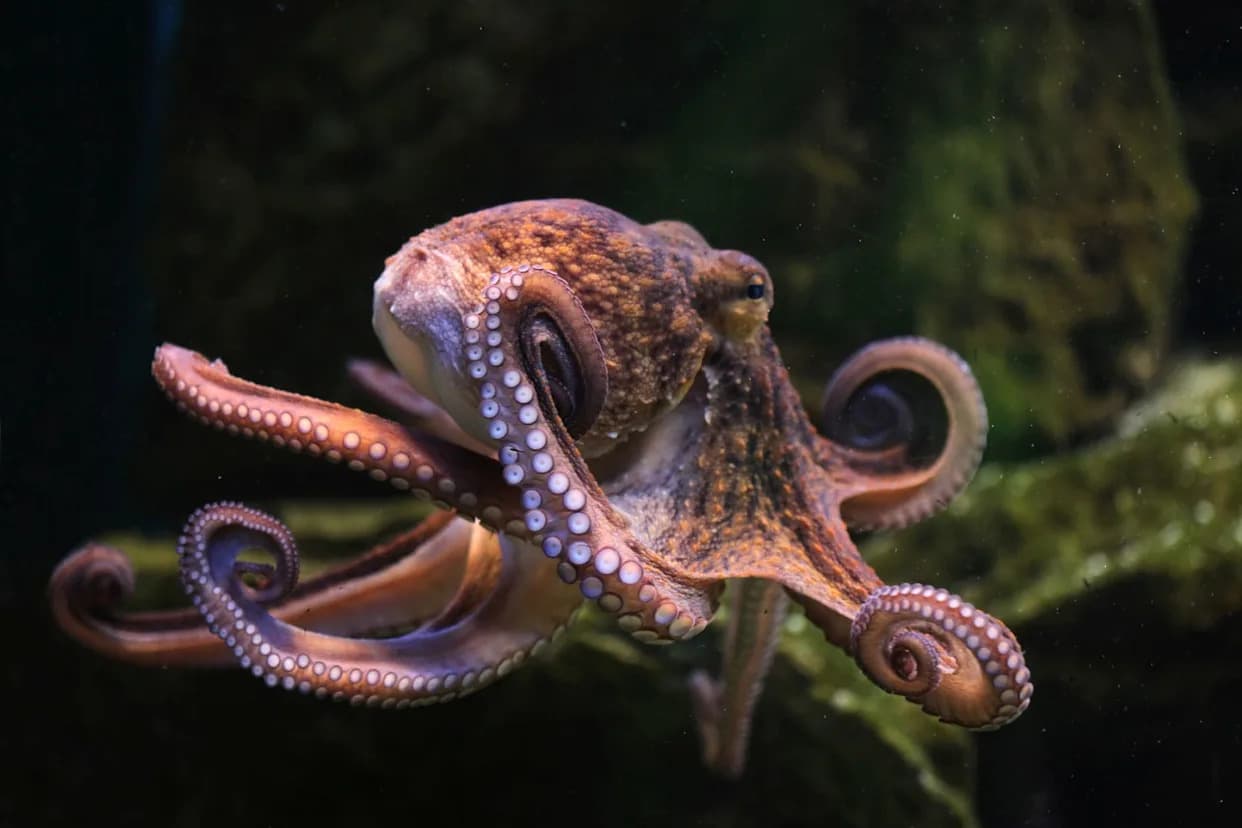
Photo Credit: iStock
Octopuses have shown a surprising new cognitive skill: researchers report that these cephalopods can use mirrors to locate prey they cannot see directly.
Study and Methods
Published in Current Biology, the study conducted at Dartmouth College tested three California two-spot octopuses to see whether they could be trained to use a mirror as an informational tool. Scientists first trained each animal to avoid striking at a reflected crab and instead go to the real prey. Initially, all three octopuses moved toward the mirror image, but after roughly 10–12 training trials each they learned to ignore the reflection and approach the actual crab.
Harder Test: Virtual Prey Visible Only in the Mirror
To rule out simple cues such as smell or touch, the researchers then displayed virtual crab images positioned so they were visible only via the mirror. A correct choice was rewarded with a live crab. Across these tests, the animals chose the correct location 73% of the time—well above chance—and all three octopuses selected correctly on their first formal test trial.
Why This Matters
This behavior is an example of mediated perception: treating a reflection as informative about the world rather than as a meaningless or confusing image. Until now, such mirror-mediated spatial inference had been documented mainly in vertebrates. Because octopuses are evolutionarily distant from vertebrates, these results suggest complex spatial cognition can evolve independently in very different animal lineages when similar ecological challenges arise.
Peter Tse, cognitive neuroscientist and co-author, told Discover Wildlife: "We don't enter the world knowing how to use a mirror but learn how to use a mirror. Octopuses can also learn how to use a mirror to infer where things are in the world."
The findings hint that octopuses might form map-like internal representations of space, a capability useful for predators that must track their position relative to the environment. The authors caution, however, that further work is needed to determine whether the animals solved the task through simple associative learning or by forming deeper, mental spatial representations.
Bottom line: This is the first documented case of mirror-mediated spatial inference in an invertebrate, expanding our understanding of how complex cognition can arise across diverse branches of life.
Help us improve.