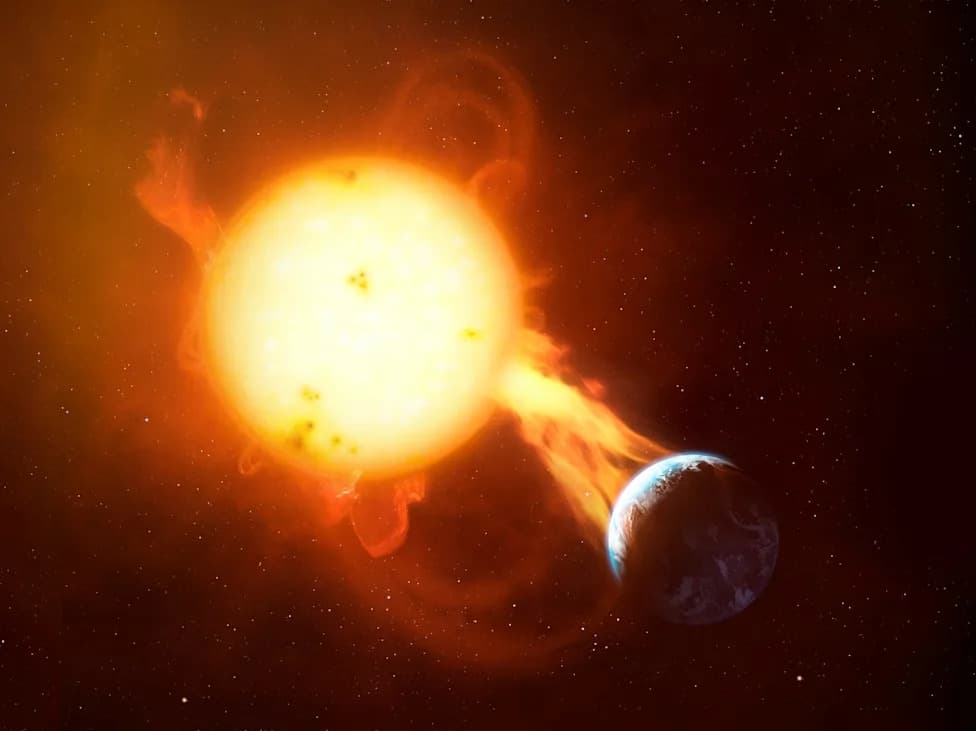
Researchers analyzing nearly five hours of IRIS observations before an X9-class solar flare on Oct. 3, 2024, found that plasma brightness, Doppler flow and non-thermal velocity (turbulence) began rising about three hours before the eruption. Two regular oscillations — every 7–10 minutes and 18–21 minutes — appeared near a magnetic-field boundary, and turbulence surged 15–20 minutes before the flare. While these combined signals are promising as precursor signatures, the result is based on a single event and needs verification across many more flares.
Scientists Identify Hours-Long Warning Signs Before Powerful X9 Solar Flare
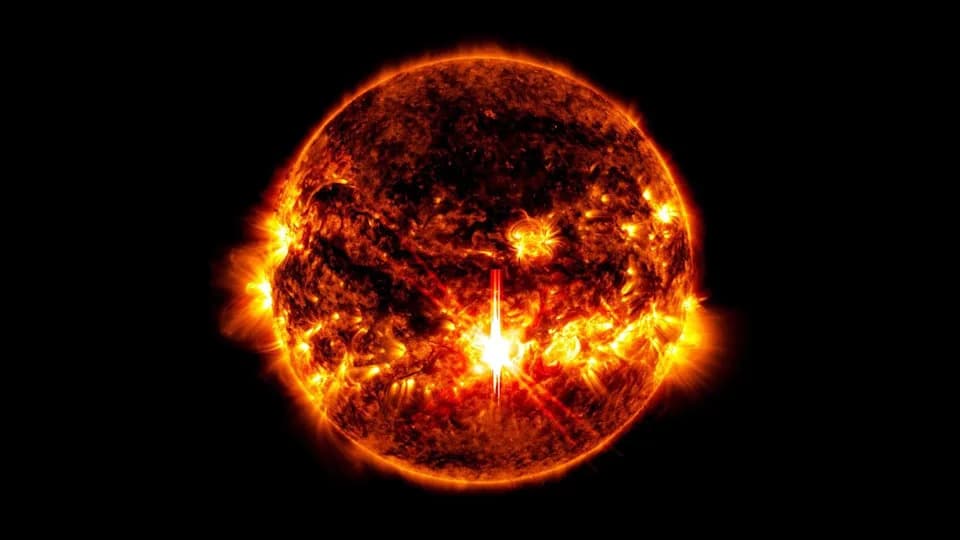
NASA's Solar Dynamics Observatory captured this image of an X9.0 solar flare — as seen in the bright flash in the center — on Oct. 03, 2024. | Credit: NASA/SDO
Researchers have identified a sequence of measurable changes in the sun's atmosphere that began hours before one of the star's most powerful eruptions — an X9-class solar flare that erupted on Oct. 3, 2024. The discovery, based on nearly five hours of uninterrupted observations, offers new clues about how major flares develop and could inform future space-weather forecasting if the pattern proves repeatable.
Louis Seyfritz, a graduate researcher at the New Jersey Institute of Technology and lead author of the study, described the preflare patterns as unexpected and striking: "I was not expecting what I found," he told Space.com.
Rare, High-Resolution Observations
The team took advantage of continuous monitoring by NASA's Interface Region Imaging Spectrograph (IRIS), which happened to be observing the active region that produced the Oct. 3 X9 flare. Because that region had produced several strong flares in preceding days, multiple observatories were already focused on it — allowing IRIS to collect nearly five uninterrupted hours of high-resolution data leading up to the eruption. Such sustained preflare coverage is uncommon and provided a rare window into the buildup to a major event.
What the Scientists Measured
Using the IRIS dataset, researchers tracked three plasma properties in the sun's lower atmosphere: brightness, Doppler motion (flow toward or away from the observer), and non-thermal velocity — a measure of turbulence and small-scale motions. All three properties began a steady increase roughly three hours before the flare, suggesting gradual destabilization of the magnetic field in the active region.
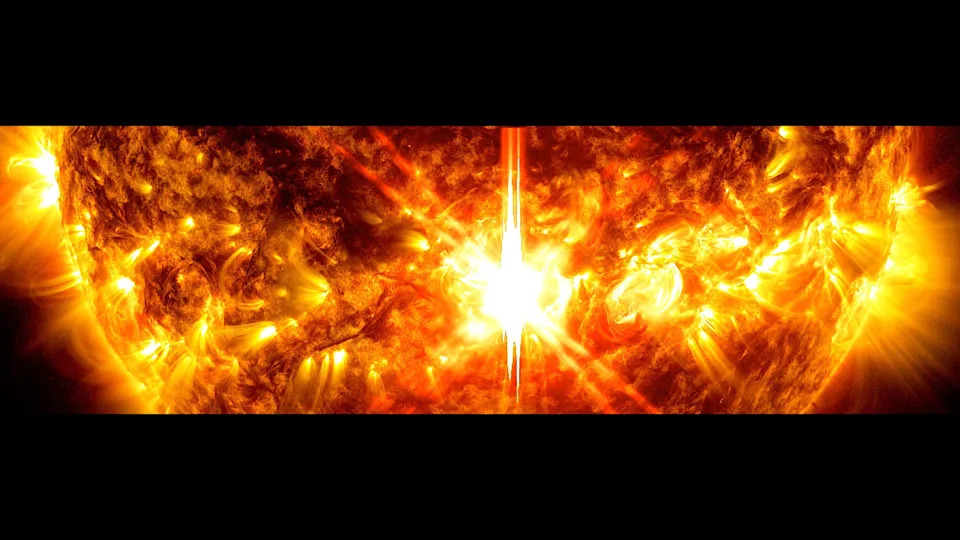
A closer view of the X9 flare. | Credit: NASA/SDO
In addition to the slow rise, the team detected two distinct oscillatory patterns in those properties: one repeating every 7–10 minutes and another every 18–21 minutes. These oscillations were concentrated near a boundary where oppositely directed magnetic fields meet — a location where magnetic stress and reconnection are thought to build before eruptions.
"If we see those oscillations happening before the flare, it can be a strong indicator that a flare is going to happen," Seyfritz said.
Final Minutes Before Eruption
About 15–20 minutes before the flare, the atmosphere shifted into a more volatile state: turbulence surged and plasma began streaming outward. Those rapid changes likely reflect the sudden release of magnetic energy that powers solar flares and may mark the transition from gradual buildup to explosive release.
Implications and Caution
No single metric provided a definitive early warning. Instead, the notable signal was the combination of steadily rising brightness, coordinated oscillations, and increasing turbulence. The authors emphasize that the study covers a single event, so these candidate precursor signatures must be tested on many more flares before they can be integrated into operational space-weather forecasts. The results were published in May in the journal Solar Physics.
Next steps: analyze a larger sample of well-observed flares to see whether the same preflare patterns repeat, and explore whether the oscillations reflect waves, repeated small-scale reconnection, or another process.
Help us improve.