The Curtin University team used microscopic laser sampling and high-precision isotopic dating to match Stonehenge’s Altar Stone to bedrock in Caithness, northeast Scotland. Their results make a Welsh origin less likely and argue against glacial transport to Dogger Bank because of a large chronological gap. Instead, the researchers conclude the stone was intentionally moved by people—likely by a combination of coastal and river travel plus overland hauling—highlighting advanced planning and long-term cooperation among Neolithic communities.
New Study Traces Stonehenge’s Altar Stone to Scotland — Reveals Likely Human-Led Journey
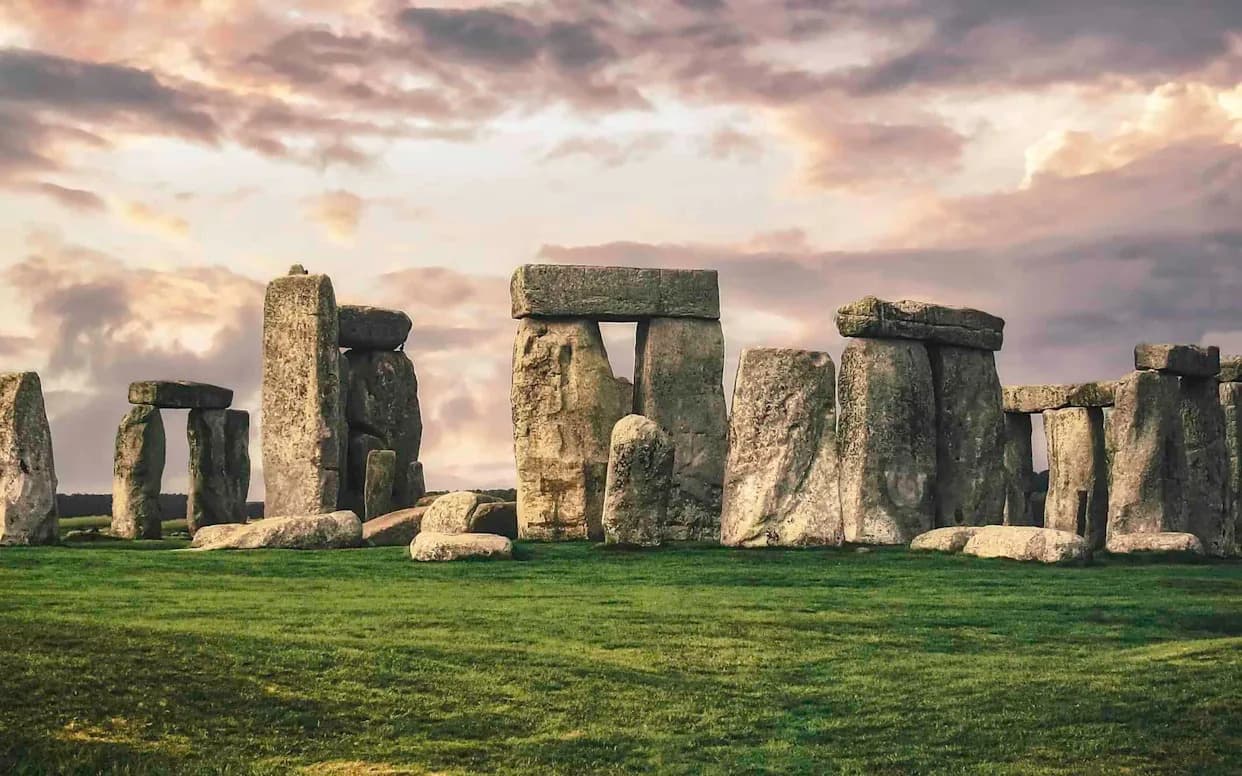
High-tech "DNA" test proves the 6.5-ton Altar Stone was hauled all the way from Scotland. ©Image Credit: Unsplash / K. Mitch Hodge
Researchers at Curtin University in Australia report new geological evidence suggesting Stonehenge’s Altar Stone likely came from northeast Scotland rather than Wales, and that its long journey to the monument was intentionally organized by people rather than delivered by glaciers.
High-Precision Dating Like ‘Rock DNA’
The team used microscopic laser sampling to remove tiny particles from the Altar Stone and then applied high-precision isotopic dating to the mineral crystals. Because different bedrock regions have distinct geological age signatures, this approach can pinpoint a stone’s source much like a DNA test identifies an individual’s origins.
From Caithness to Salisbury Plain
The analysis matched the Altar Stone’s age signature to bedrock in Caithness, in northeast Scotland. That finding rules out some earlier suggestions of a Welsh origin and supports a much longer, deliberate movement of the 13,000-pound (≈6.5-ton), roughly 16-foot block to Stonehenge.
Human Effort Over Glacial Transport
Previous hypotheses proposed glacial transport across the North Sea toward Dogger Bank followed by later movement to southern England. The Curtin team argues this is unlikely because Dogger Bank was submerged well before Stonehenge was constructed, creating a chronological gap that weakens the glacial-transport scenario. Instead, the researchers favor a human-led, multi-stage route that likely used coastal and river craft combined with overland hauling.
Logistics and Social Implications
Co-lead author Dr. Anthony Clarke of Curtin’s School of Earth and Planetary Sciences says the evidence points to careful planning and coordination: “Transporting a stone of this size over such a long distance would have required planning, coordination and a deep understanding of the landscape—not to mention tremendous determination.” The study portrays the monument’s builders as capable of long-range organization and sustained, multi-generational effort.
What This Means
While some details remain open to interpretation—such as the precise route and the full sequence of transport stages—the new dating evidence strengthens the case that Neolithic communities deliberately moved the Altar Stone from Scotland to southern England. This reframes the Altar Stone not as a glacial erratic but as the product of prehistoric engineering and social collaboration.
Sources: Curtin University research summarized in media reports; peer-reviewed methodological details referenced by the authors.
Help us improve.