The Hubble Space Telescope imaged the irregular dwarf galaxy ESO 490-017, about 23 million light-years away and roughly 12,000 light-years across. The galaxy's low surface brightness makes distant background features appear hazy, while foreground stars — some with clear diffraction spikes — stand out vividly. Colored compact spots in the background are distant galaxies, and the observation is part of a Hubble programme studying galaxy and cluster motions to map the universe's "cosmic flow." The image showcases Hubble's ability to resolve faint, distant objects with remarkable clarity.
Hubble Reveals Starry Swarm in Faint Dwarf Galaxy ESO 490-017 — Space Photo of the Day
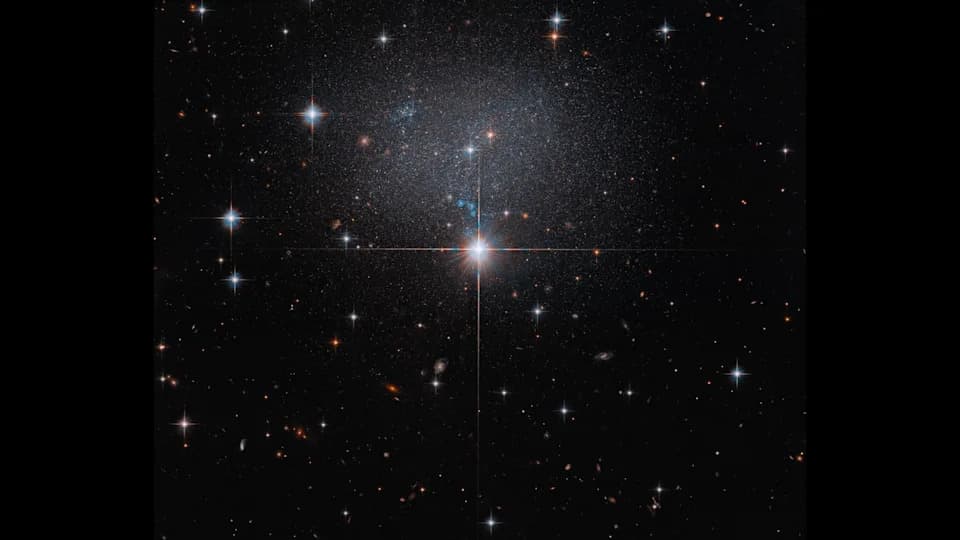
The dwarf irregular galaxy ESO 490-017. | Credit: NASA, ESA, R. Tully (University of Hawaii); Image Processing: G. Kober (NASA/Catholic University of America)
The Hubble Space Telescope has produced a striking portrait of an irregular dwarf galaxy, revealing a dense field of stars and numerous background galaxies in a single, sharply detailed view.
Located about 23 million light-years from Earth, the galaxy catalogued as ESO 490-017 spans roughly 12,000 light-years across — small compared with the Milky Way, which measures at least about 100,000 light-years across. For scale, one light-year equals 5.88 trillion miles (9.46 trillion km).
What the Image Shows
In Hubble's exposure the dwarf galaxy appears speckled with individual stars, with a particularly bright star near the centre of the frame drawing the eye. Because ESO 490-017 is a low-surface-brightness galaxy, many of the more distant background stars and faint features appear hazy, enhancing the contrast with nearer foreground stars. Several bright foreground stars show distinctive diffraction spikes — a result of Hubble's optical structure — that radiate outward from their cores.
Scattered across the cosmic backdrop are compact red, orange and beige spots. These are not single stars but distant background galaxies seen through the same patch of sky, illustrating the depth of the field captured in a single Hubble view.
Context And Scientific Purpose
The image was taken as part of a Hubble observing programme that surveys galaxies and galaxy clusters to measure how these systems move through space — the larger-scale motions often described as the universe's "cosmic flow". Rather than being fixed in place, galaxies are in continual motion under gravity, and datasets like this help astronomers map those flows and the underlying distribution of mass.
This portrait also highlights Hubble's resolving power: even a distant, faint dwarf galaxy like ESO 490-017 and a surrounding field of background galaxies can be captured with clarity, showing both individual stars and more distant galaxies in one compelling image.
Location: The galaxy lies in the direction of the constellation Canis Major, the same region of sky that contains Sirius, the brightest star visible from Earth.
Help us improve.