
The goblin shark, often called the world's 'ugliest' shark, has been filmed alive in its deep-ocean habitat. Australian researchers from the Minderoo-UWA Deep-Sea Research Centre captured over 20 seconds of footage in the Tonga Trench at about 6,500 feet (≈2,000 m) during a 2024 expedition. A separate 2019 sighting near Jarvis Island is published alongside the new clip in the Journal of Fish Biology. Experts say live observations are rare and the species typically inhabits around 3,000 feet (≈915 m).
Rare Deep-Sea Footage Shows Goblin Shark in the Wild — Filmed 2,000 m Down
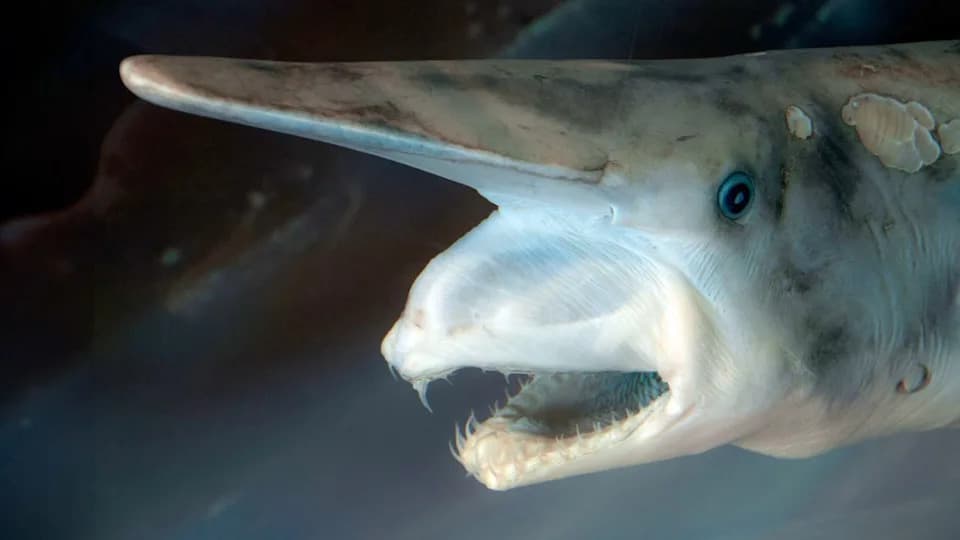
Credit: Alamy
A famously odd-looking deep-sea predator has been caught on camera in its natural habitat. Australian scientists from the Minderoo-UWA Deep-Sea Research Centre recorded a goblin shark during a 2024 expedition to the Tonga Trench, producing one of the clearest in-situ video clips of this rarely seen species.
The short clip — a little over 20 seconds — shows an individual filmed at roughly 6,500 feet (about 2,000 metres) in the Tonga Trench, the second-deepest marine trench on Earth. A separate sighting from 2019 near Jarvis Island, recorded by researchers from the University of Hawaii, is published alongside the new footage in the Journal of Fish Biology. The two encounters occurred about 1,500 miles apart.
'We actually know virtually nothing about them,' Professor Alan Jamieson, director of the Minderoo-UWA Deep-Sea Research Centre, told The Guardian.
Although goblin sharks were first described in 1898, live observations remain rare. The species normally inhabits depths around 3,000 feet (≈915 metres), and most previous encounters were the result of accidental fishing bycatch. The Tonga Trench recording was possible because the team gathered an enormous amount of footage during the expedition, including more than 50 days of continuous filming.
'They are ridiculously horrendous to look at,' said Professor Culum Brown, a fish expert at Macquarie University. 'Not even their mother would love their faces.'
Brown added that goblin sharks have an almost cinematic appearance: a long, sensitive snout used for detecting prey and a highly protrusible jaw that shoots forward to seize targets. The new footage gives researchers an invaluable glimpse of their natural behavior and appearance in deep-ocean conditions.
Why it matters: Rare in-situ recordings like this help scientists learn more about the biology and ecology of deep-sea species that are otherwise known primarily from dead or bycaught specimens. Publishing the Tonga Trench and Jarvis Island encounters together in the Journal of Fish Biology helps consolidate sparse observations and provides reference material for future study.
Help us improve.





















