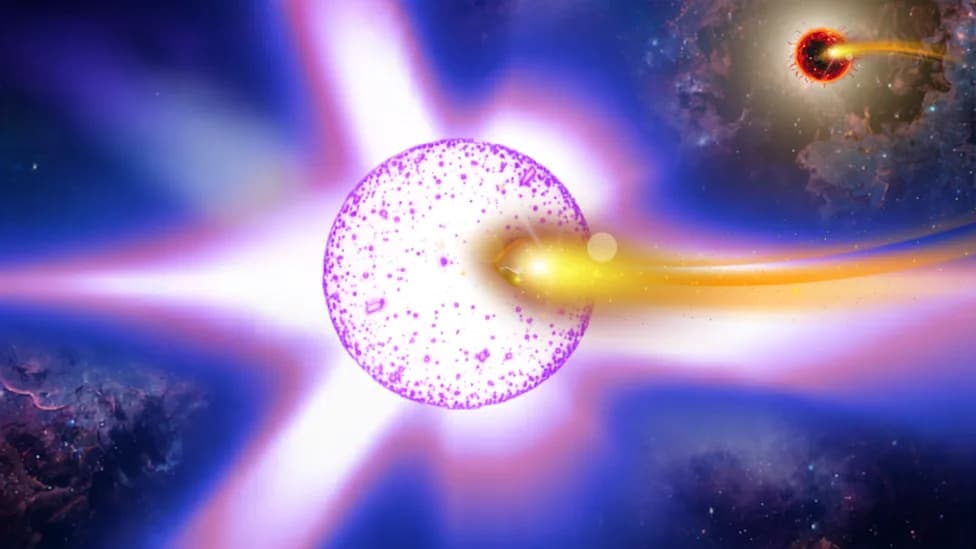
Researchers Daniel Jampolski and Luciano Rezzolla present a dynamical general-relativity model in which a collapsing star can produce a gravastar: a compact object whose de Sitter core (vacuum-like energy) pushes outward and halts collapse before a black hole forms. Successful formation requires finely tuned initial conditions and obeys a maximum initial compactness of 3/8 (0.375), below the Buchdahl limit. The work is theoretical and idealized but gives concrete constraints and observational handles (notably gravitational-wave signatures) for future tests.
Collapsing Stars Could Become Gravastars — New General-Relativity Model Shows How
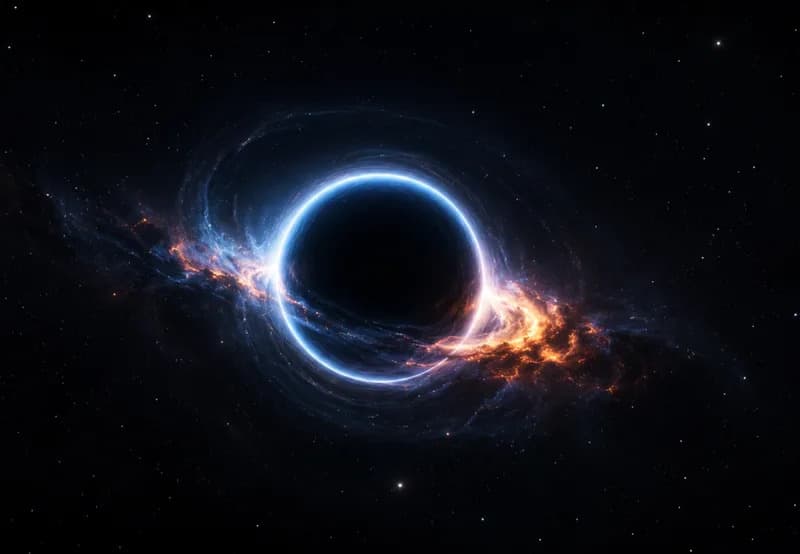
New calculations show how a collapsing star might form a gravastar, avoiding a black hole’s singularity and event horizon. (CREDIT: AI-generated image / The Brighter Side of News)
A textbook picture of stellar death says a massive star collapses until matter and spacetime compress into a singularity hidden behind an event horizon: a black hole. That scenario raises deep conceptual problems—singularities mark where theory loses predictive power, and event horizons conceal the fate of information—so some theorists have long explored alternatives that are nearly as compact as black holes but avoid both a singularity and a horizon.
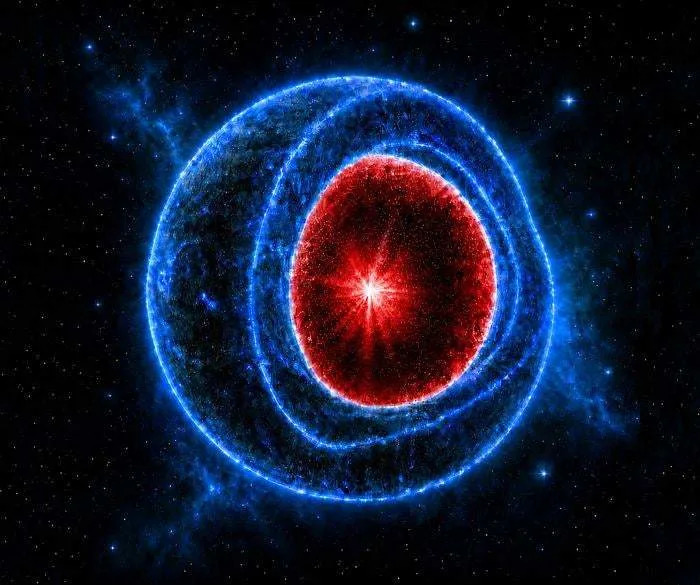
An expanding mini universe could counterbalance the collapsing matter of a star, thereby creating a stable gravastar. (CREDIT: Daniel Jampolski and Luciano Rezzolla, Goethe University Frankfurt)
What the New Work Shows
Researchers Daniel Jampolski and Luciano Rezzolla (Goethe University Frankfurt) present a mathematical, dynamical pathway within Einstein’s general relativity by which an ordinary, spherically symmetric collapsing star can end as a gravastar rather than a black hole. In their solution the collapse seeds a small, expanding de Sitter core (a bubble with vacuum-energy–like pressure) at the star’s center. The bubble’s outward push can halt the inward fall of the outer layers, producing a compact object with a dark-energy–supported interior and an outer shell of ordinary matter.
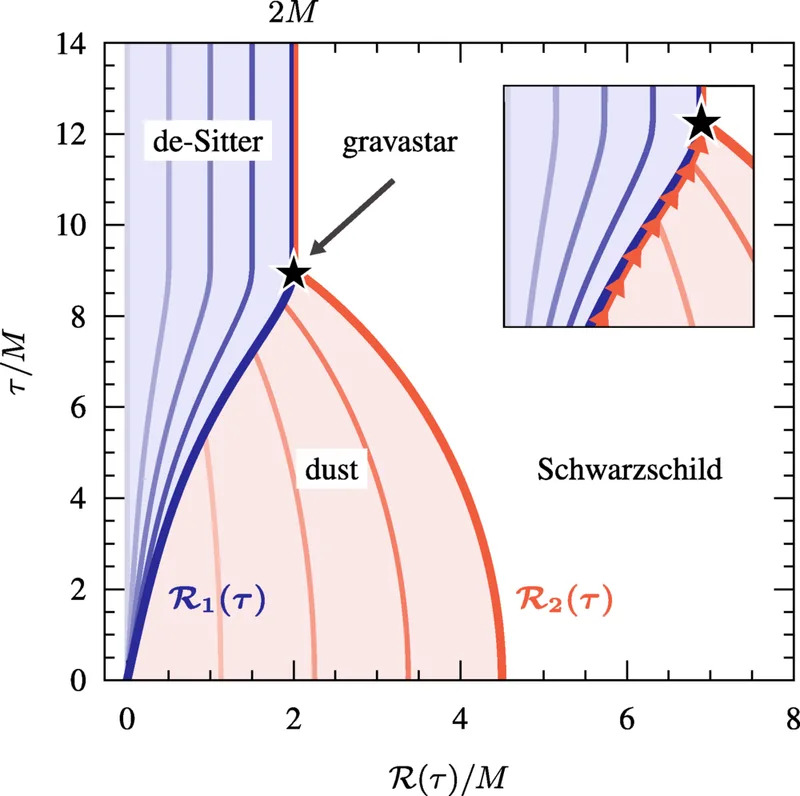
Spacetime reporting the worldlines in proper time of the proper circumferential radii R1 (blue solid line) and R2 (red solid line) separating either the expanding de Sitter bubble (blue-shaded area) with the collapsing dust (red-shaded area), or the latter with the exterior Schwarzschild spacetime. (CREDIT: Physical Review D)
How the Mechanism Works
The authors build on the classic Oppenheimer–Snyder collapse of a pressureless, dustlike spherical cloud and add an expanding de Sitter region matched smoothly to the collapsing layer and to an exterior Schwarzschild spacetime. In some cases the de Sitter bubble expands gradually; in other scenarios it remains dormant until very late and then bursts outward, stopping the collapse just before an event horizon would form. Jampolski likens the interior behavior to a miniature Big Bang emerging at extreme compression.
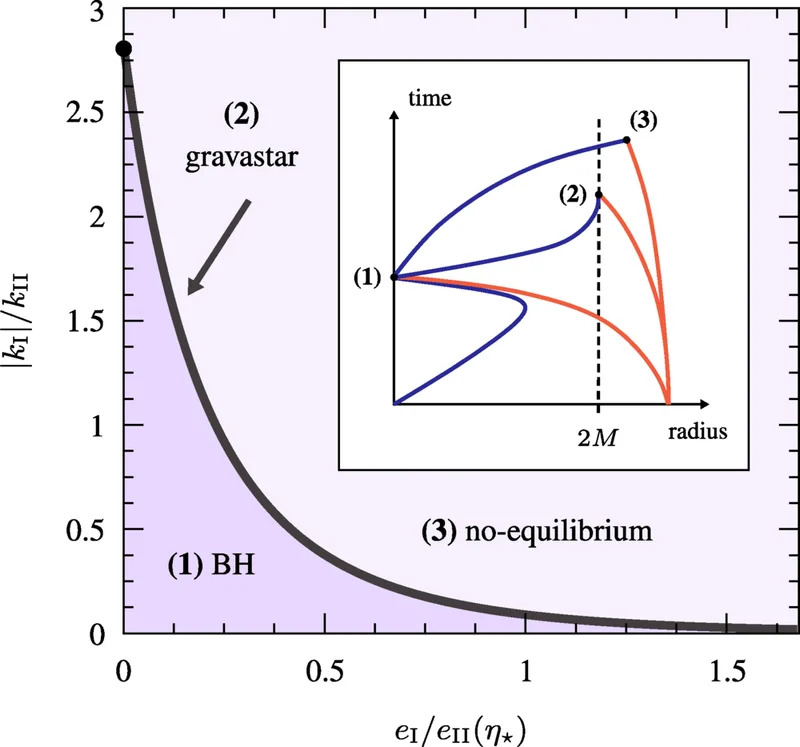
Possible space of parameters for the collapse scenarios when expressed in terms of the energy density and spatial curvature of the de Sitter region. (CREDIT: Physical Review D)
“The Big Bang of the emerging universe can unfold once the star has already collapsed almost to the point of becoming a black hole,” Jampolski said. Rezzolla adds that exploring exotic but consistent solutions is part of healthy theoretical inquiry.
Limits, Fine Tuning, And Robustness
The balance required to produce a stable gravastar is delicate. The authors identify three generic outcomes for their initial configurations: (1) black-hole formation, (2) a nonequilibrium remnant that is not a static gravastar, or (3) a gravastar, which occurs only on a narrow boundary in parameter space. Each individual gravastar solution requires fine-tuned combinations of the inner region’s energy density and spatial curvature, though there is an infinite family of such tuned starting conditions.
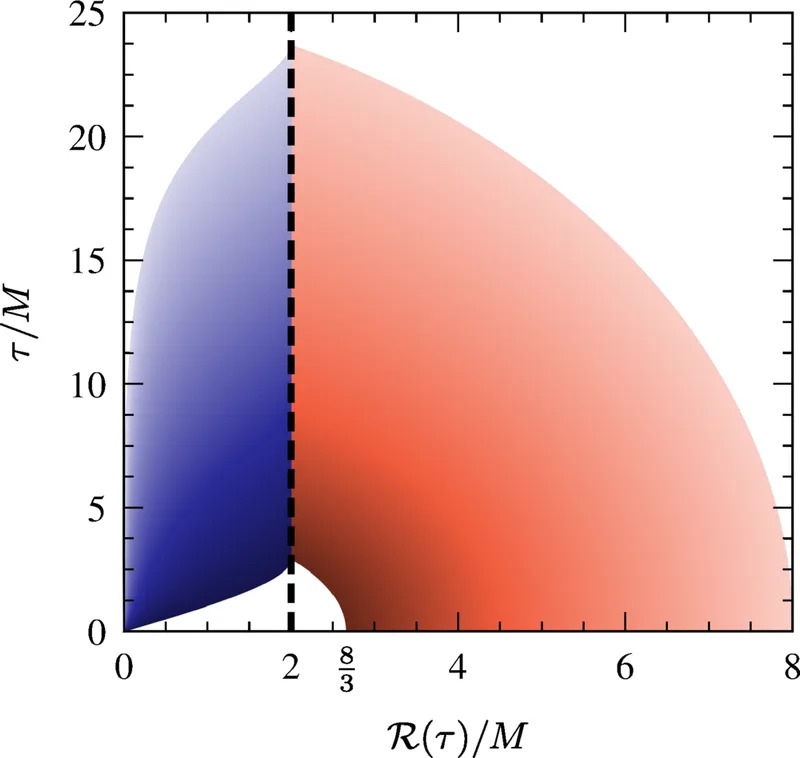
Worldlines R1(τ) and R2(τ) for initial radii R¯2/M∈(8/3,8) being represented by different colors for a fixed de Sitter energy density eI/eII(η⋆)=1, which in turn determines the curvature constant kI. (CREDIT: Physical Review D)
Crucially, causality constrains how quickly the inner bubble can expand. The model therefore imposes a maximum initial compactness of 3/8 (0.375); if the collapsing object is more compact than this bound, the rescue by a de Sitter bubble cannot occur in time and a black hole is expected to form. This compactness limit lies below the familiar Buchdahl bound of 4/9 (~0.444).
Open Questions And Observational Prospects
The solution is idealized: exact spherical symmetry, pressureless dust for the collapsing matter, and a sharply defined interface between the de Sitter core and the outer layer. Future work must test whether gravastar formation survives when more realistic physics are included (pressure, rotation, off-center bubble nucleation, and asymmetries that might destabilize the shell).
Observationally, gravastars were proposed partly because they can closely mimic black holes in electromagnetic observations. The authors note that gravitational perturbations and gravitational-wave signatures should distinguish gravastars from black holes more clearly, but determining whether any observed compact object requires this exotic interpretation remains an open challenge.
Bottom Line
The new paper does not overturn black holes or claim that observed black-hole candidates are gravastars. Rather, it demonstrates that within general relativity there exists at least one mathematically consistent, dynamical route by which ordinary stellar collapse can avoid both singularity and event-horizon formation. The result is primarily theoretical but provides concrete, testable conditions—most notably the compactness limit and the need for finely tuned initial states—that future simulations and observations can confront.
Reference: The research appears online in Physical Review D.
Help us improve.