
NASA named the four-person Artemis III crew for 2027: Andre Douglas, Frank Rubio, Randy Bresnik and ESA pilot Luca Parmitano. The Parker Solar Probe completed its 28th close pass of the Sun, again reaching roughly 3.8 million miles and 430,000 mph while remaining in good health. Ember reported May 2026 as the first month in which solar generation in the U.S. exceeded coal (Solar 12.8% / 45.5 TWh; Coal 12.2% / 43.4 TWh). Astronaut Jessica Meir shared striking aurora footage from the ISS amid NOAA G2–G3 geomagnetic storm watches.
Parker Probe’s 28th Solar Flyby, Solar Power Tops Coal in May, Artemis III Crew Revealed — This Week in Science
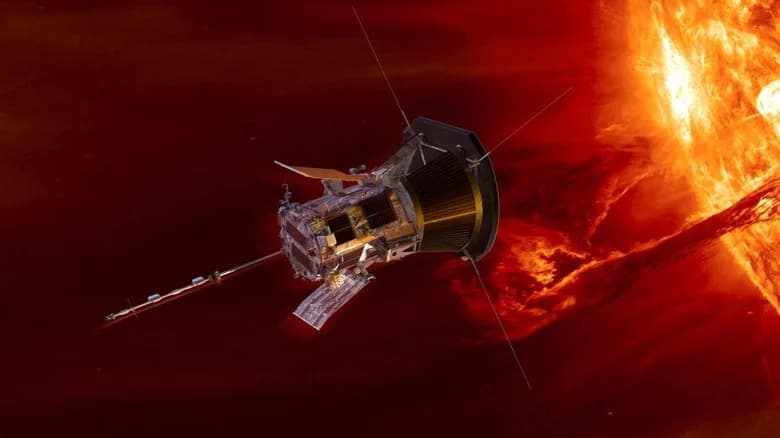
An artist's impression of the Parker Solar probe flying near the sun - NASA/Johns Hopkins APL
NASA this week announced the four-person crew that will lead Artemis III in 2027: NASA astronauts Andre Douglas, Frank Rubio and Randy Bresnik, with ESA astronaut Luca Parmitano serving as pilot. Elsewhere, the Parker Solar Probe completed another close pass of the Sun, solar generation in the U.S. edged past coal for the first time in May, and astronauts aboard the ISS captured dramatic aurora footage.
Parker Solar Probe: Another Close Encounter
The Parker Solar Probe executed its 28th perihelion this week, passing roughly 3.8 million miles above the Sun’s visible surface and reaching a top speed near 430,000 mph. Those distance and velocity figures match the records the spacecraft first set in December 2024 — marks it has now equaled five times. The latest close approach began on June 3; mission controllers received a beacon tone signaling normal operations on Thursday.
Launched in 2018, Parker has spent eight years steadily closing the gap to our star. Its first close approach in late 2018 brought it to about 15 million miles from the Sun with a peak speed of 213,200 mph. Despite extreme conditions near perihelion—engineers estimate the heat shield can reach roughly 1,700°F at closest approach—the team reports the spacecraft remains healthy. Thermal blankets under the heat shield have kept the probe’s internal temperatures stable across successive flybys.
"That temperature consistency is a major indicator of spacecraft health," said John Wirzburger, Parker Solar Probe mission systems engineer at the Johns Hopkins Applied Physics Laboratory. "If the heat shield were degrading, we'd see temperatures drift upward as more heat leaked through."
Parker continues monitoring the solar wind and other activity as the Sun moves through its 11-year cycle. The mission arrived near a solar minimum and stayed through the rise to solar maximum, which was confirmed in 2024. That peak saw more sunspots, flares and coronal mass ejections; activity is expected to decline gradually as the cycle progresses. Parker’s long-term, close-up measurements are producing unprecedented data to improve forecasts of space weather and our understanding of stellar processes.
Energy Shift: Solar Surpasses Coal in May
Energy think tank Ember reported that May 2026 was the first month on record in which solar generated a larger share of U.S. electricity than coal. Ember found solar supplied a record 12.8% of U.S. generation in May (about 45.5 TWh), while coal fell to 12.2% (roughly 43.4 TWh). Coal generation in May dropped about 11% year-over-year, and April hit a record-low monthly total of 39.3 TWh.
Ember highlighted a multi-year trend: coal’s share of U.S. generation fell from 19.7% in May 2021 to 12.2% in May 2026, while solar’s share rose from 5.4% to 12.8% over the same span. Although natural gas and nuclear still produced more overall electricity, analysts say renewables are gaining ground — in March renewables collectively generated more electricity than gas in the U.S. for the first time, Ember reported.
Auroras And Space Weather Alerts
NASA astronaut Jessica Meir shared a timelapse of aurora australis (the southern lights) captured from a SpaceX Dragon docked to the International Space Station. Meir described the display as "dancing and snaking" beneath the station and said she was "in awe of this evocative phenomenon."
The NOAA Space Weather Prediction Center issued G2 and G3 geomagnetic storm watches last week, warning that auroras could be visible farther from the poles than usual. Forecasts suggested displays across Canada and the northern U.S. in the Northern Hemisphere, and across Australia and New Zealand in the Southern Hemisphere.
Other Notable Headlines
- Axiom unveiled a Prada-designed inner layer for a spacesuit.
- Coverage continues on Artemis III life-support and spacesuit systems as preparations advance for the 2027 lunar mission.
- Seattle is close to approving a year-long moratorium on approvals for very large data centers.
- Researchers are developing textiles that can harvest drinking water from ambient air.
These items reflect ongoing progress across space exploration, clean energy transitions and environmental technology.
Help us improve.





















