
In July 2025 the interstellar object 3I/ATLAS sparked speculation it might be artificial. A focused radio search using the Allen Telescope Array produced nearly 74 million narrowband hits across 7.25 hours, later reduced to ~2 million after removing human RFI and then to 211 candidates for follow-up; none survived detailed review. Earlier Green Bank Telescope observations also found no candidate signals. Researchers say the null result is valuable because it demonstrates that current telescopes and analysis techniques can realistically search for technosignatures on unusual interstellar visitors.
After 74 Million Hits, Radio Search Finds No Evidence 3I/ATLAS Is An Alien Probe
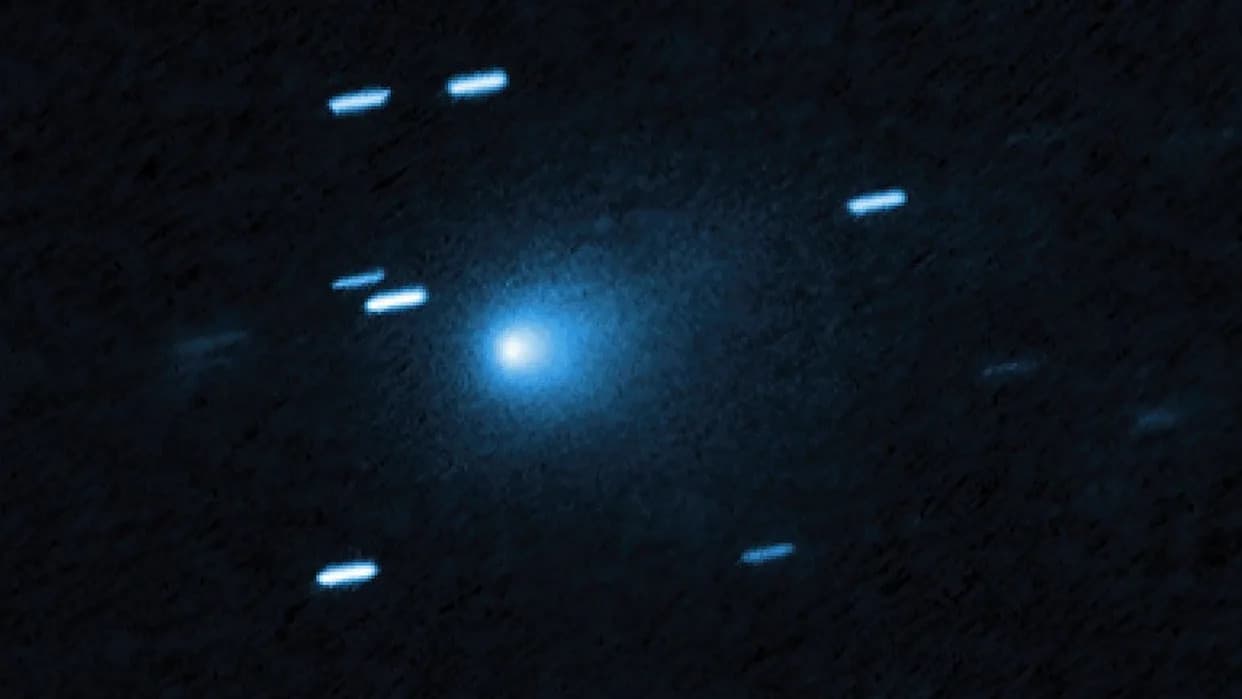
Photo Credit: NASA
In July 2025, astronomers recorded an unexpected object entering the Solar System from interstellar space. Cataloged as 3I/ATLAS, the object immediately generated intense interest and debate over whether its origin was natural or artificial.
To test the hypothesis that 3I/ATLAS might be an artifact emitting deliberate radio signals, teams from UC Berkeley's Search for Intelligent Life Institute and the Breakthrough Listen project conducted a focused radio search using the Allen Telescope Array near San Francisco.
Massive Data, Clear Outcome
Over 7.25 hours of observation, the initial data-processing pipeline identified nearly 74 million narrowband hits. After removing obvious radio-frequency interference (RFI) from human-made sources such as communications equipment, that pool fell to roughly two million candidates. An automated follow-up algorithm winnowed the list to 211 signals that merited detailed inspection.
None of those 211 signals survived further scrutiny. The team concluded that every candidate was readily attributable to terrestrial RFI. Independent earlier observations with the Green Bank Telescope likewise produced no viable candidate signals.
What This Means
Although the negative result makes it unlikely that 3I/ATLAS is an actively transmitting alien probe, the study is still a scientific success. It demonstrates that existing telescopes and modern analysis techniques can rapidly investigate unusual interstellar visitors and reliably separate true anomalies from Earth-generated electronic noise.
Interstellar objects remain valuable to science: they provide rare samples from beyond our Solar System that can inform models of planet formation, interstellar debris transport, and the broader distribution of materials between stars.
"The results from 3I/ATLAS show how realistic it is to detect a signal with the technology we have today. That is why it is important to keep searching for technosignatures, even from objects we might not expect to have signals," said co-author Valeria Garcia Lopez.
Lead author Sofia Sheikh added, "Eventually, our own Voyager spacecraft will be extraterrestrial artifacts in other stellar systems. Given that, it is important that we understand the natural distribution of interstellar objects so that we will be able to identify any anomalies that could one day be signs of an artificial interstellar object."
The paper detailing the observations and analysis was published in The Astronomical Journal. The null detection underlines both the challenge of distinguishing weak technosignatures from pervasive RFI and the readiness of current methods to perform these searches when another rare interstellar visitor appears.
Help us improve.





















