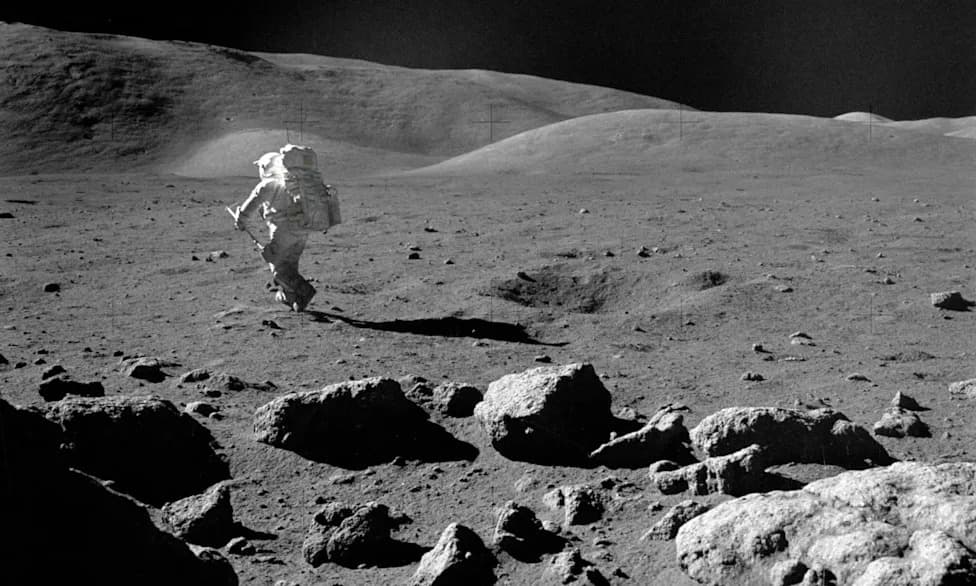
Researchers led by Dr. Aaron Bell analyzed the angrite meteorite NWA 12774 and found aluminum-rich clinopyroxene consistent with formation under pressures of at least 17.5 kilobars. From those pressures they infer a parent body with a radius of ≥1,000 km and possibly >1,800 km — a world comparable to the Moon. The finding supports the idea that large planetary embryos formed early and later vanished, and highlights the rarity and scientific value of angrite meteorites.
Rare Sahara Meteorite May Be Fragment of a Lost Protoplanet — Evidence Points to a Moon-Scale Parent Body
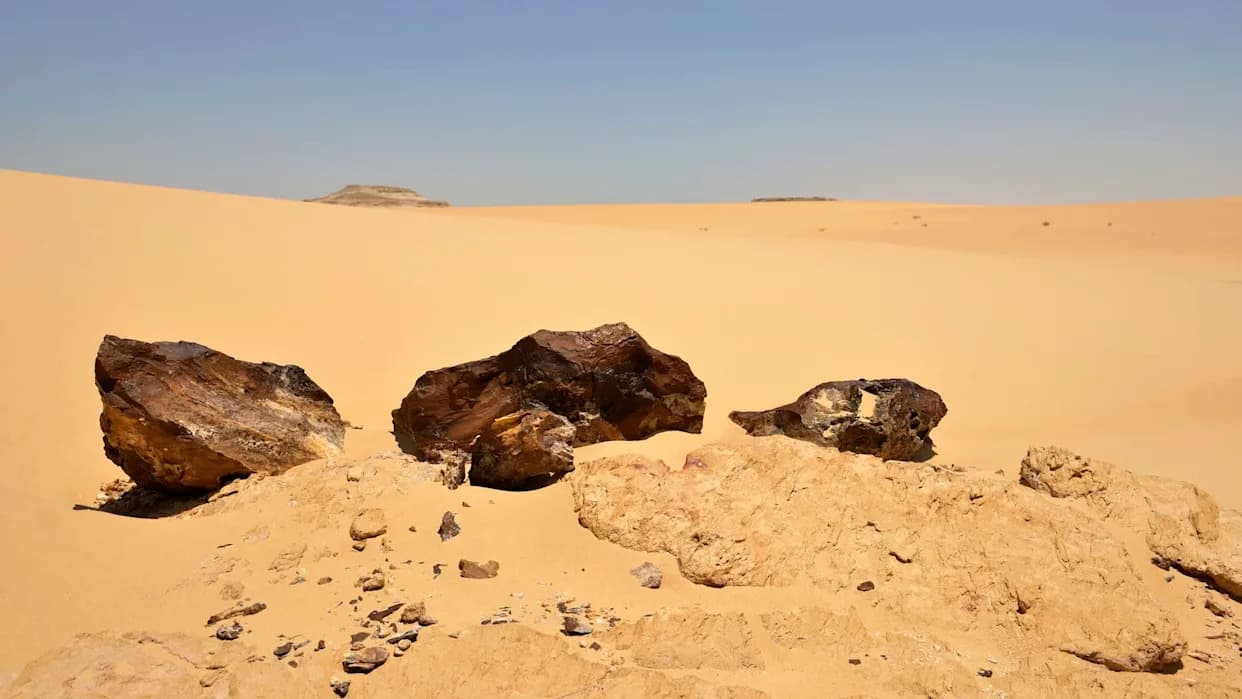
Photo Credit: iStock
Scientists propose that a rare meteorite recovered from the Sahara Desert, designated Northwest Africa 12774 (NWA 12774), may be a fragment of a protoplanet that was destroyed early in the Solar System's history. The study, led by Dr. Aaron Bell of the University of Colorado Boulder, identifies the specimen as an angrite — an exceptionally scarce type of volcanic meteorite — most likely found in Mauritania.
What the Researchers Found
The team's mineralogical and structural analysis revealed aluminum-rich clinopyroxene, a mineral whose formation requires intense compressive stress deep inside a large planetary body. Based on that mineralogy, the researchers estimate formation pressures of at least 17.5 kilobars, far higher than what modest asteroids can generate.
Using those pressure estimates, the team inferred a parent-body radius of at least 1,000 kilometers (about 621 miles), and possibly exceeding 1,800 kilometers (1,118 miles). Such dimensions place the parent object in a size range comparable to the Moon and approaching Mars in scale.
Why This Matters
If this interpretation holds, NWA 12774 would be among the strongest evidence that sizable planetary embryos formed very early in the Solar System and were later shattered or otherwise lost before becoming fully fledged planets. Angrites themselves are among the oldest volcanic rocks known, and they are rare: only 68 angrites have been identified among more than 80,000 meteorites recovered on Earth.
Broader Implications
Laboratory techniques used to study meteorites like NWA 12774 help scientists reconstruct how rocky planets form, how violent collisions shaped the early Solar System, and which materials Earth may have inherited. The study also suggests that some early planetary bodies assembled from materials different from those that built Earth and Mars, hinting that the young Solar System contained a diversity of worlds and evolutionary paths.
Dr. Aaron Bell: "It's incredible to think there was once a world this large. There are many meteorites sitting in drawers that haven't been thoroughly studied, so there were likely more of these protoplanets we don't know about."
Reporting and analysis cited from Sci.News; NWA 12774 is the meteorite specimen studied by Dr. Bell's team at the University of Colorado Boulder.
Help us improve.