Researchers at Dartmouth trained three California two-spot octopuses to use mirror reflections to locate prey that was hidden from direct view. In training, octopuses learned to associate a mirrored image with an object's real-world position and to navigate a 90-degree turn to reach a sealed crab. In controlled trials with a virtual crab visible only in the mirror, the animals selected the correct side about 73% of the time. The findings point to advanced spatial reasoning in octopuses and raise questions about convergent evolution and possible internal spatial maps.
Octopuses Learn to Use Mirrors to Locate Hidden Prey — First Mirror Use Demonstration in Invertebrates
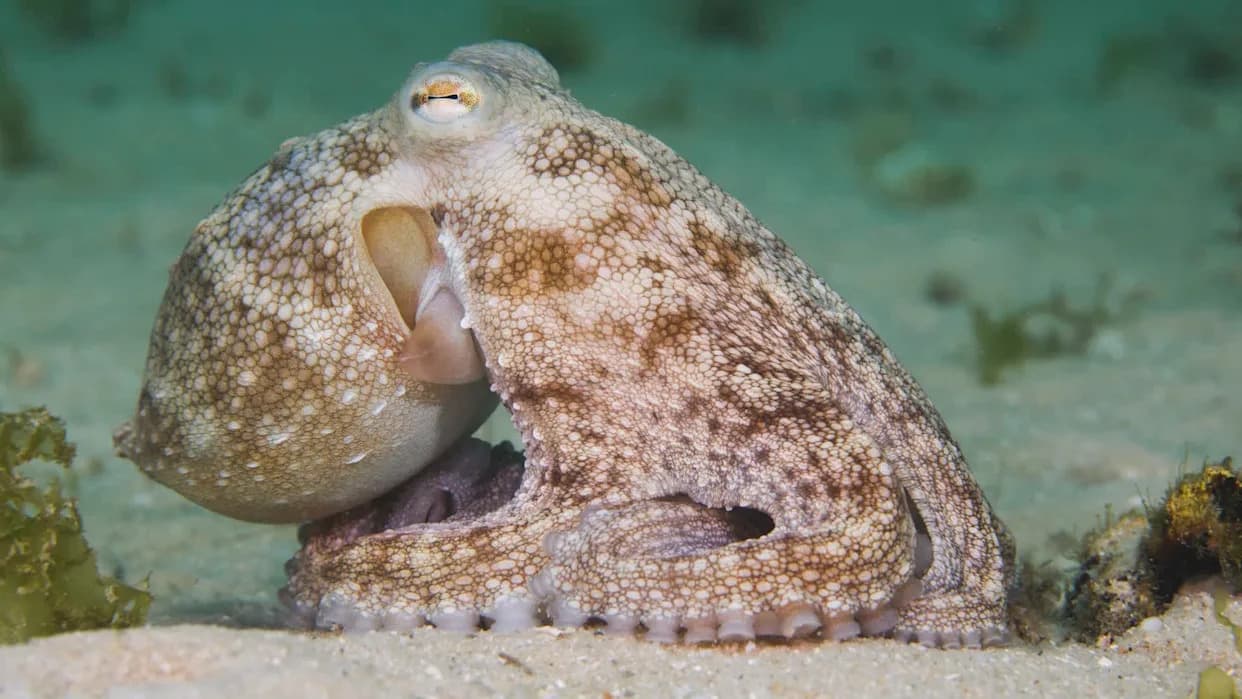
Photo Credit: iStock
Researchers at Dartmouth College report that octopuses can be trained to use mirror reflections to locate prey that is out of direct sight, a finding published in Current Biology. The experiments suggest a more sophisticated level of spatial reasoning in these invertebrates than previously recognized.
The Dartmouth team worked with three California two-spot octopuses in the institution's Octopus Lab. After allowing the animals to acclimate to mirrors in their environment, the researchers trained them to associate an image seen in a mirror with the object's actual position in space.
One training exercise placed a live crab inside a sealed glass jar so the octopus could detect it only via the mirror. To obtain the reward, the octopus had to turn roughly 90 degrees and move around a corner rather than attack the apparent, direct reflection — demonstrating the animal could use information from the mirror to guide real-world movement.
In follow-up, more controlled trials, each octopus started inside a box facing a mirror while a virtual crab image appeared behind the animal and was visible only as a reflection. Across trials, the octopuses selected the correct side about 73% of the time, well above chance.
"Our findings are the first to demonstrate that invertebrates can use mirrors to understand their environment to find prey," lead author Mary Kieseler said in the university press release.
While mirror use is not equivalent to mirror self-recognition, it does require an animal to appreciate that reflected information can be used to navigate and act in the physical world. The result therefore strengthens evidence that octopuses possess complex problem-solving abilities and spatial cognition.
Study senior author Peter Tse suggested the results point to a clear path for additional research into internal spatial representations. "Hunters are very effective when they have a mental map of their territory," Tse said. "Our work suggests that octopuses might also have internal maps, an internal representation of space." The co-authors emphasize that more research is needed to confirm whether octopuses truly form such internal maps.
The team also highlighted the broader evolutionary implications: because octopuses are evolutionarily distant from mammals and birds, their ability to learn mirror-based tasks supports the idea of convergent evolution — similar cognitive skills arising independently in very different nervous systems.
Beyond cognition, the authors note that understanding octopus behavior and intelligence can inform conservation and ecosystem management. Further study will help clarify octopuses' ecological roles and how best to protect their habitats.
What This Study Does Not Show: The experiments demonstrate mirror-guided foraging ability, not mirror self-recognition or human-like self-awareness. The authors call for careful follow-up experiments to probe the mechanisms underlying these behaviors.
Study Source: Dartmouth College press release summarizing research published in Current Biology.
Help us improve.