
Researchers analysing 62 cremated tooth roots from eight Lusatian Urnfield Culture cemeteries in Poland found that cementum microstructure can still indicate age at death. The study in Scientific Reports shows both cementum thickness and counts of lines of Salter correlate with age, even after cremation. Variation in growth‑line width between cemeteries points to local factors like diet or health. The method is reproducible across observers and could prompt reanalysis of cremated remains in museum collections.
Burned Teeth Tell Time: 3,000-Year-Old Urn Burials Reveal How To Estimate Age At Death
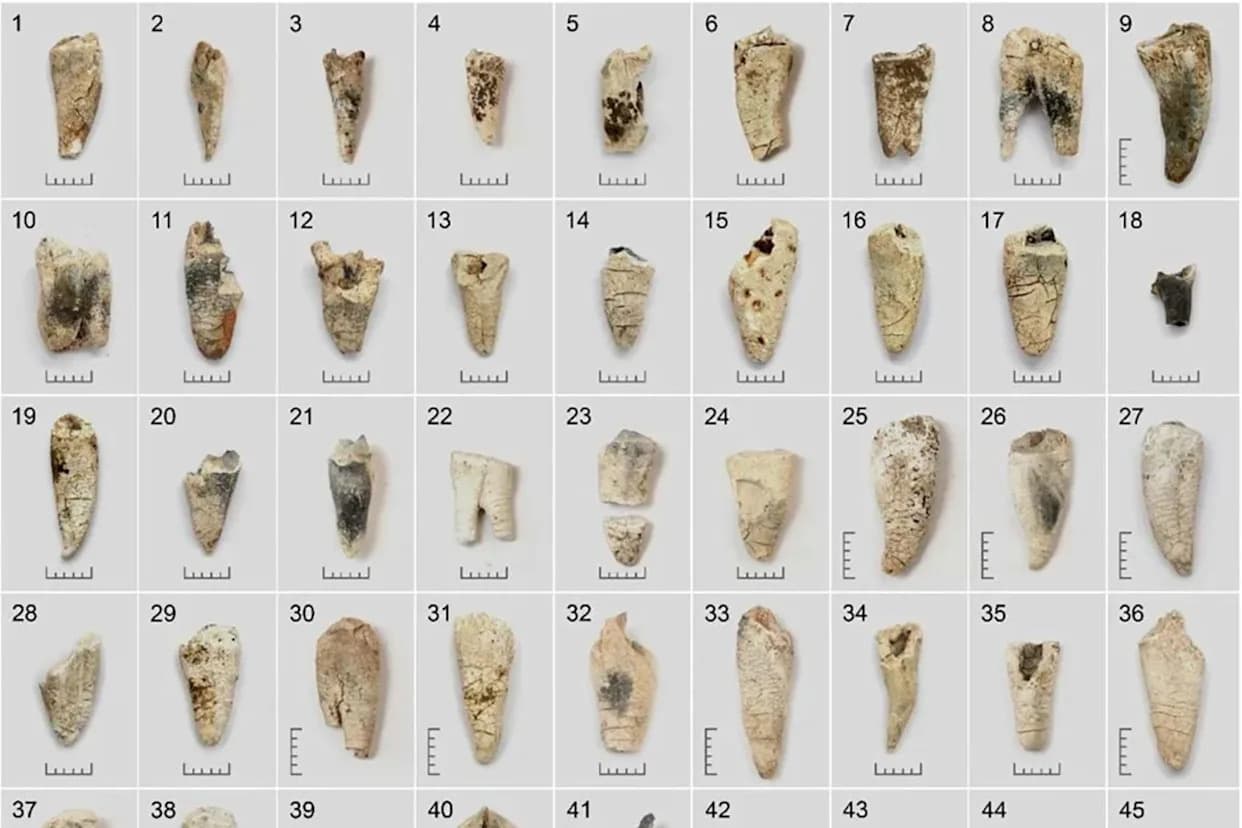
Photo Credit: A. Hałuszko / Hałuszko et al., Scientific Reports (2026)
New research shows that microscopic structures preserved inside cremated teeth can still reveal a person's age at death — even after the intense heat of ancient funerary pyres. The findings stem from an analysis of cremated tooth roots from Bronze‑ and Iron‑Age urn burials in what is now Poland.
What the Study Examined
Published in Scientific Reports, the study analyzed 62 tooth roots recovered from eight cemeteries associated with the Lusatian Urnfield Culture (roughly 1300–500 BCE). That culture commonly cremated the dead and placed ashes in ceramic urns during the Late Bronze Age and Early Iron Age.
How Age Was Estimated
The researchers focused on cementum, the thin tissue that coats tooth roots. Cementum accumulates microscopic growth lines over a lifetime called lines of Salter. By counting those lines and measuring cementum thickness — then combining that information with known tooth eruption ages — the team produced age estimates for individuals whose skeletons had been cremated.
Key Findings
Both cementum thickness and the number of growth lines correlated with age, allowing more refined age ranges than traditional skeletal methods alone often permit for cremated remains. The study also found that the width of growth lines differed between cemeteries, suggesting local influences — such as diet, environment, or health — affected tissue formation.
Reliability And Wider Implications
Independent observers produced similar line counts, indicating the method can be reproducible across analysts. That reliability makes cementum analysis a promising tool when well‑preserved skeletons are absent. The technique opens the door to re‑examining cremated remains in museum collections and older excavations that were previously considered too damaged for detailed age estimation.
Why This Matters
More precise age estimates improve reconstructions of ancient demography, health patterns, and funerary practices, especially in societies where cremation predominated. By looking closely at tiny, burned tooth roots, archaeologists can recover personal and population‑level details from people who lived more than 3,000 years ago.
Bottom Line: Cremation does not necessarily erase the biological record — cementum microstructure in tooth roots can preserve a reliable signal of age at death, even after ancient burning.
Help us improve.





















