
New study: Analysis of the angrite meteorite NWA 12774 indicates it crystallized under high pressures consistent with formation inside a large, magmatic protoplanet. Geobarometry and mineral chemistry place the angrite parent body's radius between roughly 1,000 km and 3,300 km, with a preferred estimate near 1,800 km—slightly larger than the Moon. The work, published in Earth and Planetary Science Letters, sheds light on lost worlds from the Solar System's turbulent youth.
Meteorite Evidence Points to a Lost World Nearly as Big as Mars
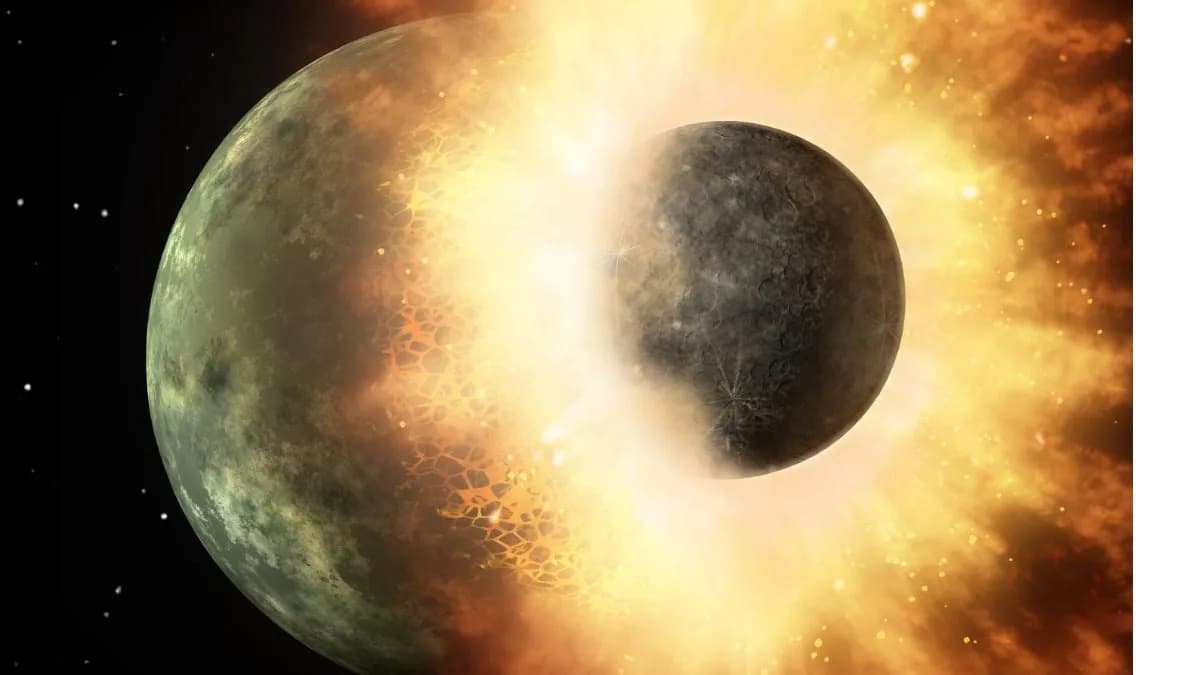
An artist's conception showing a planetary smash-up between a Moon-sized object and a Mercury-sized object. (NASA/JPL-Caltech)
New analysis of a small meteorite suggests our early Solar System once hosted a now-lost planetary embryo nearly as large as Mars. Fragments of that vanished world were preserved as angrite meteorites, and a detailed study of one specimen—NWA 12774—reveals mineral textures and chemistry that point to formation deep inside a large, magmatic body.
What the Meteorite Reveals
NWA 12774 was found in the Sahara in 2019 and weighs roughly half a kilogram. It belongs to the rare angrite class (about 0.09% of meteorites recovered on Earth). Angrites are among the oldest known igneous rocks, having crystallized only a few million years after the first solids in the solar nebula assembled.
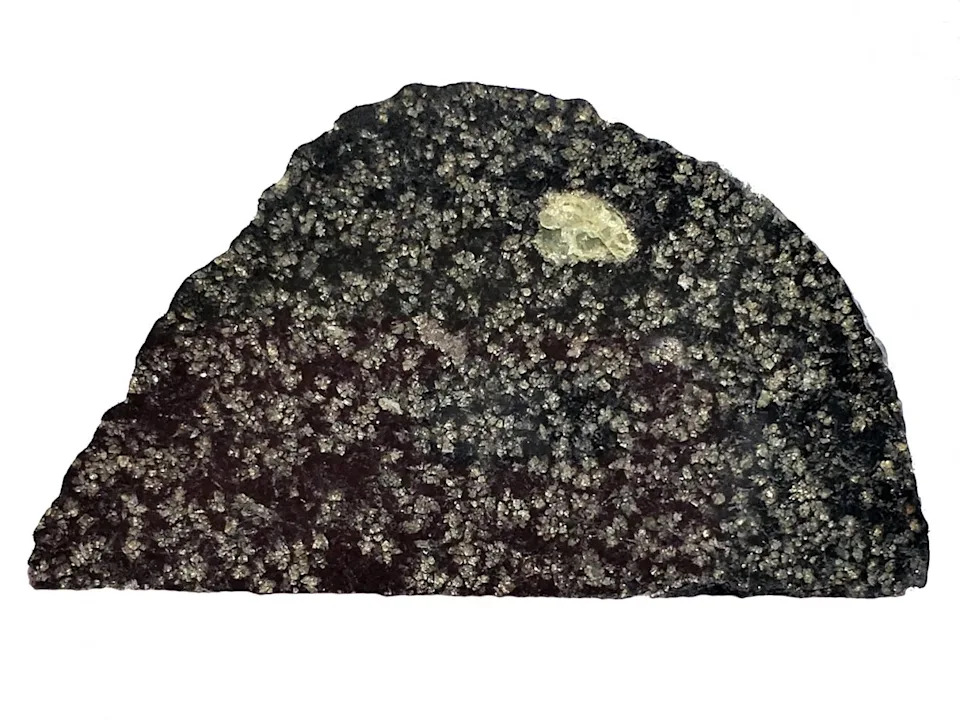
A portion of NWA 12774, showing the greenish olivine crystal within. (John Kashuba)
The research team used electron microprobe analysis and high-resolution X-ray mapping to examine the meteorite's crystal assemblages and chemistry. They also developed a new geobarometric model to estimate the pressures at which the observed minerals formed. NWA 12774 contains unusually aluminum-rich clinopyroxene—minerals whose composition indicates crystallization under relatively high pressures consistent with a large, planetary-scale magmatic interior.
Size Estimates for the Angrite Parent Body
Using geobarometry together with estimates of core mass and mantle density, the authors derive a conservative minimum radius for the angrite parent body (APB) of about 1,000 kilometers. However, the pristine, chemically zoned and jagged crystals preserved in the meteorite imply they formed in a relatively shallow region of a large magma reservoir. That favored estimate puts the APB at roughly 1,800 kilometers in radius—slightly larger than the Moon (1,740 km).
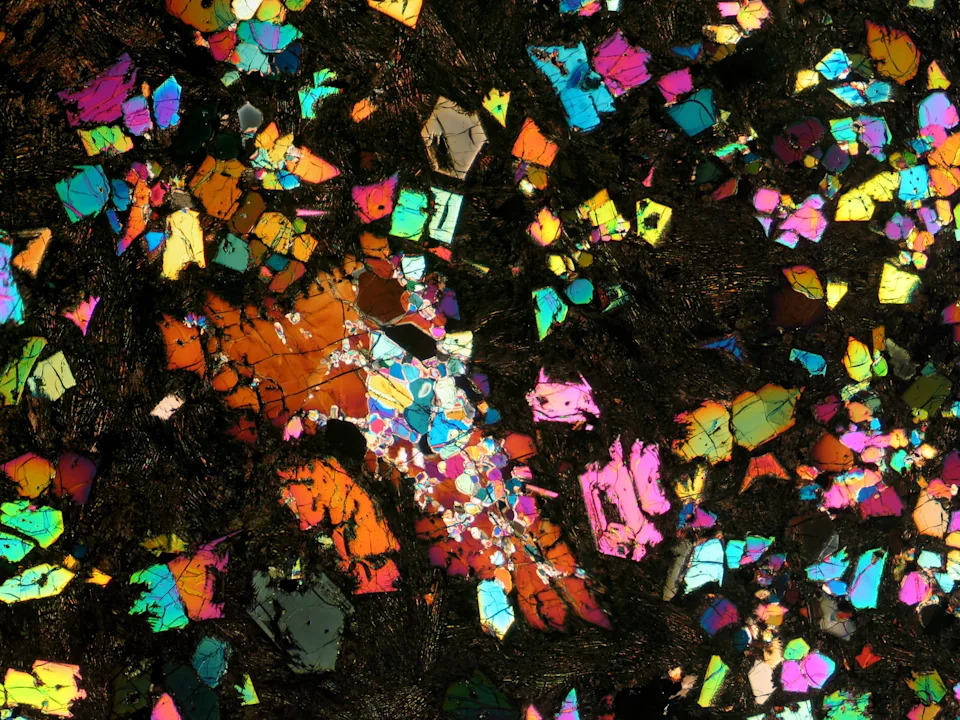
A portion of NWA 12774 shown under cross-polarized light, revealing the diversity of its inner structure. (John Kashuba)
Upper-range estimates from the study approach ~3,300 kilometers in radius, making the APB only a bit smaller than Mars (3,390 km). Whether the true size is near the minimum, the preferred, or the upper estimate remains uncertain, but all imply a body far larger than typical asteroids.
How the Body May Have Been Destroyed
The fate of this protoplanet is unknown. It could have been shattered by a cataclysmic collision, or torn apart by gravitational interactions—some models even suggest a migrating Jupiter could have helped destabilize such objects. Whatever the cause, fragments of the APB were scattered through the Solar System and occasionally fell to Earth, where scientists can now study them.
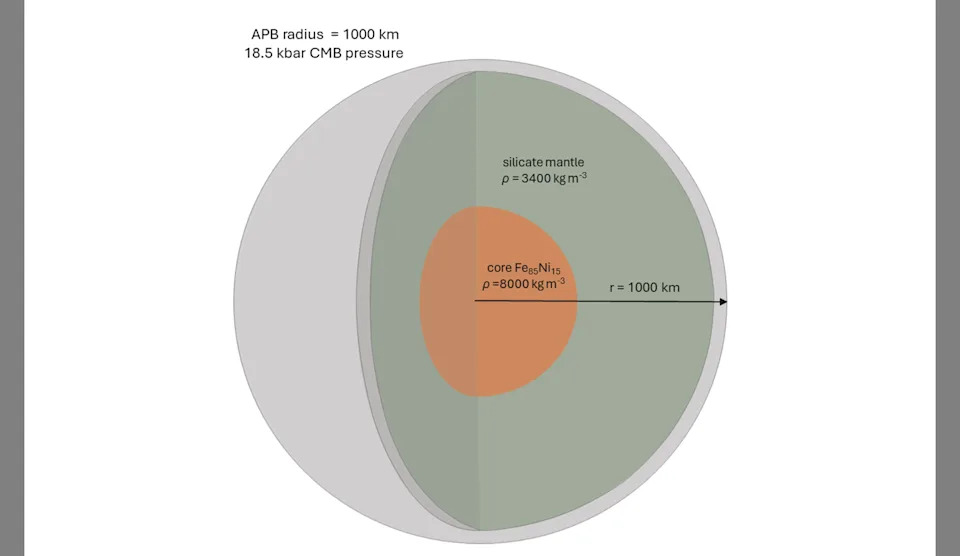
Minimum size estimate for the angrite parent body. (Bell et al.,Earth Planet. Sci. Lett., 2026)
"It's incredible to think there was once a world this large," says Aaron Bell, the study's lead author and an experimental petrologist at the University of Colorado Boulder. "We only know it existed because a few fragments of it happened to land on Earth."
Why This Matters
Identifying a former Moon-to-Mars-sized protoplanet improves our understanding of early planetary formation, differentiation, and the dynamical sculpting of the young Solar System. It also highlights the value of carefully reexamining meteorite collections: small samples can record evidence of lost worlds.
Publication: The study appears in Earth and Planetary Science Letters.
Help us improve.





















