A Boston University team led by Brian Walsh proposes "StormWall": six geosynchronous satellites that would release vaporized metals (barium, lithium, sodium or calcium) to create an artificial plasma shield at the sunward edge of Earth’s magnetosphere. Simulations of the May 2024 "Mother's Day" storm suggest the scheme could reduce a major geomagnetic storm's intensity by more than 50%, diverting harmful energy away from satellites, communications and power grids. The system would require a substantial payload (about a dozen oil trucks' worth), be effectively single-use per deployment, and the team estimates the injected plasma would be swept away within roughly six hours.
StormWall: Proposed Fleet Would Spray Vaporized Metals to Reinforce Earth's Magnetosphere Against Solar Storms
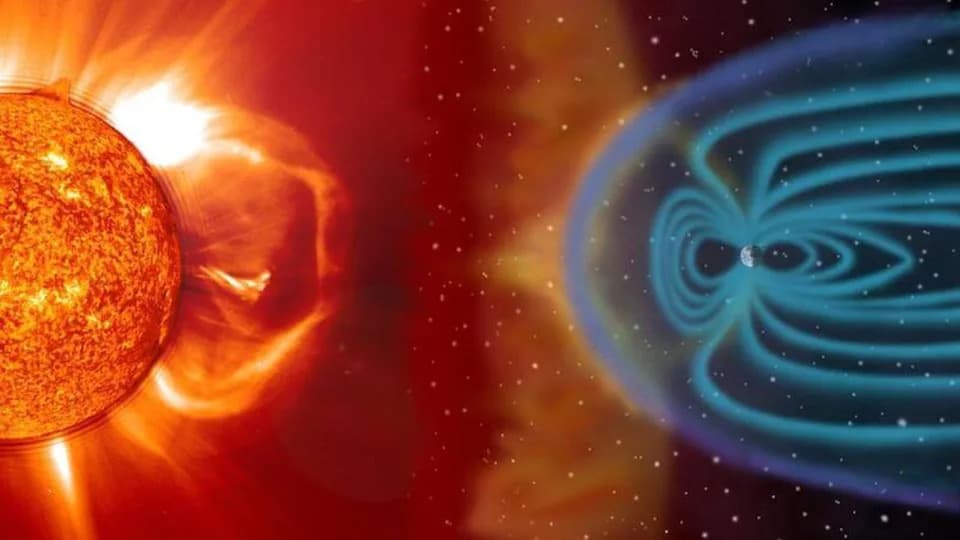
Credit: ESA & NASA
When powerful solar eruptions head toward Earth, our first line of defense is the magnetosphere — a vast magnetic bubble that deflects harmful charged particles from the Sun. A team led by Brian Walsh of Boston University has proposed a proactive, if unconventional, way to bolster that shield before a storm arrives.
The concept, called StormWall, would place six spacecraft in geosynchronous orbit. Each satellite would carry a supply of so-called mass-loading materials — elements such as barium, lithium, sodium or calcium — stored as solids or liquids and vaporized on command.
When forecasters detect a threatening coronal mass ejection (CME), controllers would release the materials. Sunlight would rapidly ionize the vapor, creating an artificial cloud of charged particles (plasma) that drifts to the sunward boundary of the magnetosphere. According to the team's simulations, this extra plasma would thicken that interface and reduce the efficiency of magnetic reconnection, the process that can open a direct pathway for solar energy to rush into near-Earth space.
“People have always thought, 'space is huge, the sun is massive, we just have to sit here and take whatever it gives us,' but what we found is that we can impact it,” Walsh said in the study statement.
To test StormWall, the researchers simulated the May 2024 "Mother's Day" geomagnetic storm. One run reproduced the event under normal conditions; a second run included the StormWall plasma shield. The models indicate the approach would not completely prevent a geomagnetic storm but could reduce its intensity by more than 50% by diverting much of the incoming energy around Earth instead of letting it penetrate to damage satellites, communications networks, GPS and power grids.
The fleet would need to carry a substantial payload: the team estimates a total mass roughly equivalent to a dozen oil trucks. Launching that amount into geosynchronous orbit would be costly, and the system is essentially single-use for each deployment — once the payload is released and photoionized it cannot be replenished without re-supplying the satellites.
The study addresses environmental and operational concerns. The authors argue the contamination risk is low because the artificial plasma would be swept away by the solar wind within roughly six hours rather than falling back into the atmosphere. They also emphasize that, because the magnetosphere surrounds the whole planet, a deployed StormWall would provide a global benefit rather than protecting any single nation or company.
“If you built it, if it was deployed, it would help all people on the planet. You couldn’t make it in a way that helped only one country, one group of satellites,” Walsh added.
The proposal was detailed in a paper published June 2 in the journal Space Weather. The authors acknowledge many open questions remain — including exact material choices, deployment logistics, cost, legal and geopolitical implications, and further modeling of unintended effects — and call for additional study before any real-world tests.
Help us improve.