Researchers report in Nature the identification of the East Antarctic Fan-Shaped Basin Province, a vast subglacial structure about two miles beneath East Antarctica that links the Wilkes and Aurora basins with Lake Vostok. The team combined geological, gravity, magnetic and crustal-model data and suggests the province formed by 'distributed rotational extension.' Because these basins underlie roughly half of the East Antarctic Ice Sheet, they could significantly affect ice flow and the continent's response to warming.
Scientists Reveal Giant Subglacial Province Two Miles Beneath East Antarctica
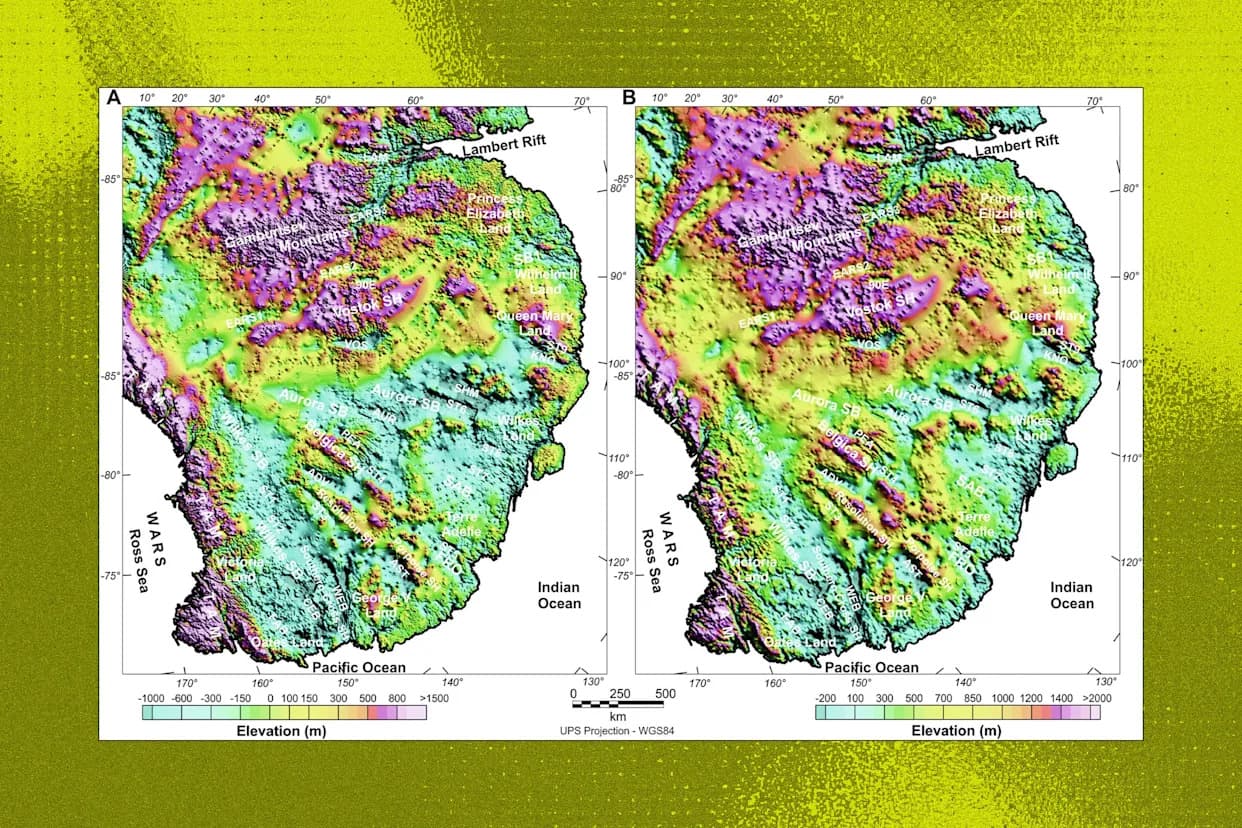
A map of a fan-shaped subglacial basin province in East Antarctica.
Researchers report the discovery of a vast geological province buried roughly two miles beneath the ice of East Antarctica. Published in Nature, the study shows that several previously studied features — including the Wilkes and Aurora subglacial basins and Lake Vostok — are components of a single, much larger structure the authors call the East Antarctic Fan-Shaped Basin Province.
How the Structure Was Mapped
To delineate the province, the team integrated multiple datasets: geological observations, gravity and magnetic surveys, and models of the Earth’s crust, among other geophysical measurements. Combining these independent lines of evidence allowed researchers to identify consistent boundaries, internal patterns, and a plausible formation mechanism.
Proposed Formation and Significance
Based on the integrated data, the authors propose the province formed through a process known as 'distributed rotational extension,' in which continental crust slowly stretches outward from a central locus over millions of years. If correct, this explains the fan-like arrangement of basins and their regional scale.
"Because these basins underlie about half of the East Antarctic Ice Sheet, they are likely to heavily influence both ice flow and landscape evolution," the study's authors write.
The finding is important for both Earth science and climate research. These buried basins sit beneath roughly half of the East Antarctic Ice Sheet, so their geometry, depth, and basal conditions could strongly influence ice dynamics, subglacial hydrology, and the long-term stability of Antarctic ice in a warming climate.
Next Steps
The authors emphasize that further targeted geophysical surveys and modeling will be needed to confirm details of the province and to refine how its presence affects ice-sheet behaviour. The discovery provides a new framework for interpreting decades of separate observations and highlights priority areas for future Antarctic research.
Help us improve.