Argonne scientists demonstrate near‑atom‑level control of MXenes across 40 new MAX phases, some containing up to nine metals. Ordered atomic arrangements persist up to six metals but collapse at seven or more, as shown by layer‑by‑layer SIMS mapping. Applications include EMI shielding and catalysis, and AI/ML may accelerate selection of promising compositions for scale‑up.
Argonne Engineers MXene 2D Materials With Near‑Atomic Precision — 40 MAX Phases, Up To 9 Metals
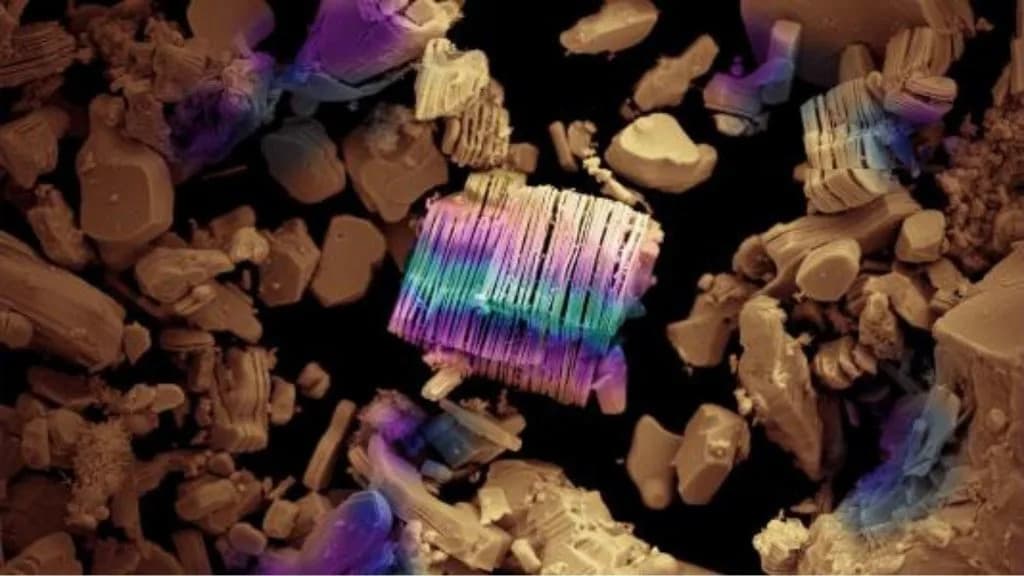
Researchers at the U.S. Department of Energy’s Argonne National Laboratory report near‑atomic control of MXenes — a versatile family of two‑dimensional materials — demonstrating design strategies that tune which atoms appear, where they sit, and which chemical groups terminate their atom‑thin surfaces.
What the Team Did
In two papers published in Science, the group synthesized 40 distinct MAX phases (the layered precursors to MXenes), expanding the available chemical space for MXene production. Some of these MAX phases contain as many as nine different transition metals within a single crystal structure.
Atomic Order And The Role Of Entropy
The researchers found that ordered atomic arrangements persist in compositions containing up to six different metals. When seven or more distinct metals are introduced, the ordered patterns collapse and atomic positions become largely disordered — a behavior the team attributes to entropy, the natural tendency toward randomness as complexity increases.
“This is where entropy, the natural tendency toward randomness, wins,” said Brian Wyatt, a Maria Goeppert Mayer Fellow at Argonne. “Nature likes some kinds of order, but once we add enough different ingredients, it becomes too hard for the atoms to stay organized.”
Mapping Atoms Layer By Layer
To determine how atoms distribute through the layered structures, the team used secondary ion mass spectrometry (SIMS) to measure composition layer by layer. Those measurements confirmed that, for many compositions, atomic ordering carries through the stacked sheets — a crucial insight for designing predictable 2D materials.
Applications And Next Steps
MXenes (pronounced “max‑eens”) are only a few atoms thick and are typically built from transition metals such as titanium, vanadium, and molybdenum bonded to carbon and/or nitrogen. Their exposed 2D surfaces and compositional tunability make them promising for:
- Electromagnetic interference (EMI) shielding with nanometer‑thin coatings
- Catalysis, where surface exposure could reduce reliance on expensive catalysts like platinum
Researchers note that the next major challenge is scaling these designer MXenes for manufacturing and industrial use. Artificial intelligence and machine learning are suggested as tools to prioritize which element combinations are most promising to synthesize and test experimentally.
Implication: By nearly doubling the chemical design space for MXenes and clarifying when ordering breaks down, this work gives researchers a more reliable foundation for tailoring 2D materials to specific technologies.
Help us improve.