
President Trump told NBC's Meet the Press he is not demanding that Lebanon be part of any Iran deal, saying others "would like to see it" but he is "not demanding" it. The interview followed his ceasefire announcement between Israel and Lebanon — which Hezbollah rejected — and came as Israeli forces struck Hezbollah targets in Beirut's Dahiyeh district. Trump said the U.S. and Iran are "very close" to a deal, refused to unfreeze Iranian assets before an agreement, and reiterated claims about Iran's weakened military. He also said he would be open to direct talks with Mojtaba Khamenei, though U.S. and Israeli intelligence do not view Mojtaba as more moderate than Ayatollah Ali Khamenei.
Trump Says He Is Not Insisting Lebanon Be Included In Any Iran Deal, Urges Direct Talks
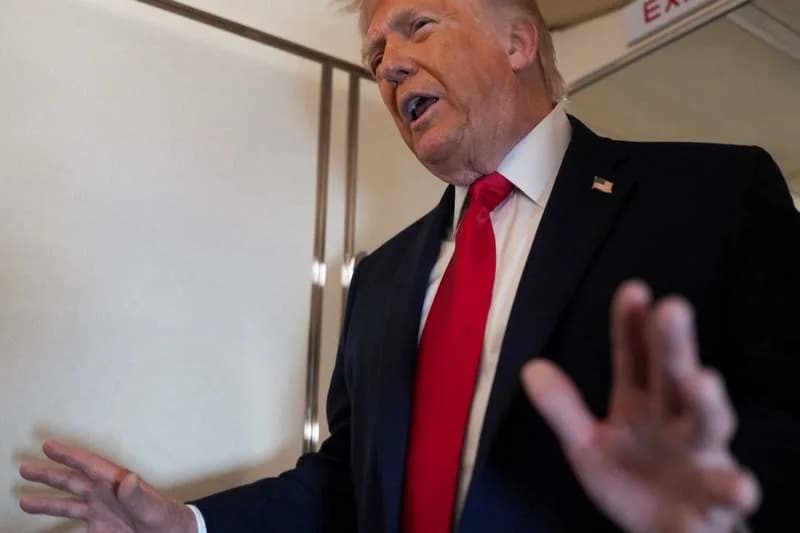
U.S. President Donald Trump speaks to members of the media on board Air Force One while flying from Joint Base Andrews to Chippewa Valley Regional Airport in Eau Claire, Wisconsin, U.S., June 5, 2026. (photo credit: REUTERS/Nathan Howard)
US President Donald Trump told NBC's Meet the Press in an interview recorded Friday and broadcast Sunday that he is not insisting that Lebanon be included in any potential agreement with Iran. "I think they'd like to see it, but I'm not demanding," he said.
The interview came days after Mr. Trump announced a ceasefire between Israel and Lebanon — a pause that Hezbollah declined to recognize — and coincided with Israeli strikes on Hezbollah targets in Dahiyeh, a district of Beirut.
On Iran negotiations: Trump said the United States and Iran are "very close" to a deal and claimed Iran has "conceded the fact that they will not have nuclear weapons." He added, "We're very close to having a deal, and if we don't have a deal, we'll do it one way or the other. Either way, we win." These were presented as his statements about ongoing talks.
Trump emphasized he would not unfreeze Iranian assets before a deal is reached, a position Tehran has described as a non-starter. "If they behave, if they do a good job, we start talking," he said. Iran has demanded the release of roughly $12 billion in frozen assets held in Qatar as a precondition for continuing negotiations.
On military claims and accountability: Trump reiterated his claim that "Operation Epic Fury" had "totally destroyed Iran's military," language presented as his assertion rather than an independent assessment.
On direct talks with Iranian figures: Trump said he would be open to direct discussions with Mojtaba Khamenei, who has been reported in some outlets as an influential figure close to Iran's leadership. Trump said, "I would if he'd like to, but I have not spoken to him directly," and suggested Mojtaba is involved in decision-making. The president also repeated unverified claims that Mojtaba had been badly injured and called him "more rational" than his father.
It is important to note that Ayatollah Ali Khamenei remains Iran's Supreme Leader. U.S. and Israeli intelligence assessments cited in reporting do not view Mojtaba Khamenei as more moderate or decisively more rational than his father, and independent confirmation of the injury claims is lacking.
Context: The interview reflects the administration's negotiating posture: willingness to engage directly, reluctance to release frozen assets before formal agreements, and public pressure on Tehran to accept constraints on its nuclear program. Many of the statements reflect the president's perspective and claims; some points remain disputed or unverified by independent intelligence or third-party sources.
Help us improve.





















