The MeerKAT radio telescope has produced the most detailed three-dimensional map of the Vela supercluster, a vast structure hidden behind the Milky Way's Zone of Avoidance. Located about 800 million light-years away and spanning ~300 million light-years, Vela contains an estimated 3 × 10¹⁶ solar masses and more than 2,000 newly detected galaxies. Its mass helps explain part of the Local Group's unexplained motion and demonstrates how radio surveys can expose major structures once obscured by our galaxy.
MeerKAT Reveals Giant Vela Supercluster Hidden Behind the Milky Way
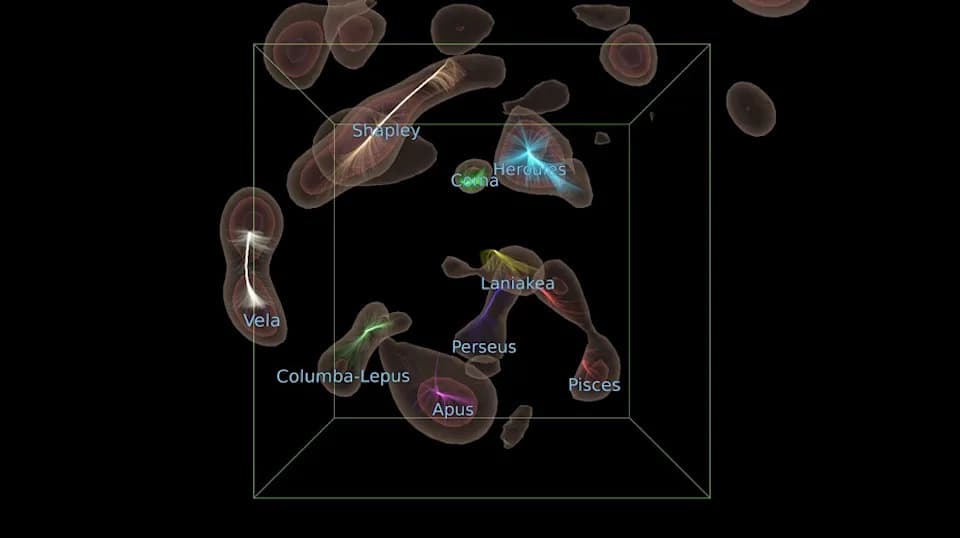
This 3D map shows the superstructures in the local universe. The curved regions enclosing each structure show “basins” where material collects, while the colored lines depict the motions of galaxies. Credit: Jérôme Léca, RSA Cosmos, St. Etienne, France (CC BY-ND 4.0)
Using South Africa's MeerKAT radio telescope, astronomers have produced the clearest three-dimensional map yet of the Vela supercluster — a colossal assembly of galaxies concealed behind the Milky Way's dust and gas. The new observations reveal the supercluster's size, internal structure and significant gravitational influence on nearby cosmic flows.
How MeerKAT Saw Through the Dust
The Milky Way's dense plane creates a long-standing blind spot called the Zone of Avoidance, which blocks visible light across nearly one-fifth of the sky. Optical surveys struggle there, but MeerKAT observes at radio wavelengths and detects the 21-centimeter emission line of neutral hydrogen, a signal that largely penetrates dust. By measuring the frequency shift of that hydrogen line (redshift), astronomers can place galaxies in three-dimensional space.
What the Survey Found
The team detected more than 2,000 previously unseen galaxies behind the Milky Way, turning what once looked like a faint overdensity into a clearly resolved supercluster with two dense cores that appear to be moving toward one another within a larger gravitational system. Vela lies roughly 800 million light-years away and spans about 300 million light-years across. Its total mass is estimated at about 3 × 10¹⁶ solar masses (approximately 30 million billion solar masses), making it one of the most massive structures in the nearby universe.
"Vela has been something of a ghost. We could infer its presence, but we couldn't trace its full extent," said Renée Kraan-Korteweg, who led the team that first identified the supercluster and is a co-author on the new study.
Why Vela Matters
Large masses create gravitational basins that drive the motions of galaxies. The Local Group (including the Milky Way and Andromeda) moves at about 2.2 million km/h relative to the cosmic microwave background. Known structures such as the Great Attractor and the Shapley Concentration account for much of that motion, but not all of it. Vela's position and mass appear to supply part of the previously unexplained gravitational pull, helping to reconcile models of large-scale cosmic flow.
Beyond Mapping: Star-Forming Fuel
Because the 21-cm hydrogen line is sensitive to cold, dense gas reservoirs, the MeerKAT map highlights not only where galaxies sit but also where the raw material for future star formation is concentrated. This provides insight into both present structure and future galaxy evolution within Vela.
Looking Ahead
MeerKAT's deep southern-sky observations are among the most sensitive to date, but they are a precursor to the upcoming Square Kilometre Array (SKA). The SKA will reach fainter galaxies and trace the filaments that stitch superclusters into the larger cosmic web — potentially revealing how Vela connects to still-larger structures and further eroding the Zone of Avoidance's influence.
Vela's discovery is a reminder that even in regions long surveyed, significant structures can hide in observational gaps. Correcting those blind spots refines our understanding of cosmic structure and the forces that shape galaxy motions, including our own.
Note: Results are described in a preprint on arXiv and have been submitted to Astronomy & Astrophysics.
Help us improve.