Hillary Dawa Sherpa, a Nepali climbing guide who went missing on Mount Everest for six days after summiting on May 29, has been found alive after crawling back to Base Camp. Members of the Sagarmatha Pollution Control Committee located him and a helicopter was sent to evacuate him to Kathmandu for treatment. British climber Chris Thrall described severe conditions on descent and how he stopped to aid a Polish climber who had run out of oxygen. The season saw more than 1,000 summiters and at least five deaths.
Miracle on Everest: Nepali Guide Found Alive After Six Days Missing, Airlifted to Hospital
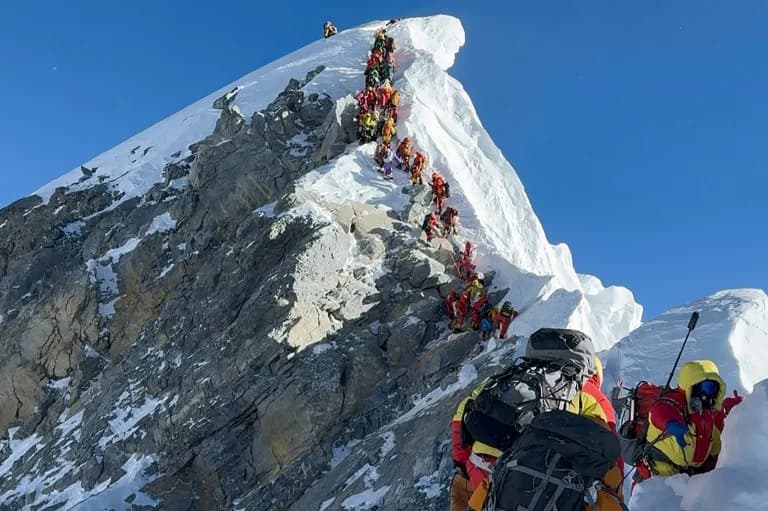
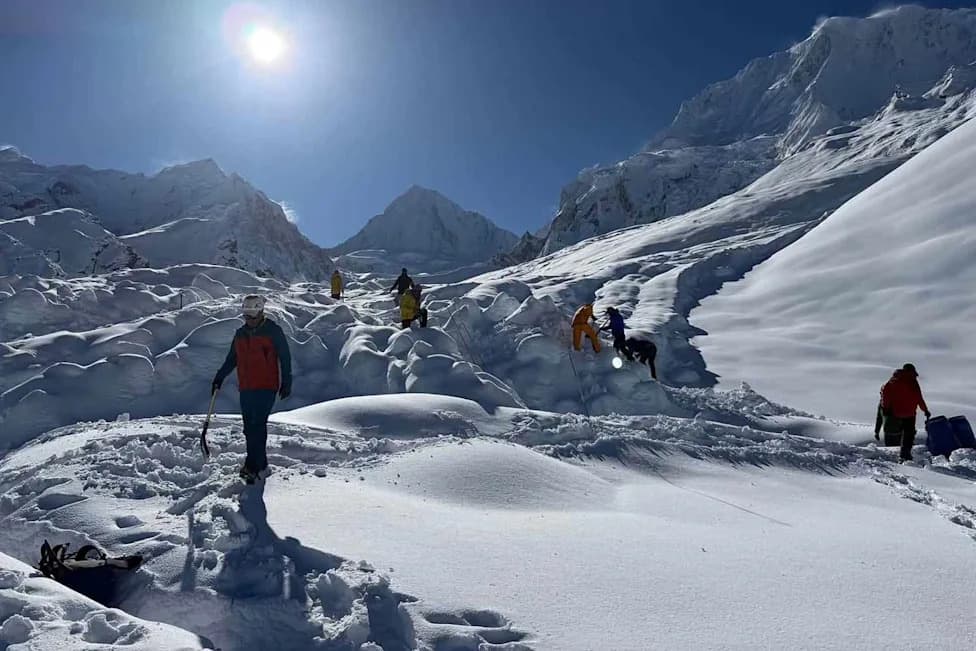
This photograph taken on May 20, 2026, shows mountaineers on Everest (Furte Sherpa)(Furte Sherpa/AFP/AFP)
A Nepali climbing guide who disappeared on Mount Everest for six days and was feared dead has been found alive after crawling back to Base Camp, officials told AFP on Thursday.
The guide, Hillary Dawa Sherpa, vanished from the upper slopes of the world's highest mountain in the early hours of May 30 after summiting with a client the evening before. Members of the Sagarmatha Pollution Control Committee (SPCC) discovered him near Base Camp on Thursday morning.
Rescue and Evacuation
SPCC team members found Hillary Dawa Sherpa crawling and in need of urgent medical attention. "He was crawling down," said Pemba Sherpa of 8K Expeditions, the company coordinating search and rescue efforts. A helicopter was dispatched to airlift him to a hospital in Kathmandu.
What Climbers Reported
British climber Chris Thrall, a former Royal Marine, said he and Sherpa reached Everest's summit — 8,849 metres (29,032 feet) — at about 5:00pm on May 29. Thrall described how Sherpa stopped to rest during the descent from Camp Four (around 7,950m), just below the so-called "death zone," where oxygen levels are dangerously low.
"I turned and I said, 'Hillary, are you okay, brother?' He said, 'Yes, yes, fine Chris, please go, go!'" Thrall recalled. He later encountered a Polish climber who had run out of supplemental oxygen and suffered frostbite; Thrall shared his oxygen and the descent to Camp Three took 11 hours instead of the usual two.
Context
The climb took place near the end of the season, when fewer mountaineers remain on the mountain. Nepali officials reported this season saw more than 1,000 climbers reach Everest's summit — the busiest season on record — and at least five deaths: two Indian nationals and three Nepali climbers involved in expedition preparations.
Authorities have not released further details about Sherpa's condition at the hospital. The incident highlights the extreme risks of high-altitude climbing, where delays, exhausted oxygen supplies and rapid changes in weather can turn routine descents into life-threatening situations.
Help us improve.