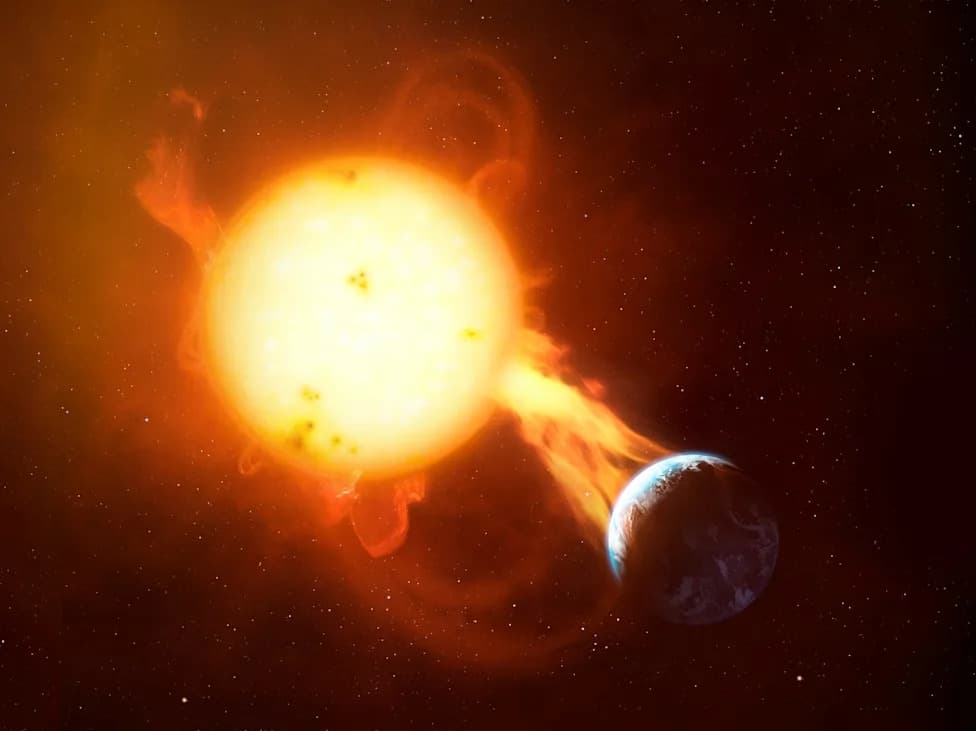
NASA’s Solar Dynamics Observatory captured a powerful X1.0 solar flare that peaked at 7:28 a.m. EST, released this week as a striking image showing brightening pockets and rippling magnetic waves. X-class flares are the most intense on the B–C–M–X scale, and the numeric suffix indicates strength within that class. Such flares can disrupt radio, navigation and power systems and increase risks for satellites and astronauts, though they do not directly harm people on Earth. NOAA notes the largest recorded solar storm occurred on Sept. 1, 1859.
NASA Captures Striking X1.0 Solar Flare — Peaked at 7:28 a.m. EST

See it: Strong solar flare caught on camera erupting from the sun
NASA this week released a striking image of a powerful solar flare that erupted from the Sun and peaked at 7:28 a.m. EST. The event was observed by NASA’s Solar Dynamics Observatory (SDO) and classified as an X1.0 flare — placing it among the most intense categories of solar flares.
What Is a Solar Flare?
Solar flares are sudden, intense bursts of radiation and energetic particles produced when the Sun’s tangled magnetic fields suddenly reconnect. They are one component of broader solar storms that can hurl particles, energy and magnetized plasma into the solar system.
What the Image Shows
The image from SDO shows small pockets on the solar surface brightening dramatically and the signature rippling of magnetic energy that follows such eruptions. These visual cues are typical of magnetic reconnection events that release large amounts of energy in a short time.
Classification and Impact
The flare was classified X1.0; the classification scale runs B, C, M and X, with each letter representing roughly a tenfold increase in energy output. Within each letter class, a numeric value (for example, X1.0, X2.0) further indicates the flare’s relative strength.
Powerful flares and the associated solar storms can disrupt high-frequency radio communications, damage or degrade satellite systems and navigation signals, and in extreme cases affect power grids. They also pose increased radiation risks for spacecraft and astronauts. According to NASA, these events do not directly harm people on Earth’s surface because our atmosphere and magnetic field provide protection.
Historical Context
NOAA records identify the strongest documented solar storm as the event of Sept. 1, 1859 (the Carrington Event), which produced widespread telegraph disruptions and vivid auroras as far south as the Caribbean.
Scientists continue to monitor the Sun closely using observatories like SDO to track activity, forecast space weather, and issue warnings to protect satellites, power infrastructure and crewed space missions.
Help us improve.