The January 2022 Hunga Tonga–Hunga Ha'apai eruption injected ash and vast amounts of salty water vapor into the stratosphere and, according to a new Nature Communications study, may have triggered chemistry that oxidized methane. Satellites observed a persistent formaldehyde cloud—an indicator of methane breakdown—suggesting the plume removed an estimated 900 tons of methane per day from about 330,000 tons emitted. The mechanism mirrors chlorine-driven chemistry seen when Saharan dust mixes with sea spray, but experts emphasize the need for atmospheric modeling and further research before any practical application.
Underwater Eruption Uncovers Unexpected Natural Pathway to Break Down Methane
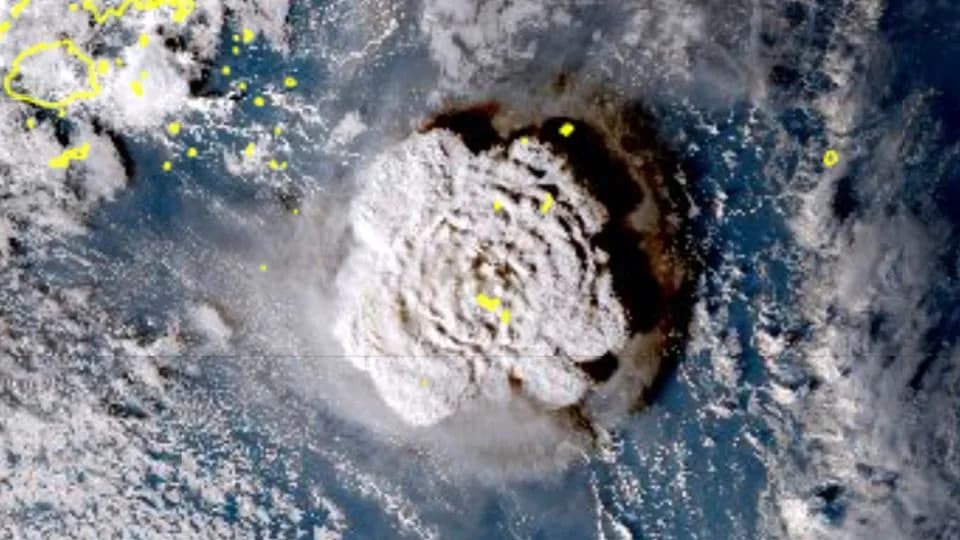
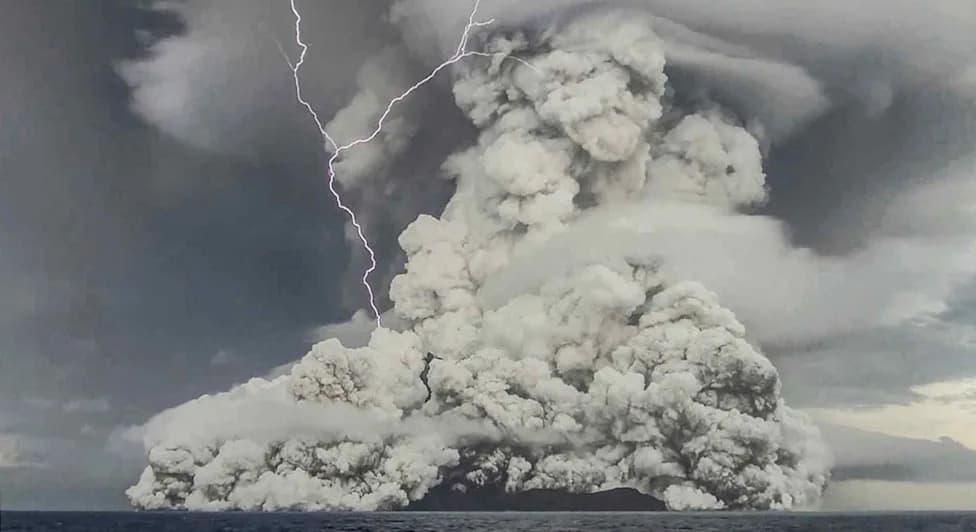
A satellite image of the eruption, which sent a plume of ash, steam and gas nearly 40 miles into the stratosphere. - Japan Meteorology Agency via AP
When the Hunga Tonga–Hunga Ha'apai volcano exploded beneath the South Pacific in January 2022, it hurled ash, steam and salty water vapor nearly 40 miles into the atmosphere. The blast—one of the most powerful in recent history—generated a tsunami and a sonic boom that circled the globe.
Now a study in Nature Communications reports an unexpected chemical reaction inside the volcanic plume that appears to have destroyed some of the methane the eruption released. Scientists detected a prolonged cloud of formaldehyde—a short-lived chemical that commonly forms when methane is oxidized—which pointed to active methane breakdown high in the stratosphere.
What the Researchers Found
Using advanced satellite observations, the team tracked a formaldehyde-bearing cloud for about 10 days. Because formaldehyde typically lasts only a few hours in the atmosphere, its persistent presence suggests continuous methane oxidation in the plume for more than a week.
The researchers estimate the eruption released roughly 330,000 tons of methane and that the plume removed about 900 tons per day during the observed period. The plume also lofted huge volumes of salty water vapor—equivalent to about 58,000 Olympic-size swimming pools—along with volcanic ash and particles.
How It May Have Worked
The proposed mechanism is similar to chemistry previously observed when Saharan dust mixes with sea spray over the Atlantic. In that case, tiny iron-containing particles formed and, when struck by sunlight, produced reactive chlorine atoms that help break down methane. The study authors suggest sunlight acting on the salty, particle-laden volcanic plume produced chlorine that oxidized methane inside the stratospheric cloud.
“It emitted methane and then destroyed these emissions through the particles in the plume,” said Maarten van Herpen, a co-author and physicist at Acacia Impact Innovation.
Implications and Cautions
The finding could point to new ideas for faster, targeted methane removal—an enticing prospect because methane traps roughly 80 times more heat than carbon dioxide over 20 years and is a major short-term contributor to warming. However, independent experts urge caution: the study infers chemistry from satellite formaldehyde observations, and the observed reactions occurred in the stratosphere, while any deliberate removal would likely be attempted in the lower atmosphere (the troposphere).
Atmospheric chemists warn that intentionally seeding oceans or the atmosphere with particles could produce unpredictable impacts on climate, air quality and ecosystems. Study authors and outside scientists agree more research—laboratory studies, atmospheric modeling and careful field experiments—is needed before any practical or engineered applications are considered.
Bottom line: The Hunga Tonga eruption revealed a surprising natural pathway for methane loss that may inform future research on methane mitigation, but the idea remains preliminary and requires thorough testing to assess safety and effectiveness.
Help us improve.