Researchers at Goethe University Frankfurt and TU Wien derived an analytic description of the critical threshold separating dispersal from black hole formation. Using a large-number-of-dimensions (1/N) expansion, they found exact discretely self-similar solutions at leading order and showed how higher-order corrections restrict those solutions, reproducing qualitative features seen in numerical simulations. The framework provides a new analytic foothold for studying critical collapse, primordial black holes and the mathematical behavior of Einstein's equations under extreme conditions.
Spacetime Can Form a Tiny 'Crystal' That Tips Into a Microscopic Black Hole, New Formula Shows
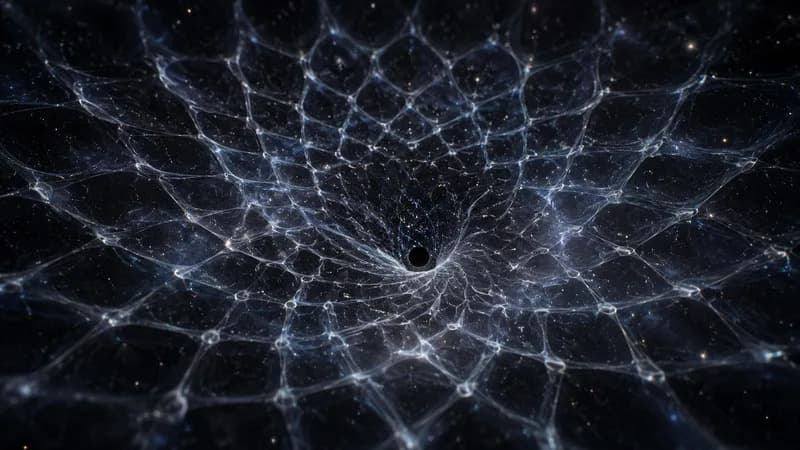
New math shows how a crystal-like critical state in spacetime can tip into a microscopic black hole. (CREDIT: Wikimedia / CC BY-SA 4.0)
Physicists have derived an exact analytic description of the razor-edge threshold where matter and spacetime either disperse or collapse into a microscopic black hole, showing that—just before collapse—spacetime can organize into a regular, crystal-like pattern.
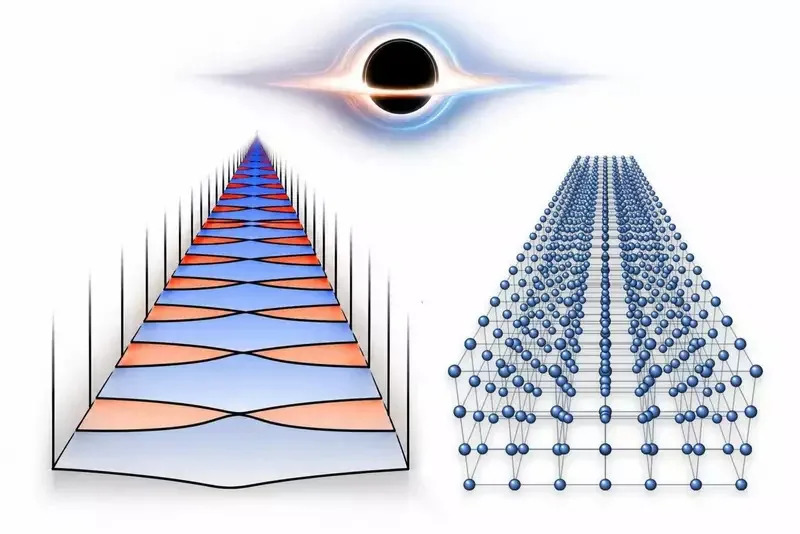
Left: visualization of a spacetime-crystel. Right: a cubic crystal structure. (CREDIT: Tu Wien)
What the Study Shows
A team from Goethe University Frankfurt and TU Wien developed a controlled analytic approach to the long-studied problem of critical collapse. Rather than relying solely on numerical simulations, the researchers exploited a 1/N expansion in the limit of many spacetime dimensions to obtain leading-order exact solutions that are discretely self-similar—repeating in space and time like a spacetime crystal. Higher-order corrections progressively constrain those solutions and recover qualitative features previously seen only in simulations.
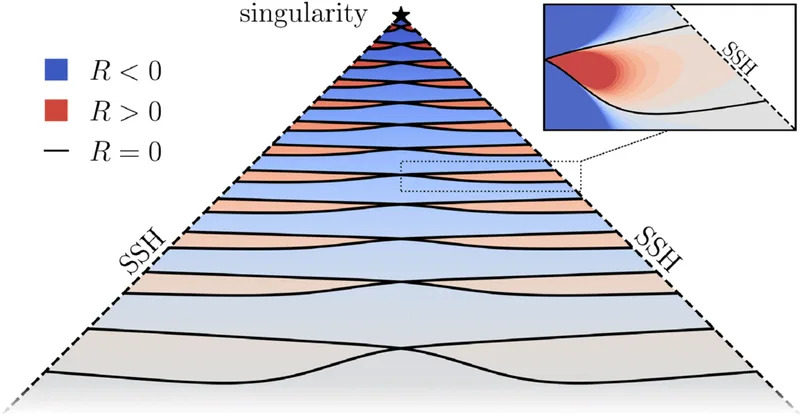
Illustration of the past patch of the Choptuik spacetime with DSS. The closer one moves towards the top, the more rapidly the Ricci scalar oscillates until the singularity is reached. (CREDIT: Physical Review Letters)
Why This Matters
Critical collapse sits on a knife edge between two outcomes: dispersal of matter and the formation of a black hole. Numerical studies since 1993 revealed an "echoing" self-similarity near this threshold, but a closed-form analytic description was lacking. The new work provides a controllable analytic foothold, connecting exact formulas to numerical behavior and helping to explain why the threshold solution appears unique at finite dimension.
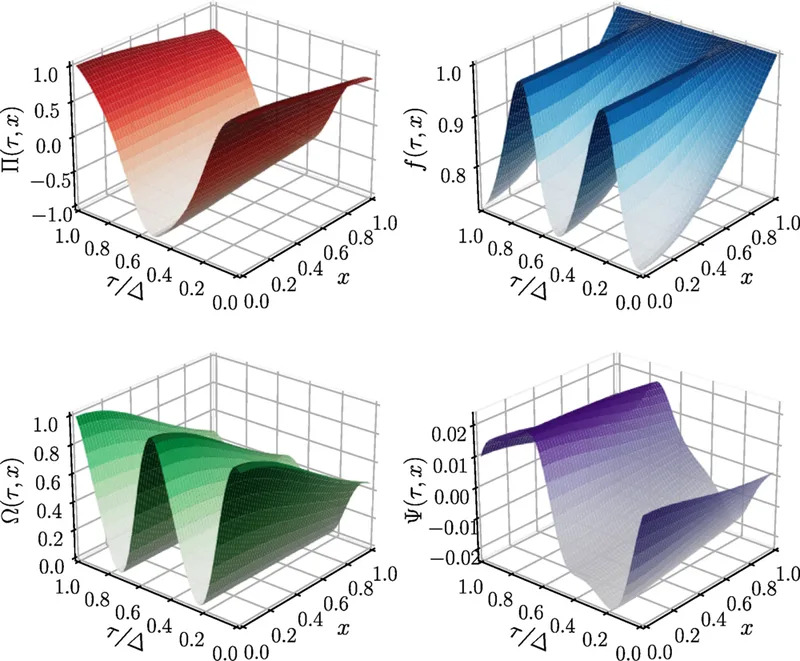
All fields of the NNLO solution evaluated at 𝐷 =300. (CREDIT: Physical Review Letters)
“Sometimes a tiny, seemingly insignificant cause is enough to trigger a huge and dramatic change,” said Prof. Daniel Grumiller (TU Wien), comparing the effect to water freezing into an ordered lattice. The team describes the transient ordered state as a spacetime crystal that can either dissolve or, with a tiny additional perturbation, collapse into a black hole.
How They Did It
The authors studied spherically symmetric Einstein gravity coupled to a massless scalar field—a simplified but physically relevant setup. They considered the formal limit of a very large number of spacetime dimensions, where 1/(number of dimensions) is a small control parameter. At leading order in that expansion they found an entire family of exact, discretely self-similar solutions. Including next-to-leading corrections imposes consistency conditions (for example, on the echoing period), narrowing the allowed solutions toward the behavior observed in four-dimensional numerical work.
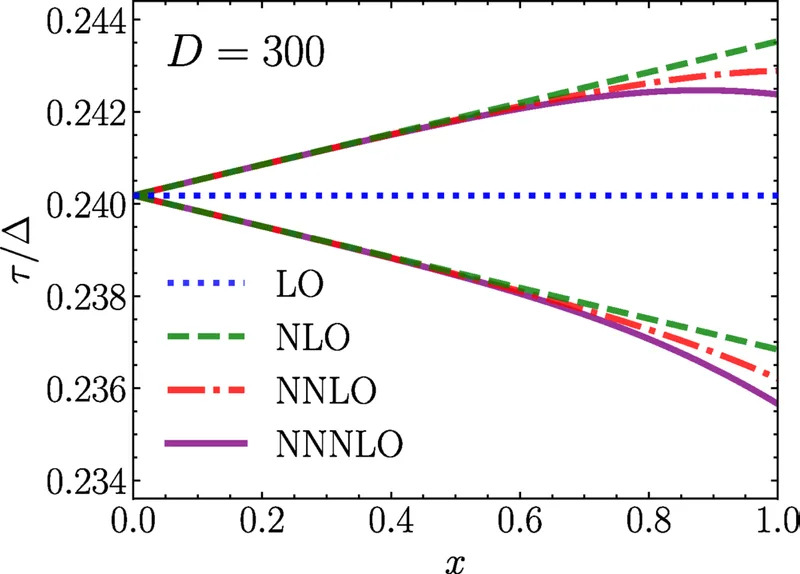
NEC lines for LO up to NNNLO. In the center, 𝑥 =0, all curves are close to each other but near the SSH there are differences between these curves. (CREDIT: Physical Review Letters)
Findings and Limitations
- The analytic solutions reproduce key qualitative features seen in simulations: discrete self-similarity (echoing), the geometry near the center and self-similar horizon, and horizon-related behavior tied to energy conditions.
- At leading order the family of solutions is large (parametrized by a free periodic function); higher-order corrections restrict that freedom and can recover unique features expected at finite dimension.
- The large-dimension expansion is expected to be asymptotic rather than strictly convergent, a common feature of such methods. It is powerful when a finite number of terms yields accurate descriptions over the region of interest.
- The present construction mainly covers the "past patch" of the critical spacetime (up to the self-similar horizon); extending analytic control toward and beyond the future Cauchy horizon remains an open problem.
Implications
This result does not predict imminent laboratory or astrophysical discovery of microscopic black holes. Instead, it supplies a new analytic tool to study critical collapse, primordial black hole formation scenarios in the early universe, and the mathematical structure of Einstein's equations in extreme regimes. It also helps bridge numerical simulation results with exact formulas, often a pathway to deeper physical insight.
Publication: The findings are available in Physical Review Letters.
Help us improve.