JWST transit observations of hot Jupiter WASP-94A b show mineral clouds forming on the morning limb and disappearing by evening, producing a sharp spectral contrast. Limb-resolved spectra identify optically thick magnesium-silicate clouds on the morning side and clear water absorption on the evening side, revise the planet’s metallicity to ~5× Jupiter (resolving previous anomalies), and detect metastable helium indicative of atmospheric escape.
JWST Sees Mineral Clouds Form Each Morning and Vanish by Evening on Hot Jupiter WASP-94A b
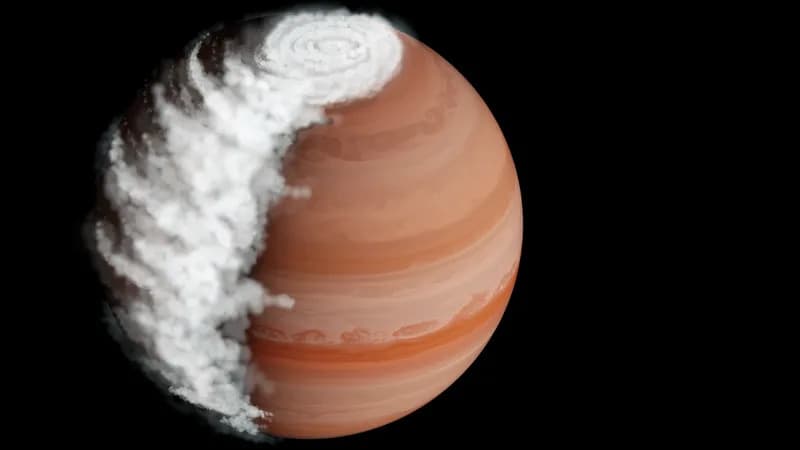
Artistic representation of WASP-94A b, a gas giant in the Microscopium constellation. Clouds build as air flows over the dark side of the planet, reaching a large swell by daybreak. The clouds dissipate on the dayside, leaving clear skies in the early evening. (CREDIT: Hannah Robbins / Johns Hopkins University)
WASP-94A b, a scorching "hot Jupiter" about 700 light-years away, develops high-altitude mineral clouds on its morning side and loses them by evening. Observations with the James Webb Space Telescope (JWST) captured this daily cloud cycle during a transit, giving astronomers a rare, limb-resolved view into the planet’s atmosphere and revealing how cloud dynamics can bias measurements of composition.
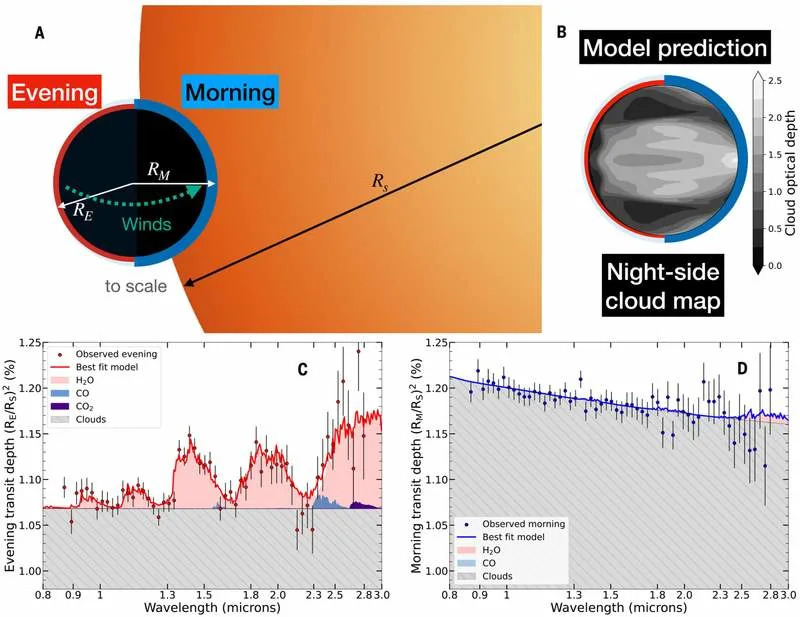
Observing geometry, model predictions, and transmission spectra of the morning and evening limbs. (CREDIT: Science)
Clearer Views By Separating Morning And Evening Limbs
The team observed WASP-94A b as it crossed its star, sampling the spectrum at the start and end of the transit to isolate the planet’s morning and evening limbs. Because the planet is likely tidally locked, one hemisphere remains star-facing while the opposite side stays in darkness; air flowing from night to day defines the morning limb, while air moving from day to night defines the evening limb.
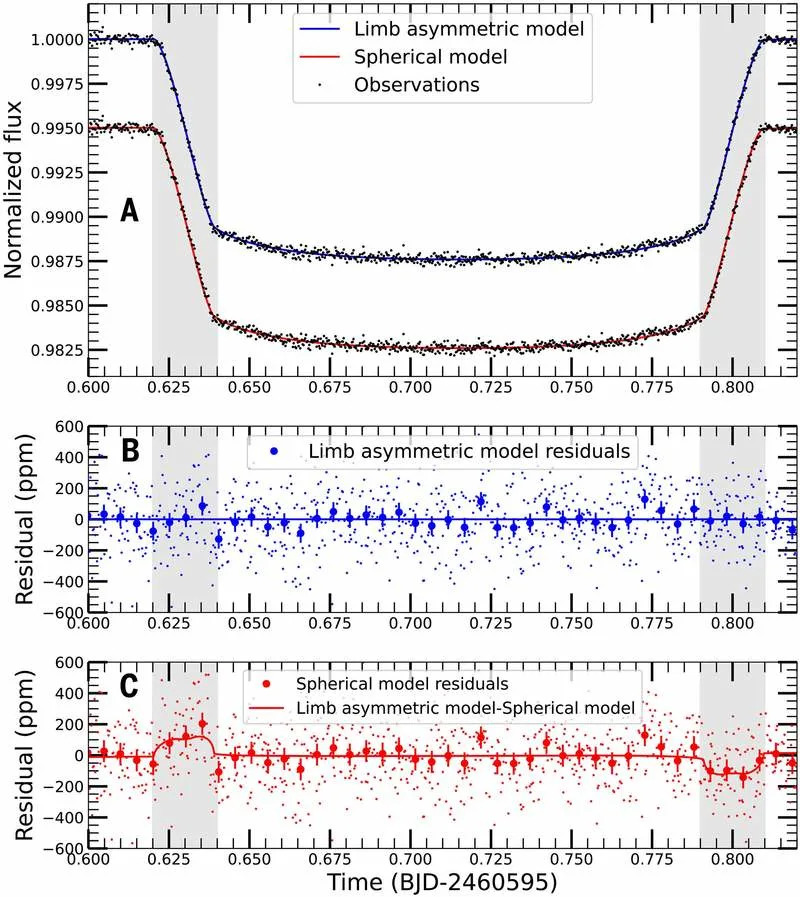
Transit light curves of WASP-94A b and fitted models. (CREDIT: Science)
Stark Differences In Spectra
The morning limb showed little in the way of gas absorption and instead exhibited a sloped spectrum characteristic of optically thick, high-altitude aerosols. The evening limb, by contrast, revealed strong water-absorption features and far weaker aerosol signatures. From spectral modeling, the researchers conclude that the dominant particles are mineral clouds—best matched by magnesium-silicate grains—forming on the cooler side and disappearing in hotter daylight conditions.
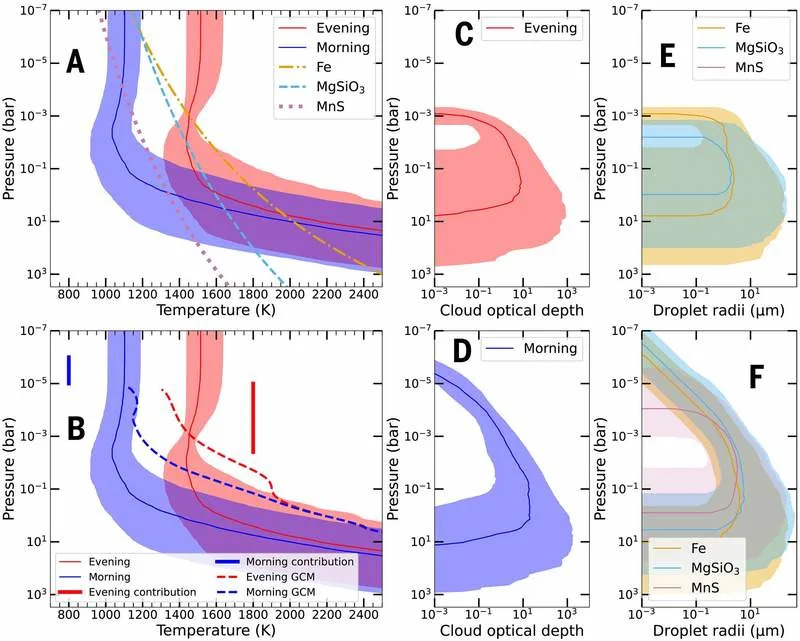
Retrieved temperature and cloud structure of the morning and evening limbs. (CREDIT: Science)
“Not only have we been able to clear the view, but we can finally pin down what the clouds are made out of and how they’re condensing and evaporating as they move around the planet,” said co-author David Sing, Bloomberg Distinguished Professor of Earth and Planetary Sciences at Johns Hopkins.
Mechanisms And Temperature Contrast
The team discusses two plausible mechanisms: mechanical lofting by strong winds that raise particles on the nightside and bury them on the dayside, or thermal evaporation as clouds move into hotter regions. Either way, the data indicate a powerful day–night contrast: the retrieved temperature difference between the two limbs is 449 ± 83 K. Spectral retrievals show the morning limb probes very high altitudes (pressures ≲0.01 mbar), where clouds are optically thick, while the evening limb becomes transparent at pressures ≲1 mbar.
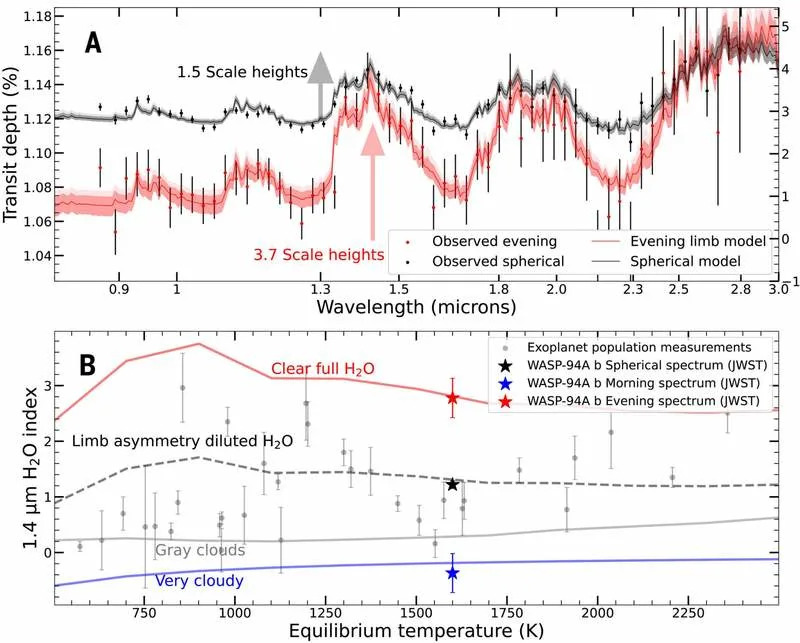
Inferred composition of WASP-94A b and the effect of limb asymmetry. (CREDIT: Science)
Statistical Strength And Chemical Implications
The cloud signature on the morning limb was detected at 9σ significance, water absorption on the evening limb at 10σ, and an asymmetric (limb-resolved) model was preferred over a symmetric one at 6σ. Crucially, limb-resolved spectra revised the planet’s inferred heavy-element abundance: earlier blended analyses implied implausibly high oxygen and carbon (hundreds of times Jupiter), while the limb-separated retrievals give roughly 5× Jupiter. The metallicity estimates from blended versus limb-resolved spectra differ by more than 4σ, showing how cloud asymmetry can strongly bias composition measurements.
The combined planet-wide spectrum also revealed absorption from outflowing metastable helium at 1.083 μm, a sign that WASP-94A b is undergoing rapid atmospheric escape.
Broader Context And Follow-Up
The authors applied the same limb-resolving method to eight other strongly irradiated gas giants and found similar morning-cloud/evening-clear patterns on two additional planets, WASP-39 b and WASP-17 b, suggesting the phenomenon may be common among hot Jupiters. Sing and collaborators plan a larger JWST program to study cloud cycling across a wider range of exoplanets, including an eccentric giant that spends part of its orbit in its system’s habitable zone.
Published in Science, this work highlights that resolving a planet’s limbs separately is essential for accurate atmospheric characterization: cloud distribution matters as much as composition when interpreting transit spectra.
Help us improve.