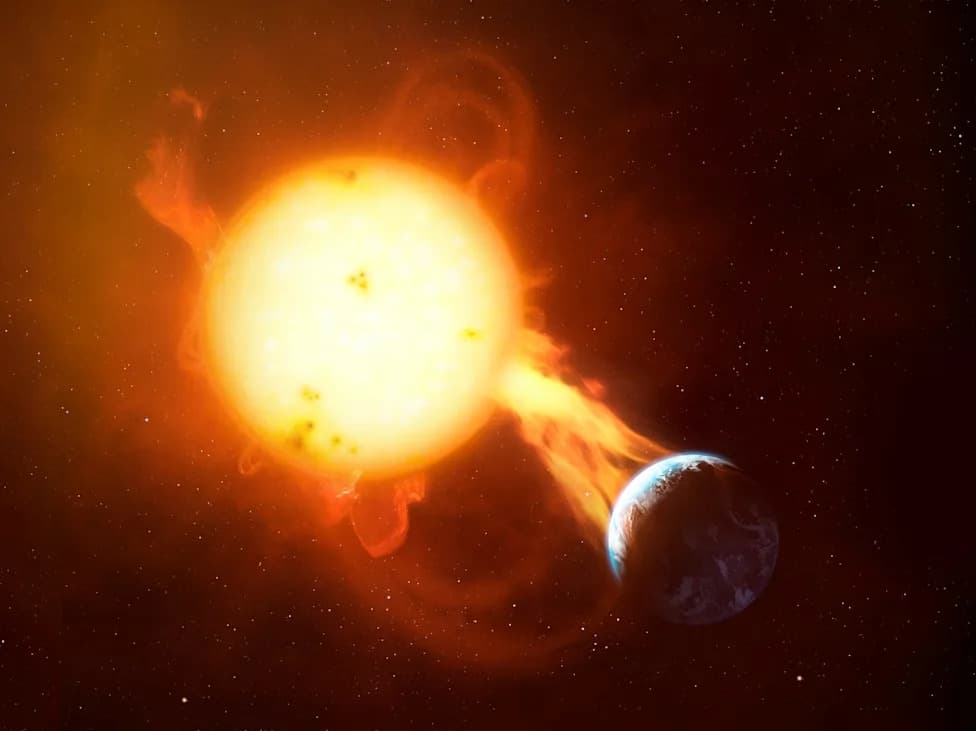
ESA’s Solar Orbiter imaged a very large, active sunspot region on the Sun’s far side on May 18. The region produced two X1‑class flares and about a dozen M‑class flares on May 15–16, and CMEs were observed following those eruptions. The active complex is expected to rotate into view from Earth around May 22, and NOAA/NASA warn it could trigger geomagnetic storms and enhanced auroras despite the solar cycle having peaked in October 2024.
Huge Far‑Side Sunspot Poised to Face Earth — Strong Flares and CMEs Could Produce Northern Lights
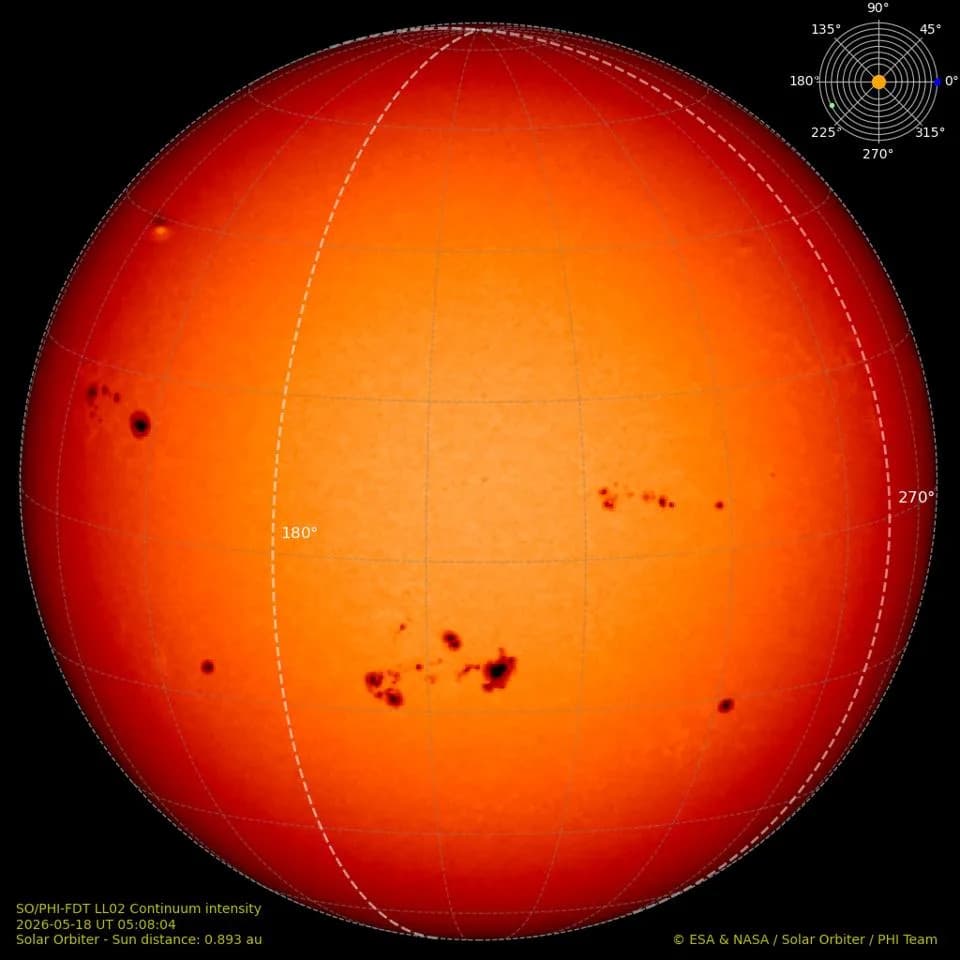
The sunspot region on the far side of the sun seen by Solar Orbiter’s X-ray instruments on May 18.ESA
One of the largest sunspot regions seen in years — currently on the far side of the Sun — was imaged by the European Space Agency’s Solar Orbiter on May 18 and is expected to rotate into view from Earth around May 22. Forecasters say the complex, active region has already produced powerful eruptions and could trigger geomagnetic storms that spark vivid auroras at high latitudes.
What Was Observed
Solar Orbiter’s X‑ray instruments detected significant activity from the region while it was facing away from Earth. An alert from NOAA on May 18 followed reports that the spot produced several strong flares earlier in the week. SpaceWeather.com reported two X1‑class flares and roughly a dozen M‑class flares between May 15–16. Solar flares release intense bursts of electromagnetic radiation that reach Earth essentially at the speed of light.
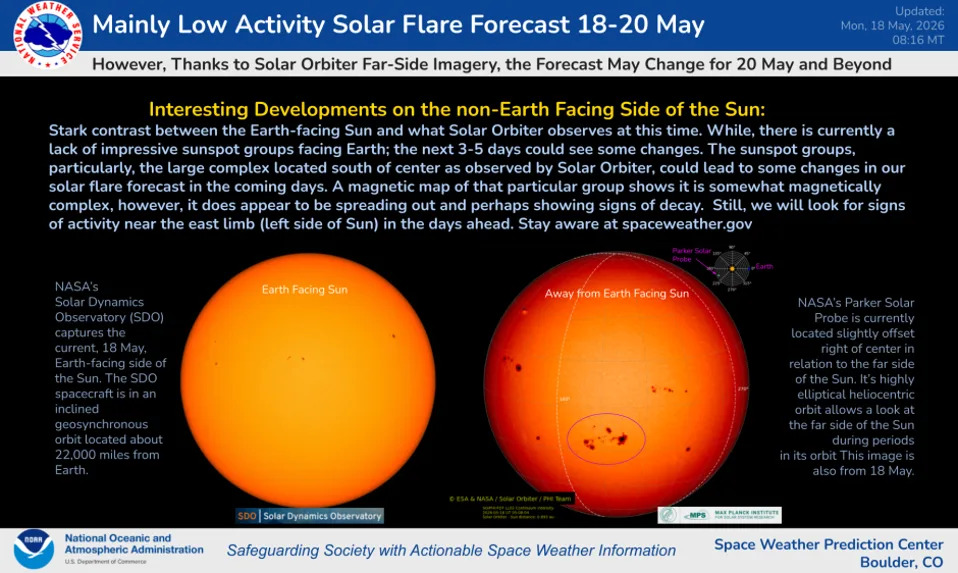
An alert published by NOAA on May 18.NOAA
Coronal Mass Ejections and Geomagnetic Risk
Following the flares, coronal mass ejections (CMEs) — large clouds of magnetized plasma — were observed being expelled into the solar system. CMEs travel far more slowly than flare radiation, but when they arrive and interact with Earth’s magnetic field they can produce geomagnetic storms that often lead to enhanced northern and southern lights.
Independent Confirmation From Mars
NASA’s Perseverance rover on Mars also captured the sunspot in a calibration image. The Left Mastcam‑Z acquired the shot on May 19, 2026 (Sol 1864) at local mean solar time 13:32:24; the rover frequently photographs the Sun to measure atmospheric dust and sometimes records solar activity in those images.
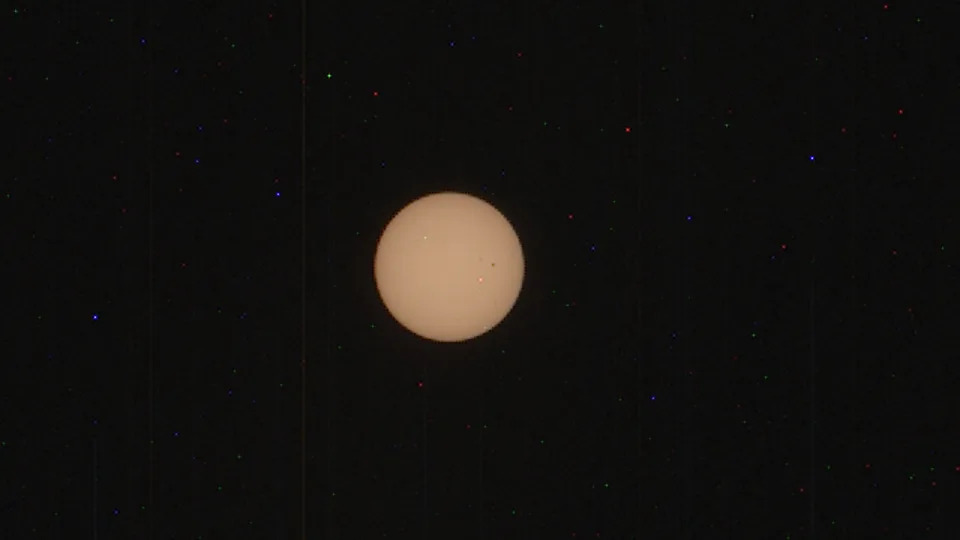
NASA's Mars Perseverance rover acquired this image using its Left Mastcam-Z camera. Mastcam-Z is a pair of cameras located high on the rover's mast. This image was acquired on May 19, 2026 (Sol 1864) at the local mean solar time of 13:32:24.NASA/JPL-Caltech/ASU
Why This Matters Now
The Sun rotates approximately every 27 days, so active regions seen on the far side typically rotate into view from Earth within days. Forecasters expect this sunspot complex to remain active as it turns toward Earth beginning around May 22. Although NOAA and NASA place the solar cycle peak (solar maximum) in October 2024, the declining phase can still produce strong magnetic activity and surprise eruptions.
Background: Solar Orbiter's Role
Launched in February 2020, the Solar Orbiter mission provides unique vantage points of the Sun, including the first clear images of the Sun’s south pole released in June 2025 (images taken March 16–17 when the spacecraft was ~15° below the solar equator). Observations from different vantage points help scientists track the evolution of active regions and better forecast space weather impacts at Earth.
Wishing you clear skies and wide eyes — scientists will be watching this active region closely as it rotates into view.
Sources: ESA Solar Orbiter, NOAA, NASA, SpaceWeather.com, images from NASA’s Perseverance rover.
Help us improve.