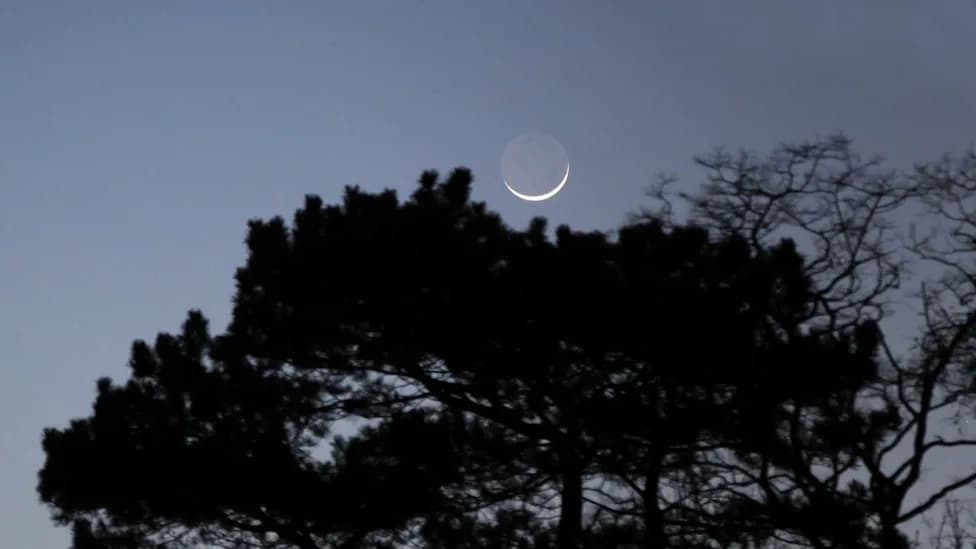
Between May 18 and May 24 a young crescent moon will pass Venus and Jupiter low in the western sky, producing several elegant evening alignments. The moon brightens from about 7% illumination on May 18 to roughly 45% by May 22, briefly lining up with Castor and Pollux on May 20 and passing near Regulus on May 22. Venus (≈ -3.9 mag) and Jupiter (≈ -1.8 mag) draw steadily closer ahead of a close conjunction in early June (around June 9–11). For best results, view just after sunset with a clear western horizon and consult Stellarium or a similar tool for location-specific timings.
Watch a Slim Crescent Moon Sweep Past Venus and Jupiter After Sunset (May 18–24)
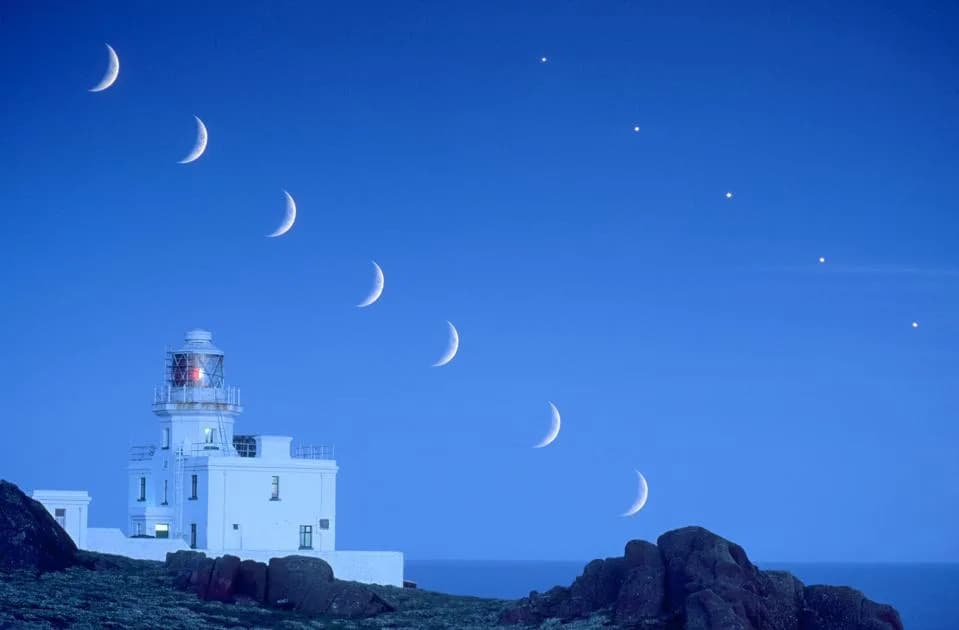
A young crescent moon returns to the western sky after sunset and passes the two brightest planets, Venus and Jupiter.getty
After last week's New Supermoon, the evening sky stages a series of delicate alignments: a thin crescent moon returns to the western sky and drifts past the two brightest planets, Venus and Jupiter. With twilight still relatively dark early in the week, these are some of the most photogenic naked-eye sights of late spring. Below is what to look for between May 18 and May 24, plus tips for getting the best view.
What To Watch This Week
Monday, May 18 — A very young waxing crescent (about 7% illuminated) appears low in the west shortly after sunset, lying very close to brilliant Venus. This close pairing is brief and best seen with a clear, unobstructed western horizon; a wide-angle photo or a binocular view will capture the scene.
Tuesday, May 19 — The crescent grows to roughly 15% illumination and climbs a little higher. It sits approximately halfway between Venus (below) and Jupiter (above), beginning to form a loose line of three bright objects in twilight.
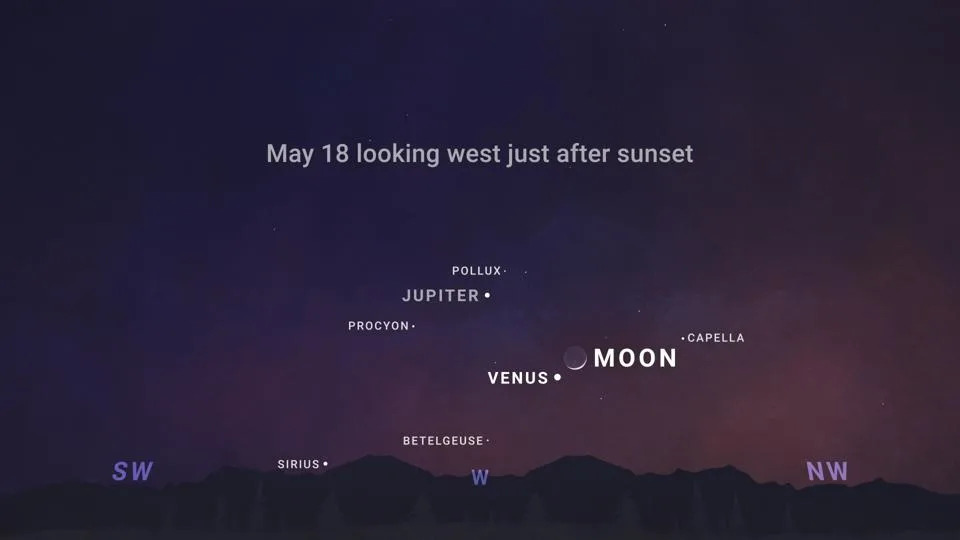
May 18's close conjunction of the moon and Venus.NASA/JPL-Caltech
Wednesday, May 20 — Now about 24% illuminated, the moon has moved past Jupiter in daylight. By sunset it forms a line with the two bright stars of Gemini, Castor and Pollux, while Venus remains lower on the horizon, creating a striking westward trio.
Friday, May 22 — The crescent continues to wax and shift eastward, reaching near 45% illumination. As it brightens it will begin to drown out fainter stars; tonight it passes close to Regulus, the brightest star in Leo.
Venus, Jupiter, and the Approaching Conjunction
Venus (about -3.9 magnitude) hugs the low western horizon after sunset, while Jupiter (around -1.8 magnitude) sits higher above it. Night by night their separation shrinks in a slow-motion convergence that culminates in a close conjunction in early June (notably around June 9–11). Observing their changing positions over several evenings is an easy and rewarding way to appreciate planetary motion with the unaided eye.
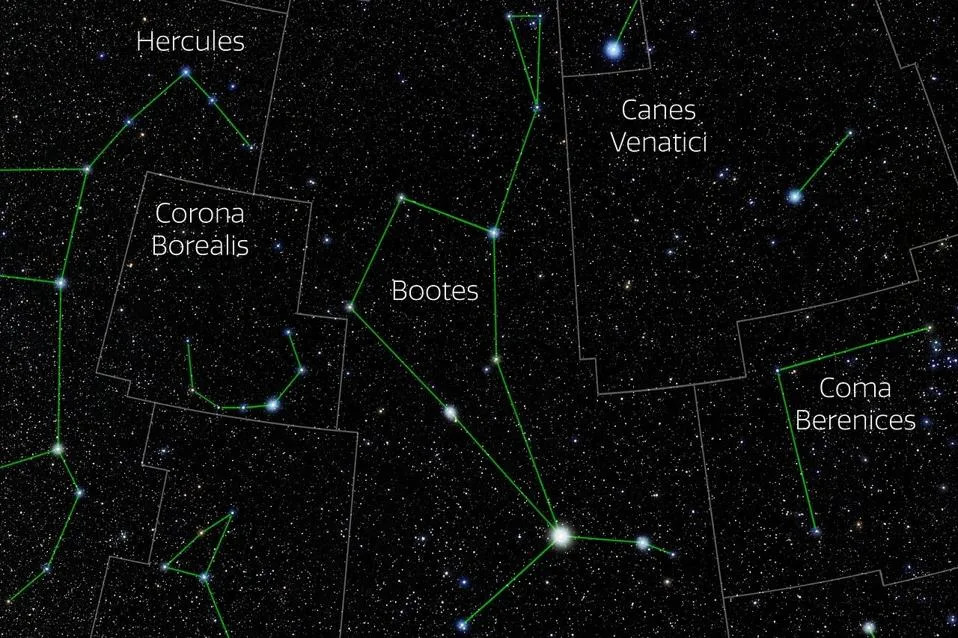
Photo of the constellation Boötes with annotations from IAU and Sky & Telescope. Here is the non-annotated version.E. Slawik/NOIRLab/NSF/AURA/M. Za
Other Highlights
Dominating the eastern sky after dark, the constellation Boötes is particularly prominent in late spring. Its brightest star, Arcturus, stands out with a warm, orange hue; the rest of the constellation forms a loose kite shape beneath the Big Dipper. There is an annotated photo of Boötes credited to the IAU and Sky & Telescope and a non-annotated version for reference.
Looking ahead: on May 30 a nearly full moon — the second full moon in May often called a 'Blue Moon' — will rise shortly after sunset and appear large and orange near the horizon. That same evening is Manhattanhenge in New York City, when the setting Sun aligns with the city streets. Venus and Jupiter continue closing in through early June, reaching their close pairing around June 9–11.
How To Observe
- Find a clear western horizon and step outside just after local sunset; the crescent and planets will be lowest and most striking then.
- Binoculars or a wide-angle lens will enhance framing and detail for close pairings; no protective filters are needed since observations are after sunset.
- Times and exact apparent positions vary with latitude and longitude; for precise, location-specific timings consult planetarium software such as Stellarium.
Safety note: All observations are after sunset. Never look at the Sun without proper protection.
Help us improve.