NASA's Psyche used a planned Mars flyby on May 15 to gain a gravity assist, passing within about 2,800 miles of the planet at roughly 12,300 mph. The maneuver conserved xenon propellant for the probe's solar‑electric ion thrusters and placed Psyche on a trajectory aligned with asteroid 16 Psyche. Launched in late 2023, the probe is on a six‑year, 2.2‑billion‑mile voyage due to arrive in July 2029 and will spend two years orbiting and studying the metal‑rich asteroid to learn about planetary cores.
NASA’s Psyche Snags Mars Gravity Assist — On Course for Metal‑Rich Asteroid 16 Psyche
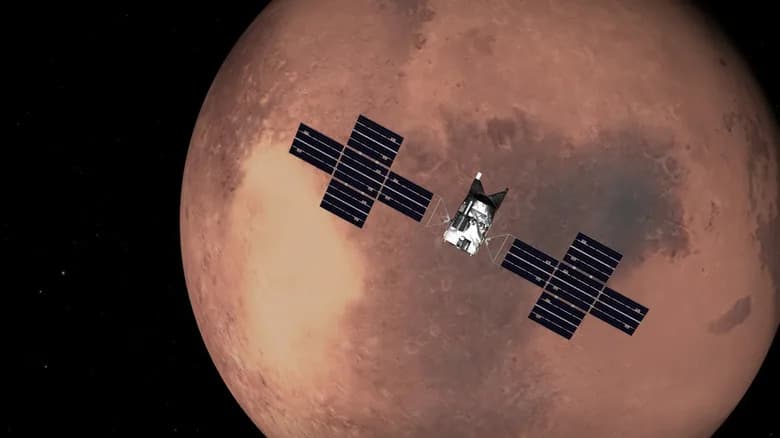
A computer render of a spacecraft and an asteroid. - NASA
NASA's Psyche spacecraft executed a planned Mars flyby on May 15 to gain a gravity assist that adjusted its trajectory and conserved propellant for the long journey to asteroid 16 Psyche. Traveling at about 12,300 mph, the probe passed within roughly 2,800 miles of Mars at approximately 3:30 PM Eastern, closer than the orbit of the Martian moon Phobos (≈3,700 miles).
Flyby Details
The flyby was designed to give Psyche a velocity boost and change its path so the spacecraft now shares an orbit aligned with the target asteroid. By using Mars' gravity, the mission preserved xenon propellant that powers Psyche's solar‑electric ion thrusters — a critical resource for precise navigation across a 2.2‑billion‑mile voyage.
Images and Data Return
Leading up to and during the encounter, Psyche's cameras captured images of Mars. From the spacecraft's approach angle the planet appeared as a bright, thin crescent as sunlight reflected off its surface and surrounding dust. Additional images taken during the flyby will be relayed to Earth over the coming days and weeks via NASA's Deep Space Network and published on the mission's official web page.
Mission Timeline
Psyche began its six‑year, 2.2‑billion‑mile journey in late 2023. The spacecraft is expected to arrive at asteroid 16 Psyche in July 2029 and will spend approximately two years orbiting the body to photograph it, map its surface and gather data to determine its composition.
Why Psyche Matters
Scientists believe 16 Psyche — the largest known metal‑rich asteroid in the solar system — may be a remnant of the iron‑rich core of a planetesimal, one of the early building blocks of planets. Studying the asteroid could provide rare insight into planetary cores and the processes that formed rocky planets.
"We can't bore a path to Earth's metal core — or the cores of the other rocky planets — so visiting Psyche could provide a one‑of‑a‑kind window into the violent history of collisions and accumulation of matter that created planets like our own," NASA explained.
As the mission continues, look for additional imagery and science updates from the mission team as they prepare for Psyche's arrival and two‑year science campaign.
Help us improve.