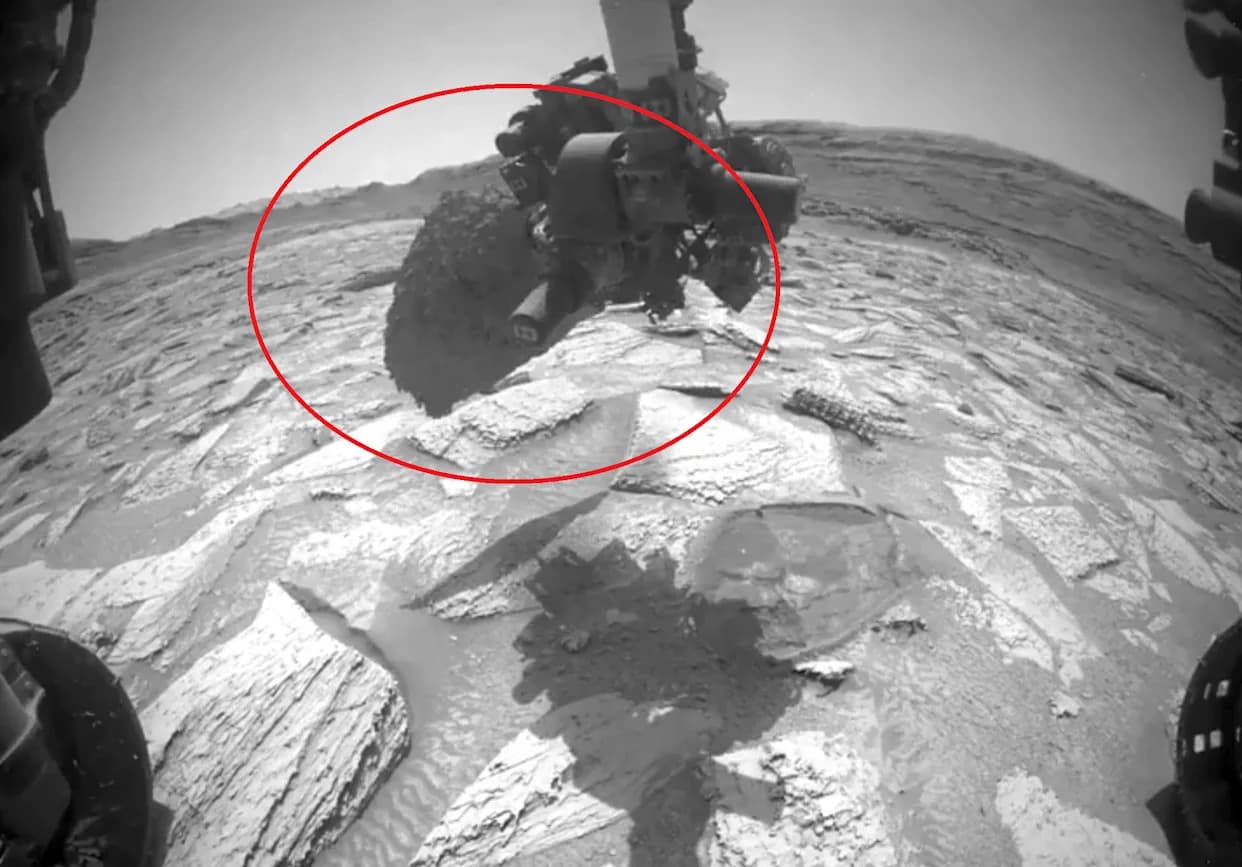
NASA’s Curiosity rover inadvertently lifted a roughly 28.6‑lb rock dubbed Atacama after drilling on April 25, 2026. Hazard‑camera images show six days of recovery attempts before engineers combined tilting, rotating, vibration and spinning on May 1 to dislodge the specimen, which shattered on impact. The episode highlights the challenges of remote fieldwork and Curiosity’s continued scientific value after more than a decade on Mars.
Curiosity’s Drill Snags 28.6‑lb Mars Rock “Atacama” — Freed After Six Days
NASA
NASA’s Curiosity rover had an unusually literal run‑in with a Martian rock during routine sampling: a roughly 1.5‑foot specimen became stuck to the rover’s drill and stayed attached for six days before engineers freed it.
What happened: On April 25, 2026, Curiosity extended its robotic arm and used its percussive drill to penetrate a target rock and collect powdered material for analysis. When the arm retracted, the rock lifted with the tool — remaining adhered to the drill sleeve in a phenomenon NASA said had not occurred before.
Sequence and Recovery
Hazard‑camera frames released by NASA, compiled into a simple black‑and‑white video, document the efforts. Initial attempts to shake the fragment loose by activating drill vibrations were unsuccessful. In later trials engineers reoriented the arm and retried vibrations, still without success. On May 1 the operations team combined several maneuvers — tilting the drill, rotating and spinning the tool, and running vibrations — and the rock finally detached on the first combined attempt. The specimen shattered when it hit the Martian surface.
About the Rock
Engineers nicknamed the piece “Atacama”. It measured roughly 1.5 feet (about 45 cm) across, about six inches (15 cm) thick, and had an estimated mass near 28.6 pounds (13 kg).
Why This Matters
Curiosity has been exploring Gale Crater since 2012, far exceeding its original two‑year design life. The rover was the first to use a drill on Mars and continues to collect samples despite aging hardware and recurring operational challenges. This incident demonstrates both the unpredictability of fieldwork on another planet and the ingenuity of mission engineers in adapting procedures to unexpected situations.
Note: NASA’s Mars account posted a lighthearted social update about the event on May 5, 2026, including the hazard‑cam footage.
Help us improve.