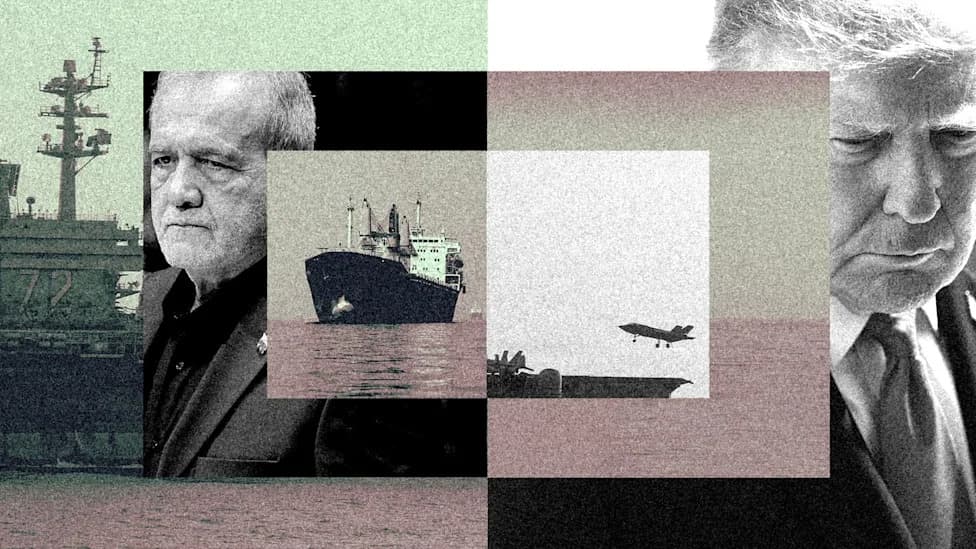
The authors warn that U.S. envoys Steve Witkoff and Jared Kushner risk guiding policy into an "Abilene Paradox"—pursuing a course no one truly supports—because of mixed signals from President Trump and a flawed negotiating posture. Tehran is using time and U.S. political constraints to avoid conceding core capabilities, and any deal that preserves IRGC control would alarm Israel and Gulf partners. The piece argues Washington should avoid a compromised settlement and consider letting military pressure complete the objective rather than locking in an unstable peace.
Opinion: Trump’s Iran Strategy Risks an ‘Abilene Paradox’ — A Road to a Compromised Outcome

President Trump’s Middle East envoys, Steve Witkoff and Jared Kushner, appear to be steering U.S. policy toward an Abilene Paradox — a situation in which a group collectively pursues a course of action that none of its members genuinely favors. Coined by Jerry Harvey in 1974, the term aptly describes the current dynamic: flawed groupthink, conflicting signals from Washington, and an adversary intent on buying time.
Mixed Signals From the White House. Part of the problem traces to the President. On Tuesday he posted on Truth Social that he was pausing "Project Freedom for a short period of time to see whether or not the Agreement can be finalized and signed." Fewer than 24 hours later he warned, "If they don’t agree, the bombing starts, and it will be, sadly, at a much higher level and intensity than it was before." That oscillation between conciliation and threat undermines sustained pressure and muddles negotiating leverage.
Iran’s Calculus: Buy Time and Survive. Tehran has signaled it will not readily surrender core capabilities. Iranian leaders appear to be leveraging U.S. political timelines — the 60-day War Powers clock, the November midterms and global economic fragility — to outwait pressure. As retired Gen. Jack Keane observed, survival is the regime’s primary objective; its rulers are prepared to absorb hardship if it buys political survival.
Why the Current Path Is Dangerous. The White House’s apparent priority of clinching a deal risks accepting outcomes that would preserve the Islamic Revolutionary Guard Corps (IRGC) and its leadership, a result likely unacceptable to Israel and several Gulf allies. A negotiated settlement that leaves figures such as Vahidi in place would perpetuate the security threats that provoked the confrontation in the first place.
On the Ground: Hostilities Continue. Administration officials have reframed operations — calling the current posture "Project Freedom" and saying the offensive phase "Epic Fury" is over — but Iran and regional actors see continued hostility. Iran recently launched cruise-missile and drone strikes that hit the Fujairah oil refinery and targeted U.S. Navy ships in the Persian Gulf, underscoring that violence has not ended.
Strategic Choice: Negotiate Or Finish The Task? The column’s authors argue that unless Washington recognizes who truly controls Tehran’s policy and negotiates directly with those decision-makers, diplomatic outreach risks becoming an Abilene detour: energetic but unwanted by the parties who matter. If the blockade has Iran on the brink, as some U.S. officials claim, the question is why accept a compromise that leaves hardliners intact and keeps the region unstable for years to come.
"It is time to exit the road to Abilene — a road to nowhere anyone wants to be — and let the U.S. military finish the task," the authors conclude.
Authors. Col. (Ret.) Jonathan Sweet served 30 years as a military intelligence officer and led the U.S. European Command Intelligence Engagement Division from 2012 to 2014. Mark Toth writes on national security and foreign policy. They co-founded INTREP360 and publish the INTREP360 Intelligence Report on Substack.
Copyright 2026 Nexstar Media, Inc. All rights reserved.
Help us improve.