Observers of a 10 Jan 2024 occultation of a background star by trans‑Neptunian object 2002 XV93 found gradual 1.5–10 s light dimming at two sites, a signature consistent with a very thin atmosphere. Ray‑tracing fits to the Kiso light curves favor surface pressures of ~124–177 nanobars for CH4, N2 or CO, far below Pluto but unexpected for a ~500 km body. The most likely explanations are recent outgassing or a recent impact; repeat occultations and JWST spectroscopy are needed to confirm the detection and identify the gas source.
Tiny Atmosphere Detected on Small Icy World Beyond Pluto — A Surprising Occultation
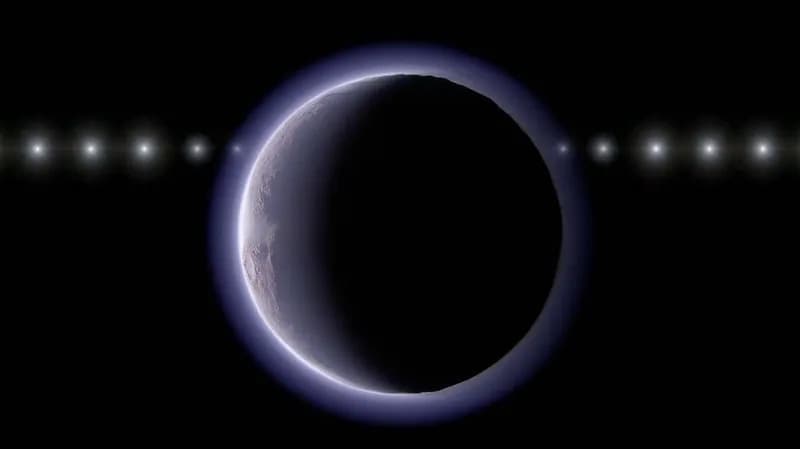
Artist’s conception of this research showing an imagined time sequence as a star passes behind a TNO with an atmosphere. (CREDIT: NAOJ)
On 10 January 2024, observers recorded an unusual stellar occultation by the trans‑Neptunian object 2002 XV93. Instead of the abrupt “wink-out” expected from a small, airless body, starlight at two observing sites faded gradually at both ingress and egress — a signature consistent with a very thin atmosphere bending and dimming the star’s light before the main occultation.
Observations and Instruments
The observation was led by Ko Arimatsu of the National Astronomical Observatory of Japan’s Ishigakijima Astronomical Observatory as part of the TABASCO campaign (Trans‑Neptunian Atmospheres and Belts Analysis through Stellar‑occultation Coordinated Observations). Four stations were deployed along the predicted shadow track; three returned usable data: Kyoto, Kiso and Fukushima.
Stations used modest but fast setups: a portable 20‑cm telescope in Kyoto, a 1.05‑m Schmidt at Kiso equipped with a Tomo‑e Gozen CMOS camera, and a 25‑cm telescope operated by a citizen astronomer at Fukushima. Kyoto and Kiso recorded positive occultation chords that constrained the object’s apparent radius to about 235 km from the shadow geometry.
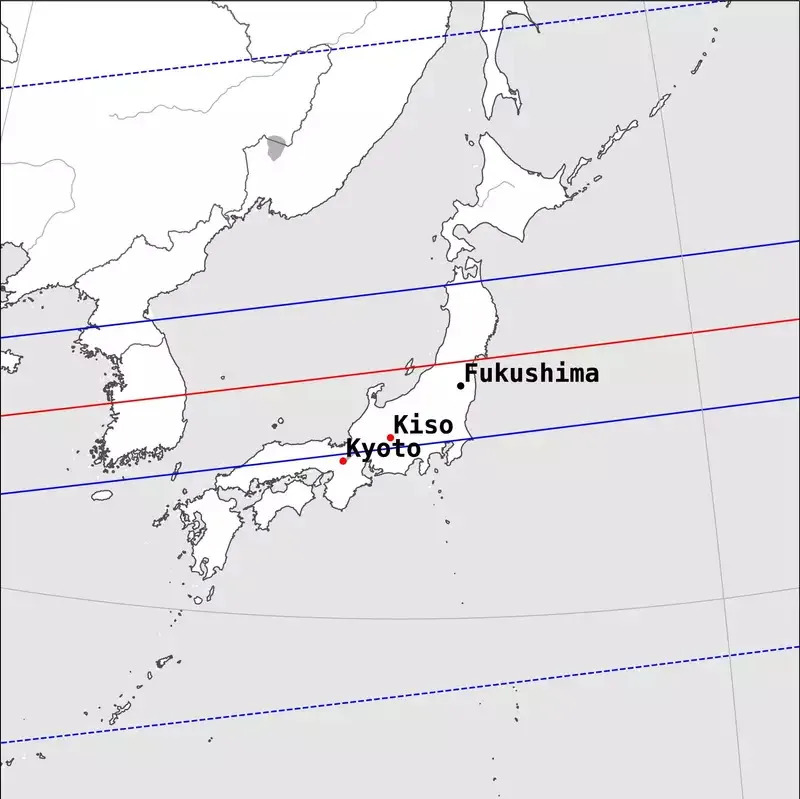
Prediction map of the 2002 XV93 stellar occultation event on 10 January 2024. (CREDIT: Nature Astronomy)
Light Curves and Atmospheric Fits
The Kiso light curves are the most telling: both ingress and egress transitions lasted roughly 1.5 seconds and showed gradual dimming that the team argues cannot be explained by diffraction or the finite angular size of the occulted star. Fukushima recorded a possible slower dimming of about 10 seconds near closest approach at roughly 4σ significance.
After excluding nearby dust or a narrow ring as implausible explanations (they would require unusually close, dense material that dynamics would likely disperse), the team ran ray‑tracing atmospheric models. Single‑species atmospheres dominated by methane, nitrogen or carbon monoxide all reproduced the Kiso curve far better than a no‑atmosphere model. Best‑fit surface pressures were estimated at:
- ~124 nanobars (pure methane)
- ~177 nanobars (nitrogen‑dominant)
- ~159 nanobars (carbon‑monoxide‑dominant)
These pressures are tiny — roughly 50–100 times lower than Pluto’s present surface pressure — but nevertheless exceed previous upper limits for similar small trans‑Neptunian objects.
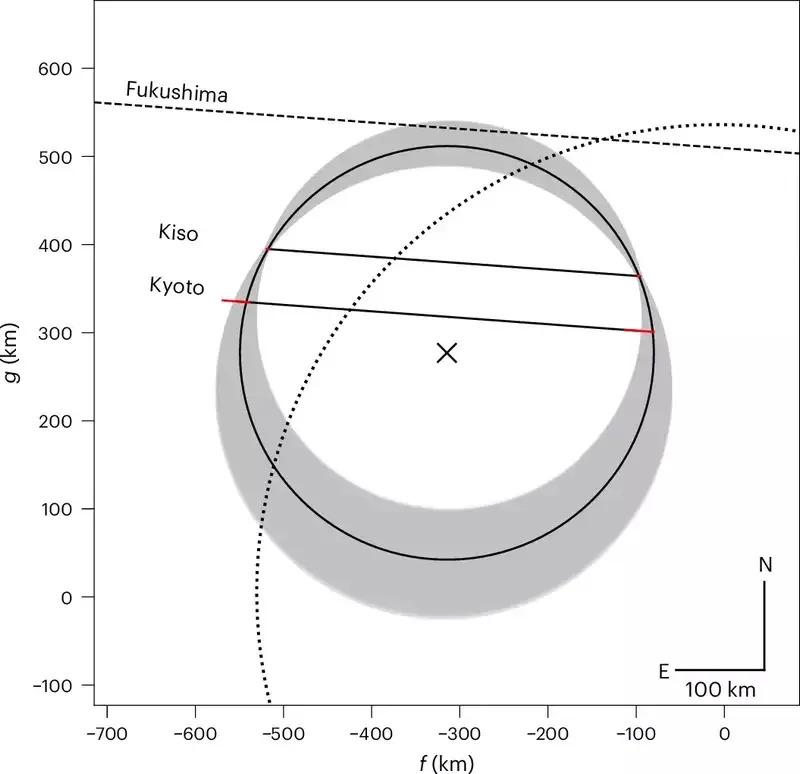
Sky-plane projection of the 2002 XV93 stellar occultation detections. (CREDIT: Nature Astronomy)
Why It’s Surprising
2002 XV93 is a plutino (in a 2:3 resonance with Neptune) with a diameter near 500 km (mean radius ~275 km), far smaller than Pluto (2,377 km). Small icy bodies have weak gravity, and in the Kuiper Belt’s cold (≈40–50 K) environment only the most volatile ices (CH4, N2, CO) can support atmospheres — and they should escape quickly from a body this size.
Complicating the picture, recent low‑resolution James Webb Space Telescope spectroscopy detected no strong signatures of hypervolatile ices on 2002 XV93’s surface, consistent with a surface largely depleted of such ices. The team’s escape calculations indicate that, even under conservative thermal (Jeans) escape, an atmosphere at the inferred pressure would survive only on the order of 100–1,000 years unless it is actively replenished.
Possible Origins: Outgassing Or Impact
The authors outline two leading explanations for the apparently recent atmosphere:
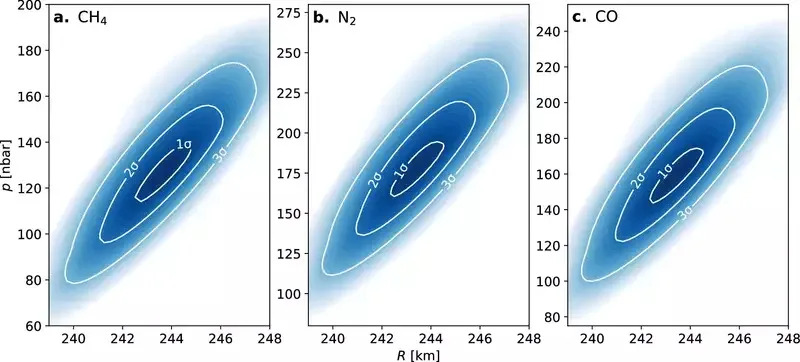
The distribution of χ2 values as a function of the circular shadow radius R and surface pressure p obtained by the light-curve fit to the pure CH4 (a), N2-dominant (b), and CO-dominant (c) atmosphere-refraction model. (CREDIT: Nature Astronomy)
- Internal outgassing / cryovolcanism: Material or volatiles from the interior could leak to the surface. While sustained cryovolcanism is harder to reconcile with a small body’s limited heat budget, it could occur under special conditions (e.g., high ammonia or methanol content) or be aided by tidal forcing from an unresolved satellite.
- Recent impact: A collision with a few‑hundred‑metre projectile could deliver volatiles or excavate buried ices, producing a transient global envelope. However, scaling impact rates from Pluto suggests such an event is rare (~10⁻⁵ probability over 100 years), albeit with large uncertainties.
What’s Next
The detection, if confirmed, implies that small icy worlds can sometimes host transient atmospheres produced by interior activity or chance collisions. The team calls for repeat occultation observations to track pressure changes (a steady decline would favor an impact, persistent or seasonal variations would support internal outgassing) and follow‑up spectroscopy with JWST to identify the molecular composition directly.
Notably, this result highlights the power of coordinated campaigns combining professional facilities and skilled amateur observers using modest telescopes and fast CMOS cameras: monitoring transient, low‑pressure atmospheres depends on many eyes on the sky rather than a single large observatory.
Publication: Research published online in Nature Astronomy.
Help us improve.